

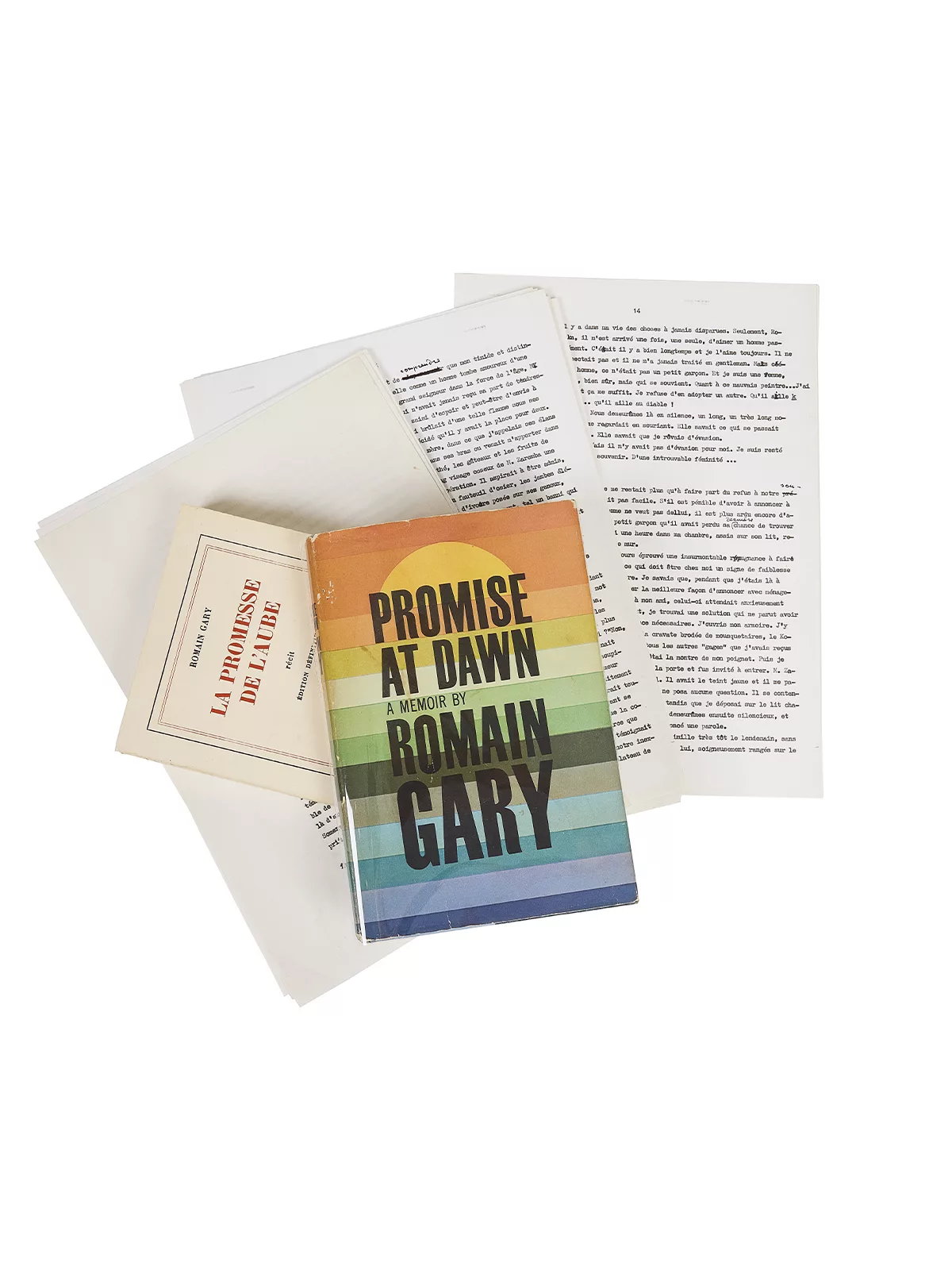
La Promesse de l’aube
1 carbon copy (210 x 300 mm), 15 leaves numbered 2 to 15.
A few months before his suicide, Romain Gary decided to finally have this chapter added to the volume of the reference edition, the French one. He therefore undertook to translate it himself and asked for it to be incorporated into a new edition of La Promesse de l'aube to be published in December, three weeks after his suicide.
The typescript bears 11 autograph corrections in black ink on pages 6, 7, 8, 12 and 14: mostly corrections of spelling and punctuation, along with four additions and variants. It also includes a copy of an earlier typed version, with several corrections. On the first leaf of this copy, a note by Gary reads: “chapitre inédit en français de La Promesse de l'aube” + chapter “XX[II].”
“I have finished the first correction of the proofs and I suddenly realize that I may be within an inch of leaving behind an indelible mark,” Gary wrote to his publisher Claude Gallimard on 8 December 1958, as he prepared to send him the proofs he had corrected himself of his autobiographical masterpiece La Promesse de l’aube (the definitive title was chosen by Gary in September 1958, after he had considered “La Possession du monde,” “La Confession de Big Sur” and “La Course contre la vie”).
A few months later, Gary undertook to publish the American edition of the text, with one important change: the addition of an entire chapter, Chapter XXII, absent from the French version. It is devoted entirely to his mother and to the figure of M. Zaremba, a wealthy client of the family boarding house in Nice, a Polish painter, who asks Gary for permission to request his mother’s hand. She categorically rejects the suitor, again through the intermediary of the young boy, acting as go-between charged with conveying the message and her refusal. Gary, having tried in vain to convince his mother of the merits of his future-ex-stepfather’s proposal, becomes aware, for the first time, of a real difference in outlook with his mother, which he eventually comes to understand: “I will never understand how I could, even at seventeen, have shown myself so ignorant of femininity.”
Benoit Desmarais, in “Romain Gary, l’impossible dérobade,” suggests why: writing in another language seems to have freed Gary. Addressing reproaches to his mother in a language other than his mother tongue — a language chosen by the mother rather than given to him — moving into another cultural universe opened up a possibility of saying elsewhere, otherwise, what had not been heard at home. For the writer, it also allowed him to react, in the heat of the moment, to the critical reception in the language of original composition. The watertightness of the French and American cultural worlds of the time was self-evident to Gary: indeed, no critic in the French articles devoted to Lady L., Les Mangeurs d’étoiles, Adieu Gary Cooper or Charge d’âme makes any allusion to the existence of these books in their original English versions.
A moving and important document, since such an addition cannot be fortuitous: in Gary’s mind, it was a necessary addition to his emblematic text, and a final tribute to his mother shortly before his own death.