

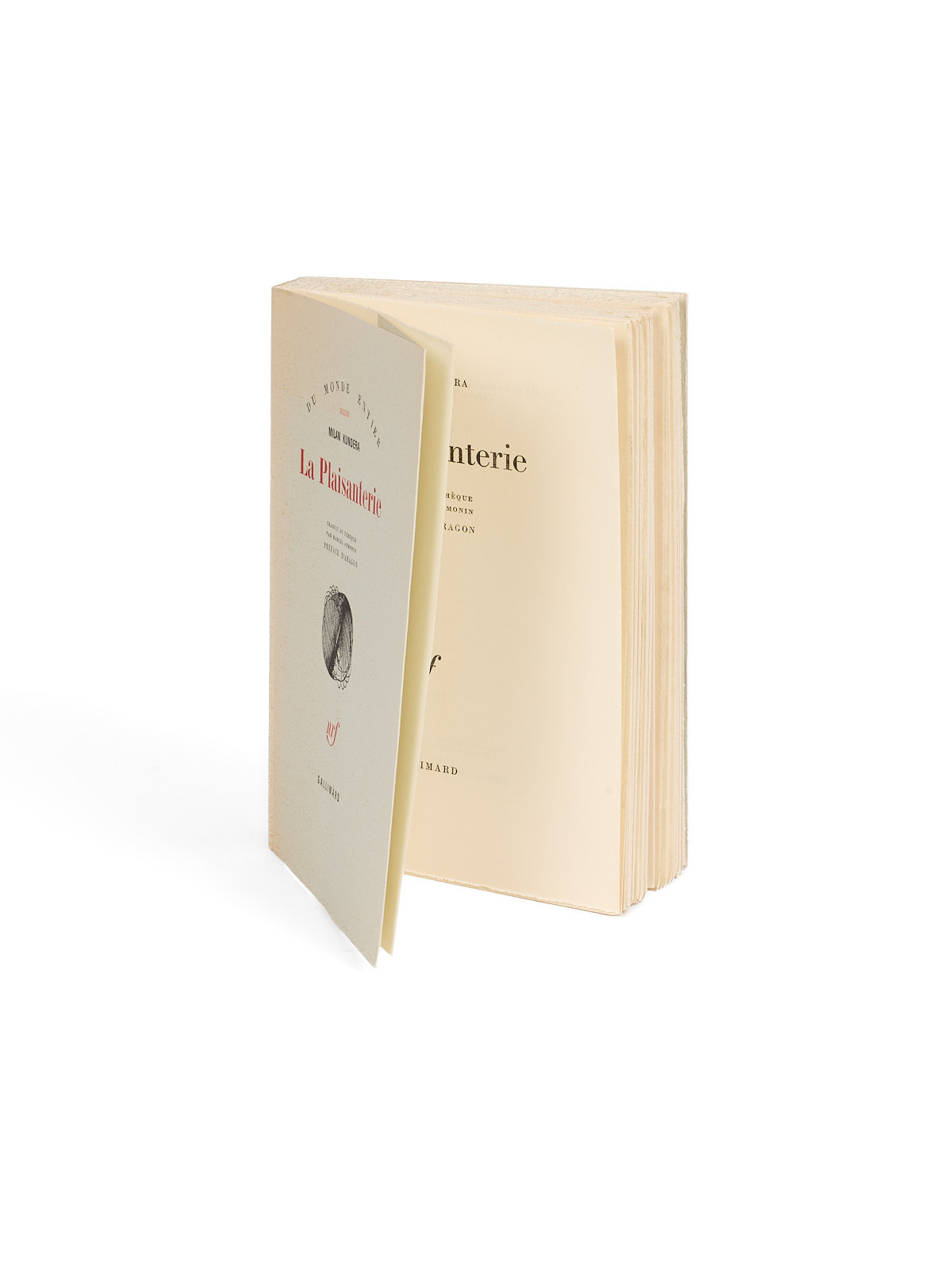
La Plaisanterie
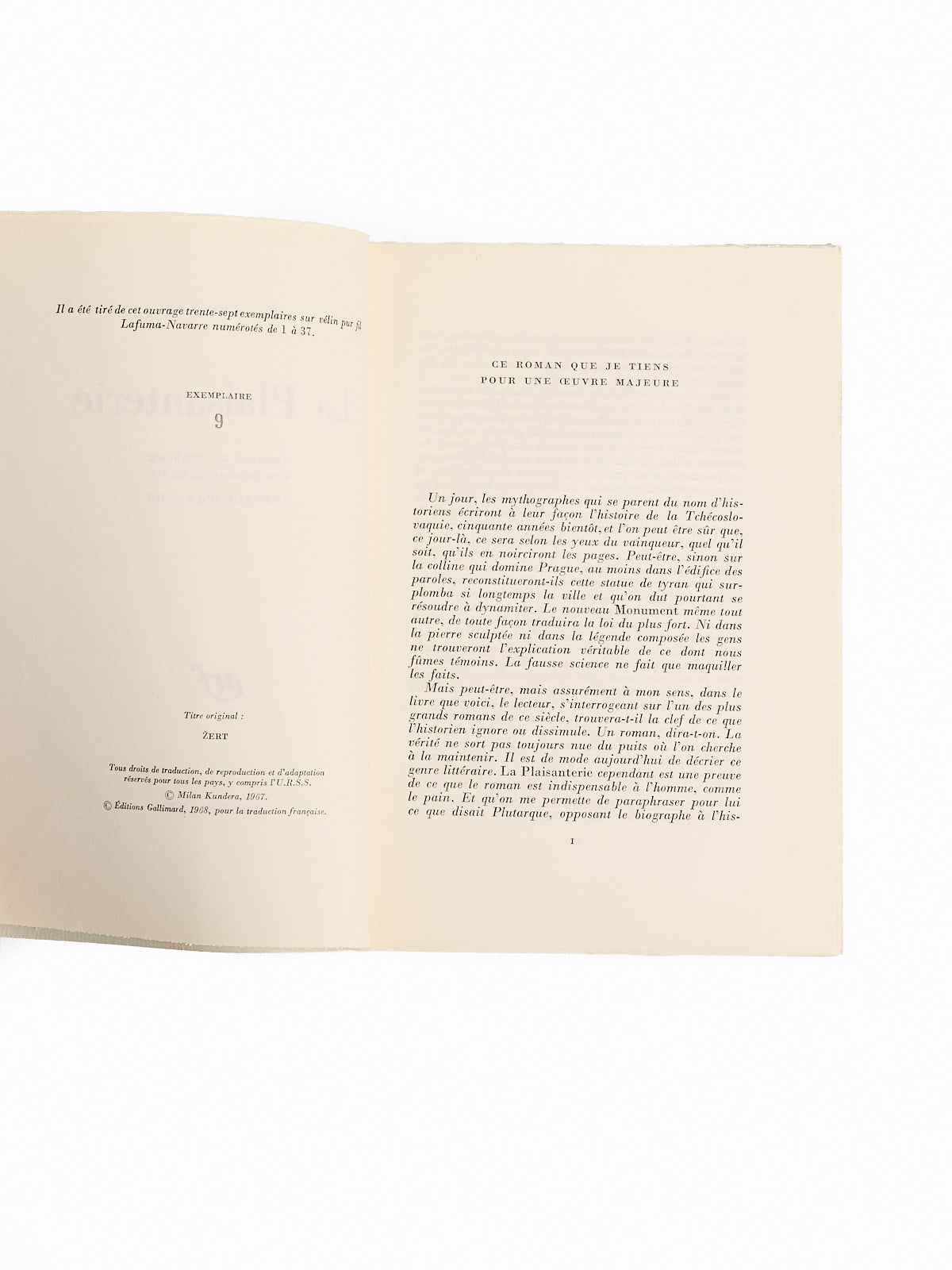
One of 37 copies on vélin pur fil (no. 9), the only paper issue.
One of Kundera’s most celebrated novels, and one of the works that best expresses his disillusionment with the Communist Party, from which he was himself expelled.
This is not the least of his affinities with his hero: a disenchanted young man, victim of a bad joke that brutally changes the course of his life, without his being able to remedy it. The story is that of Ludwik Jahn, a student and Communist activist, separated from his girlfriend by a Party seminar, who sends her a postcard written in anger, containing these simple words: “Optimism is the opium of mankind! A healthy spirit stinks of stupidity. Long live Trotsky!” Alerted, Party members did not appreciate what Ludwik presented as a “joke,” and expelled him. Expelled from the university, he then found himself forcibly enrolled in the army.
“My novel was showered with praise but read in a one-sidedly political manner. The fault lay with the historical circumstances of the moment (the novel appeared two months after the invasion [of Soviet troops into Prague]), with Aragon’s preface (which spoke only of politics), the publisher’s insert, the translation (which could only eclipse the artistic aspect of the novel), and also with the transformation of Western literary criticism into hasty journalistic commentary, subject to the dictatorship of current events” (“Author’s note” in the reissue of La Plaisanterie, Gallimard, coll. “Folio,” p. 461).
Completed on 5 December 1965, La Plaisanterie was not published until spring 1967 in Prague, and was introduced in France a year later, thanks to Antonin Liehm, a Czech intellectual who clandestinely brought a typed copy to Aragon. “Without [her], La Plaisanterie would never have seen the light of day in France, and my destiny would have taken a wholly different — and surely far less fortunate — path. At a time when my name was being erased from Czech letters,” he adds, this publication “launched my novel throughout the world […]. Liehm therefore approached Aragon, who recommended him to Claude Gallimard with all his authority and promised to write a preface […]. Gallimard’s editorial committee initially refused to publish the novel, and it was only through the direct intervention of Aragon and Claude Gallimard that the green light was finally given.”
A fine copy of this important and rare title.
Small marginal foxing to the wrappers.