

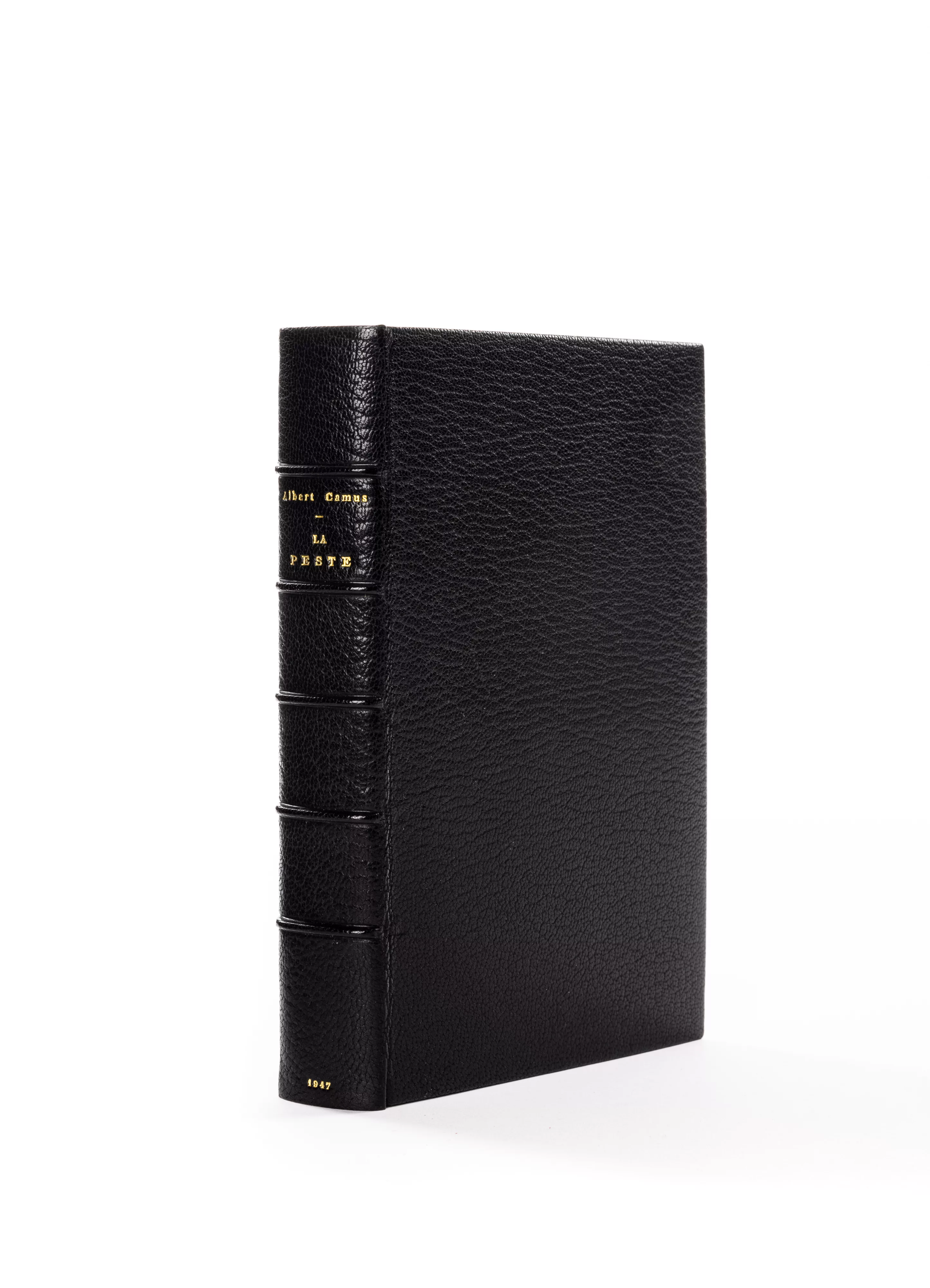
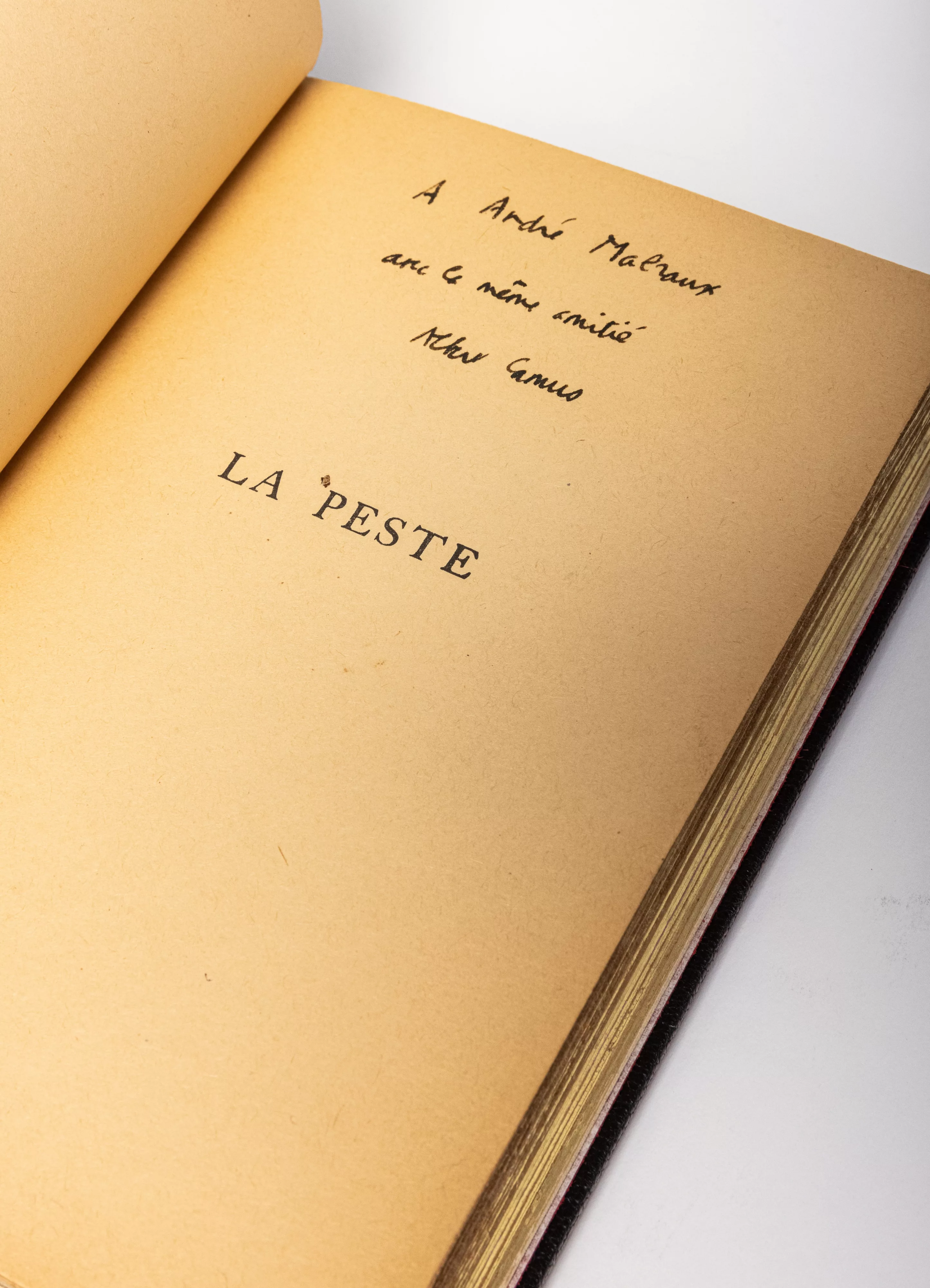
La Peste
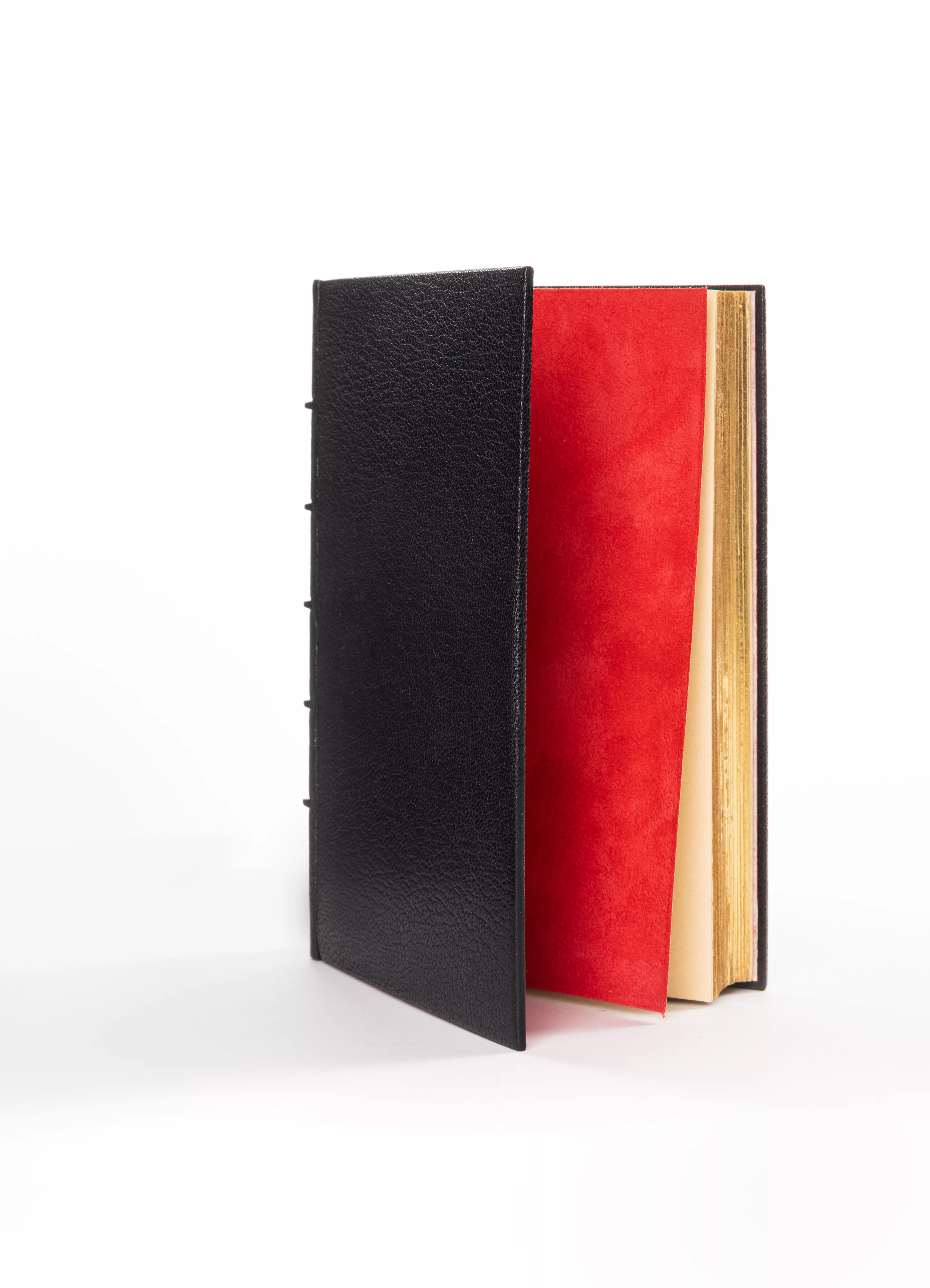
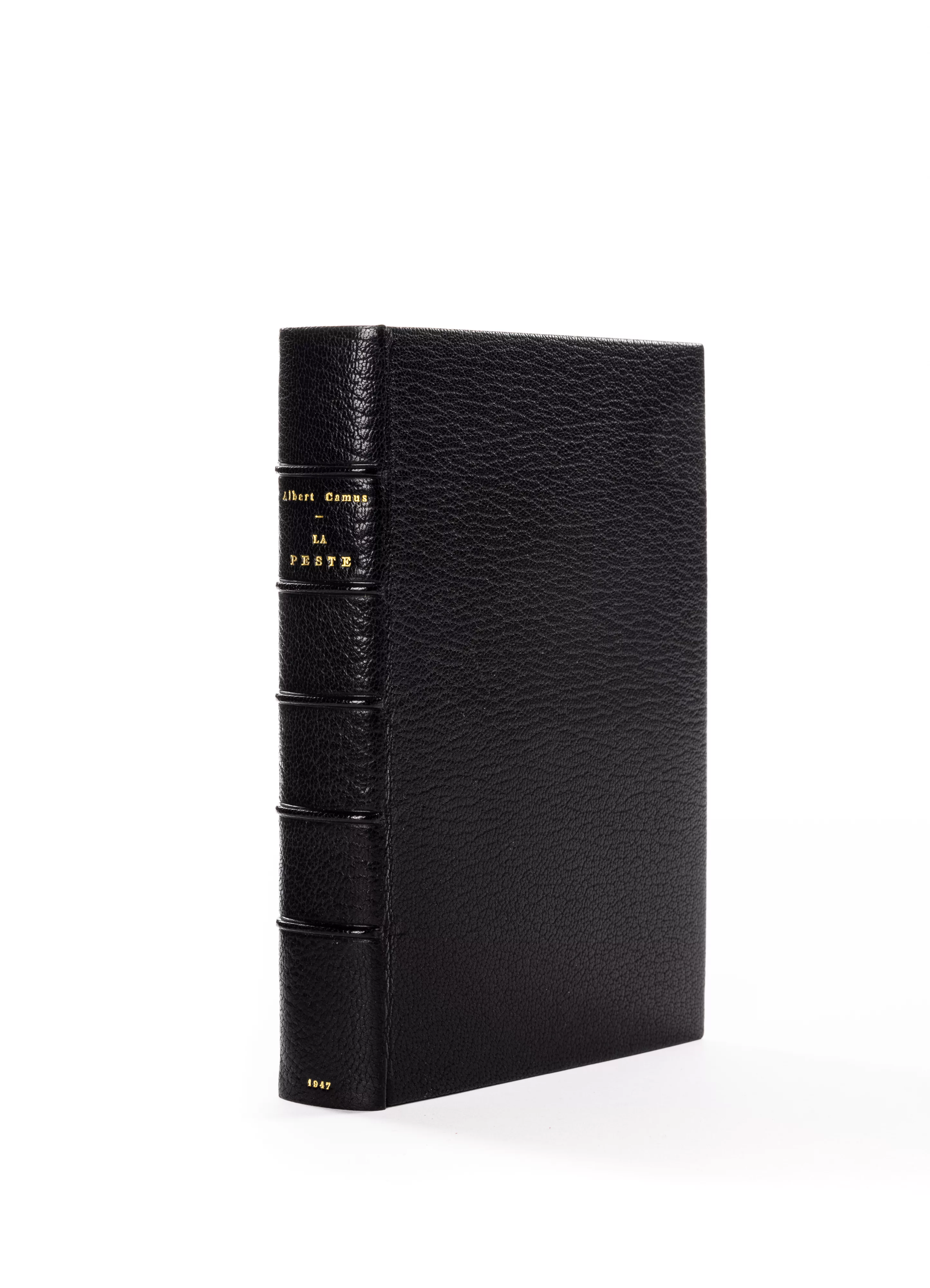
Printed review copy.
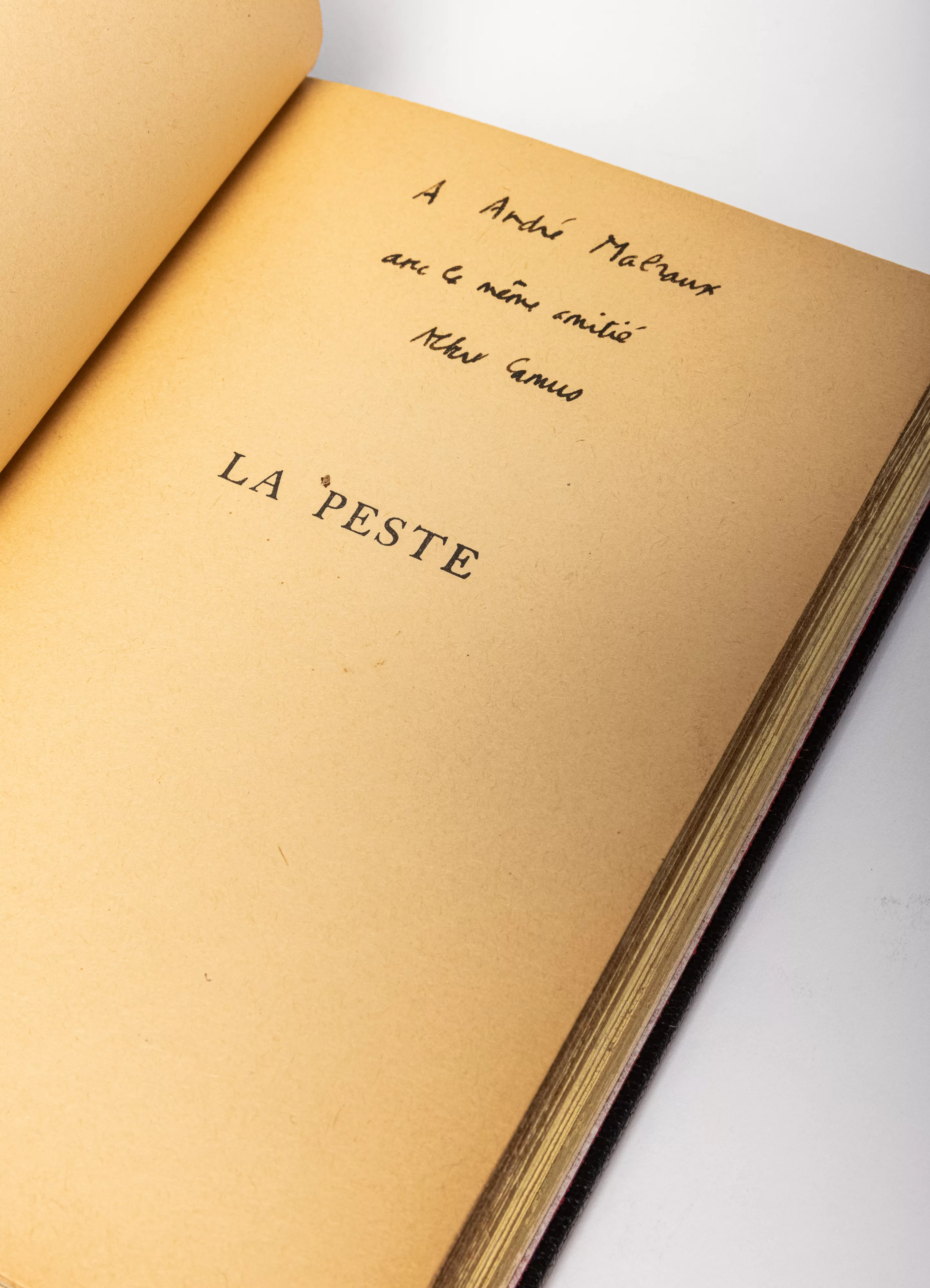
Presentation copy inscribed by Camus to Malraux: “à André Malraux, avec la même amitié. Albert Camus.”
Fifteen years before the publication of La Peste, a young student preparing the entrance exams to the École normale supérieure in Algiers discovered and devoured the works of Malraux. His interest deepened when the Théâtre du Travail — the same company that would stage his own first play, Révolte dans les Asturies — mounted an adaptation of Le Temps du mépris for its debut production. In the manifesto of the Théâtre de l’Équipe, the young Camus specified the periods to which their theater should turn: those “where the love of life mingled with the despair of living: ancient Greece (Aristophanes, Aeschylus), Elizabethan England (Forster, Marlowe, Shakespeare), Spain (Fernando de Rojas, Calderón, Cervantes), America (Faulkner, Caldwell), our contemporary literature (Claudel, Malraux)…”
Seven years later, in April 1941, Malraux read the manuscript of L’Étranger, passed to him by Pascal Pia and then Jean Paulhan. He was deeply struck by it: “it is clear that your manuscript shook him… he proposes some corrections of form,” Pia wrote to Camus on 27 May, referring chiefly to the murder of the Arab, the novel’s dramatic climax, which Malraux found “not as convincing as the rest of the book… I am not trying to say clever or penetrating things to you, I am trying to say useful things,” Malraux insisted. In November 1941 Camus replied directly to “dear Malraux”: “You are among those whose approval I have wished for,” he wrote. Not only did he follow Malraux’s advice, but in March 1942, after the novel’s publication, he wrote to his friend Jean Grenier: “I was helped by luck and by my friends; Pia and Malraux did everything.”
Among the other exchanges from 1942 (preserved at the Bibliothèque Jacques Doucet), one letter shows that Camus was unable to send Malraux an inscribed copy for lack of copies on hand. Two others already mention La Peste: “As soon as I feel better I will continue my work: a novel about the plague. Put that way, it sounds strange. But it would take too long to explain why this subject seems so ‘natural’ to me. If the opportunity arises, I may go and work on it in France: that would be the moment to meet you” (letter from Oran, 23 March 1942); and later (from Le Panelier, 2 September 1942): “Excuse this hasty letter: my thoughts are muddled at the moment. I believe that, in the end, I have caught the plague — from thinking about it so much.” In July 1943 Camus published Les Exilés dans la peste in Domaine français, issued in Geneva under the direction of Jean Paulhan and Jean Lescure, at a time when Malraux was drawing closer to the Resistance.
The two men did not actually meet until October 1944, at the offices of the newspaper Combat (accompanied here by a contretype of the single photograph taken that day, showing Camus, in shirtsleeves, facing Colonel Berger — Malraux’s nom de guerre). Their paths diverged after the war, but their friendship remained deep and sincere. Malraux stood by Camus at the time of the publication of L’Homme révolté, facing the wrath of Jean-Paul Sartre; the simplicity of the present inscription speaks eloquently of the true depth of their friendship. A little over ten years later, when Malraux was appointed Minister of Cultural Affairs on 3 February 1959, he wished to entrust Camus with major responsibilities, including the direction of a theater: a week before Camus’s death, an official ministry document dated 29 December 1959 granted him the Théâtre Récamier and released funds for it, stipulating that “Albert Camus would have complete freedom both in the choice of repertoire and performers and in the administration of the productions.” A meeting with Malraux was planned for January. The fatal accident of 6 January 1960 decided otherwise.
Only one other work by Camus inscribed to Malraux is known: the Gallimard edition of L’Envers et l’Endroit, along with the two stage adaptations performed at Angers. The correspondence between the two men begins in 1942 and ends in 1959; it is brief (32 letters) — the great years of their intellectual dialogue took place while they lived near one another, when writing was unnecessary — but it summarizes their shared history. Over time, notes Sophie Doudet, a specialist on Malraux and Camus, the letters show the two men moving “from a friendship tinged with respect and admiration” to “a loyalty founded on esteem.” “Their correspondence never reaches the intimacy, the complicity or the warmth found in the letters Camus sent to Louis Guilloux or René Char,” she observes, noting that “the tone remains always cordial, with the formal vous de rigueur” — no doubt owing to Malraux’s Gaullism and the turmoil of decolonization, which did little to bring the two writers closer.
Competing for the Nobel Prize in Literature, which he would win over his former mentor in 1957, Albert Camus exclaimed: “It is Malraux who should have had it!” The pupil had surpassed the master, but knew how to show his gratitude.
Publisher’s insert bound in at the end.