

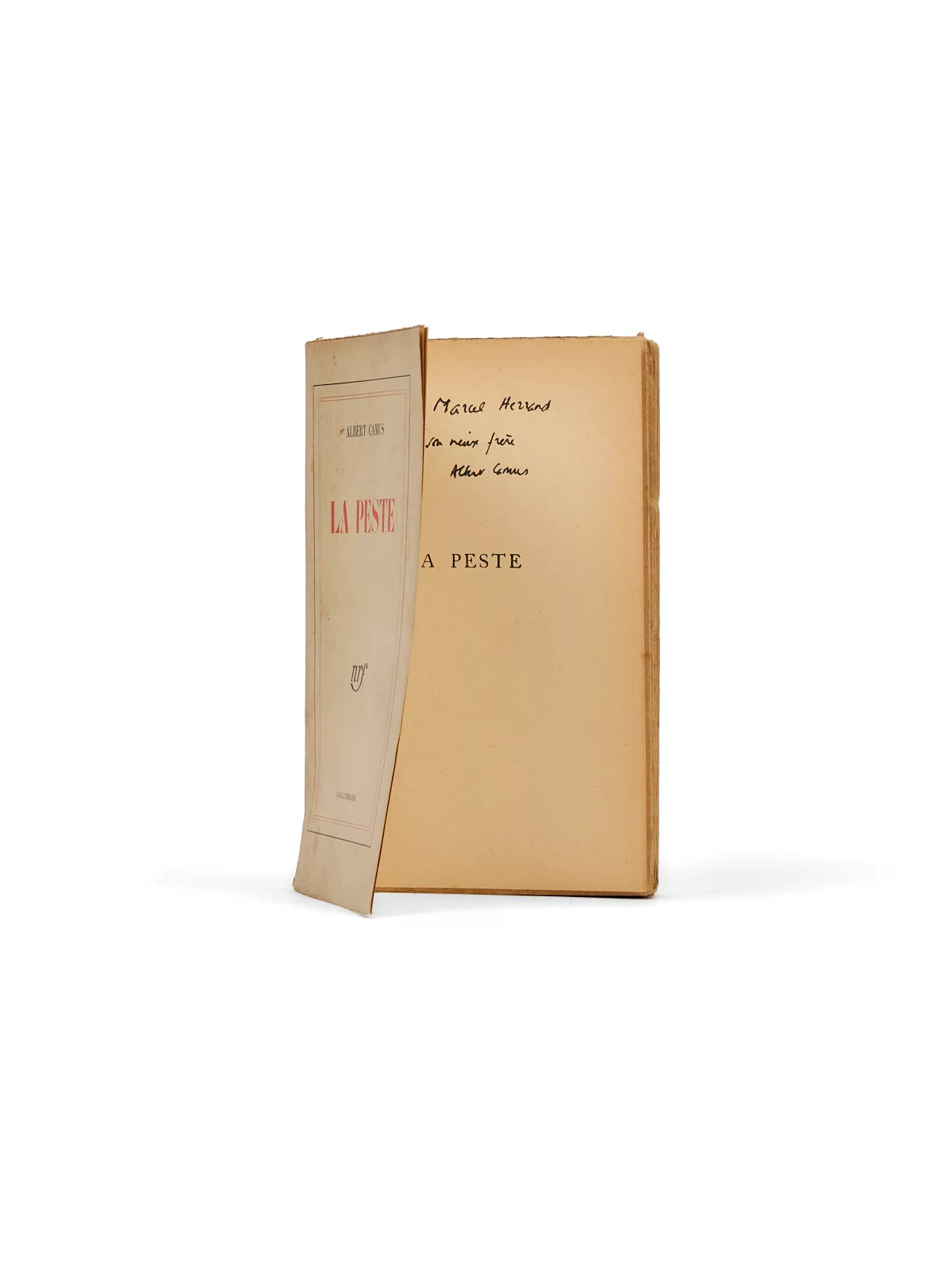
La Peste
Presentation copy inscribed by Camus to Marcel Herrand: “à Marcel Herrand, son vieux frère Albert Camus.”
A fine copy, an especially fitting testament to the friendship and respect uniting two men: Albert Camus, a playwright and man of the theater by vocation who, from 1943 onward, drew closer to the Parisian stage, and Marcel Herrand, an actor-director of dark charm (Lacenaire in Les Enfants du paradis), who since 1939 had directed the Théâtre des Mathurins, succeeding Pitoëff.
After the aborted episode with Sartre’s Huis-Clos, in which he was to play Garcin, Camus finished a play written in solitude in the Cévennes, at Le Panelier, and inspired by a news item: Le Malentendu. In early 1944, despite the German occupation, hope of imminent liberation was in the air, and a surge of literary life swept through the Saint-Germain quarter. People bustled about, wrote plays, performed them among themselves, almost had fun. It was thus that, at an evening at Louise and Michel Leiris’s, Camus became master of ceremonies for a burlesque comedy: Le Désir attrapé par la queue, by Picasso, staged by Jean-Paul Sartre, Dora Maar, Simone de Beauvoir and Valentine Hugo. For Camus, such evenings were mere interludes, but they reinforced his great ambition: to have his play performed. And this great enterprise, his great enterprise of that spring of 1944, would take place at the Théâtre des Mathurins, directed by two young and highly talented actors, Jean Marchat and Marcel Herrand. Rehearsals had been under way since late March, and Marcel Herrand proposed to Camus, for the role of the young woman Martha, a young Conservatoire student: twenty years old, long dark hair, burning eyes, a warm voice with a barely perceptible Madrid accent — the daughter of a minister of the Spanish Republic, now a refugee in France: Maria Casarès. It was their first meeting, and a revelation for the actress: “I was born at the Théâtre des Mathurins. My homeland is the theater, and my country of origin is Spain.” The rest is well known.
Published in 1947, La Peste immediately became one of the great books of the postwar period: a critical and popular success, it established the Camusian grammar of honor and restraint. Begun as early as 1941 in Oran — while a terrible typhus epidemic was spreading across Algeria — the novel transposes into a fable of plague the experience of historical evil and of “an evil that spreads terror”: a chronicle kept at human scale, in which lucid, shared struggle answers the contagion of murderous ideologies. Underlying it, La Peste nourished the reflection Camus would pursue on stage (a revised and reworked Caligula, L’État de siège, Les Justes) and in adaptation (Larivey, Calderón, Lope de Vega), with Marcel Herrand as a guiding presence. In 1952, Herrand took charge of the Angers festival, for which he asked Camus for theatrical adaptations of Pedro Calderón de la Barca’s La Dévotion de la croix and Pierre de Larivey’s Les Esprits. Rehearsals took place at the Théâtre des Mathurins early that year, but Herrand knew he was suffering from a serious cancer. He nonetheless continued directing, but died before the final rehearsals could be completed, struck down just as the performances of the two plays adapted by Camus — which Camus dedicated to him — were about to open; both met with great success. Camus and Casarès remained faithful to the festival, and Camus took over its direction in 1957, staging Le Malentendu and Caligula there again and adapting Le Chevalier d’Olmedo.
A precious copy, whose wording reveals its full significance: among all the dedications by Albert Camus that we have catalogued (a little over 300), he used the word “brother” for only three other companions:
For René Char, the closest and first among them, on six occasions: “brother of the road, brother of the planet, brother in arms, faithful brother, brother in hope, brother of these ones [Les Justes]”;
For Pierre Brasseur, “brother in arms” (on Les Justes);
For Pierre Fayol (on the Lettres à un ami allemand), a fellow Resistance member from Le Panelier, where Camus wrote Le Malentendu;
He also recalled René Leynaud in these terms: “He was my brother, not by blood, but by heart and spirit, in sorrow as in joy” (letter to Louise Leynaud, 13 November 1957, after receiving the Nobel Prize).
This dedication to “his old brother” takes on, in retrospect, the force of a fraternal farewell and a declaration of esteem.