

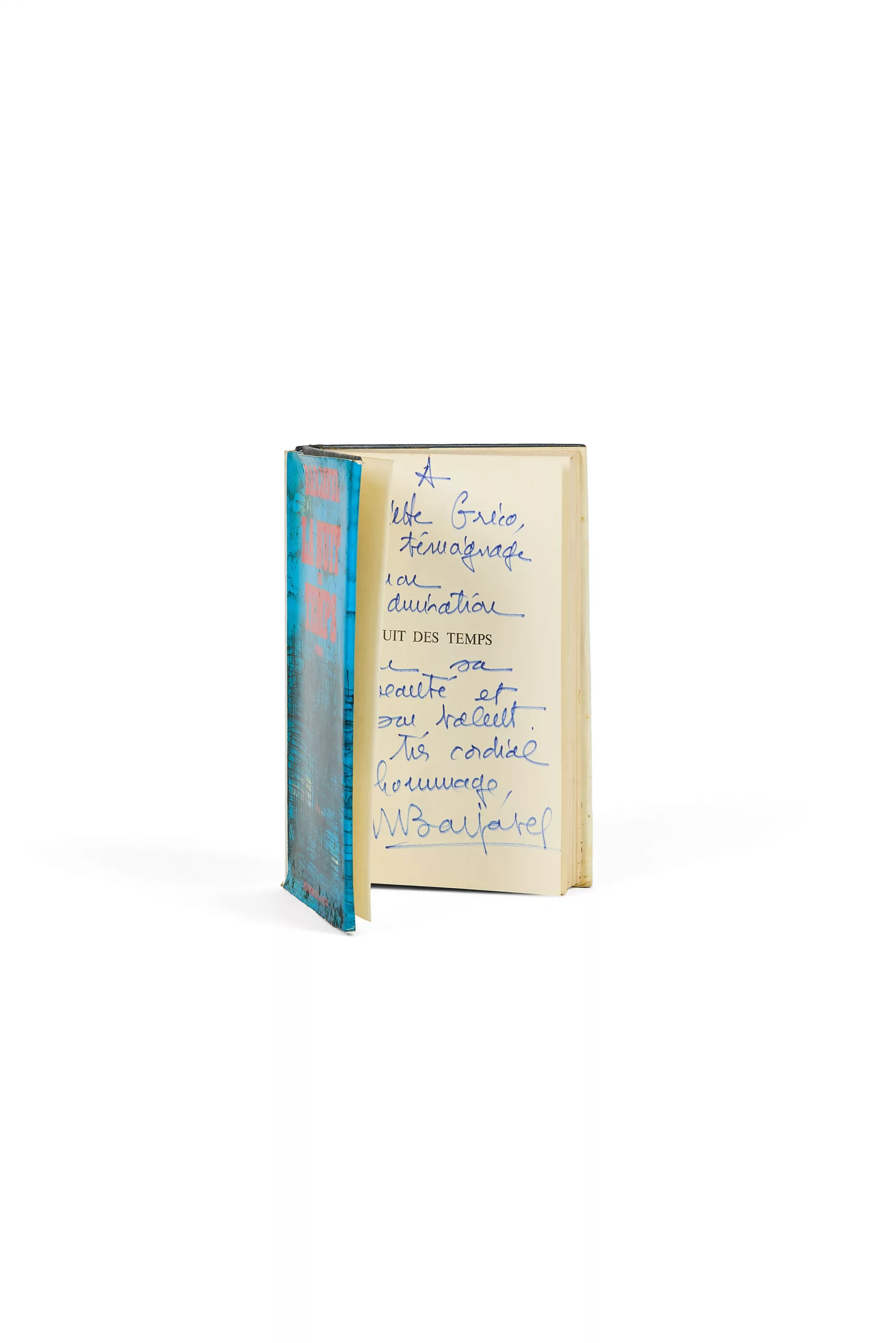
La Nuit des temps
Presentation copy inscribed by Barjavel to Juliette Gréco: “À Juliette Gréco, en témoignage de mon admiration pour sa beauté et son talent, en très cordial hommage, Barjavel.”
Somewhere in Antarctica, a team of French scientists on an expedition detects an ultrasonic signal coming from nearly a thousand meters below the surface, in an ice layer roughly nine hundred thousand years old. Beneath the ice, the scientists discover the remains of an ancient civilization — and a golden sphere…
The success of La Nuit des temps rests on two universal themes, love and the quest for a lost world, echoing the myths of Atlantis, Eldorado and Mu, and drawing on then-current geographical theories of continental drift.
The book began as a film project. In an interview published in Trente ans de prix des libraires, René Barjavel recounts that a (false) news item published in the summer of 1965 was partly the origin of La Nuit des temps: “The newspapers reported in three lines that an American satellite passing over the South Pole had received and recorded radio signals. By an extraordinary coincidence, I had just been in contact with my friend André Cayatte, who wanted to make a science-fiction film and had asked me to work with him on a screenplay based on an idea he had.” The two men wrote a synopsis of about forty pages, but the Paris producer they approached turned it down as “too expensive.” Barjavel, however, could not resist returning to this “world vanished for nine hundred thousand years,” which inspired in him so much hope, work and nostalgia.
A year later, he told Cayatte that he was starting to write the novel, which he completed in under six months. It was rejected by his usual publisher, Denoël. Barjavel then turned to Presses de la Cité, which had just signed Georges Simenon. In a masterstroke, Sven Nielsen rushed the printing of advance sheets so that the book could be included in the Prix des libraires selection. The gamble paid off twice over: the novel won the prize, and the rights were immediately bought in fifteen countries, including the United States.
Complete with its dust jacket from the first printing, and from a most agreeable provenance.