

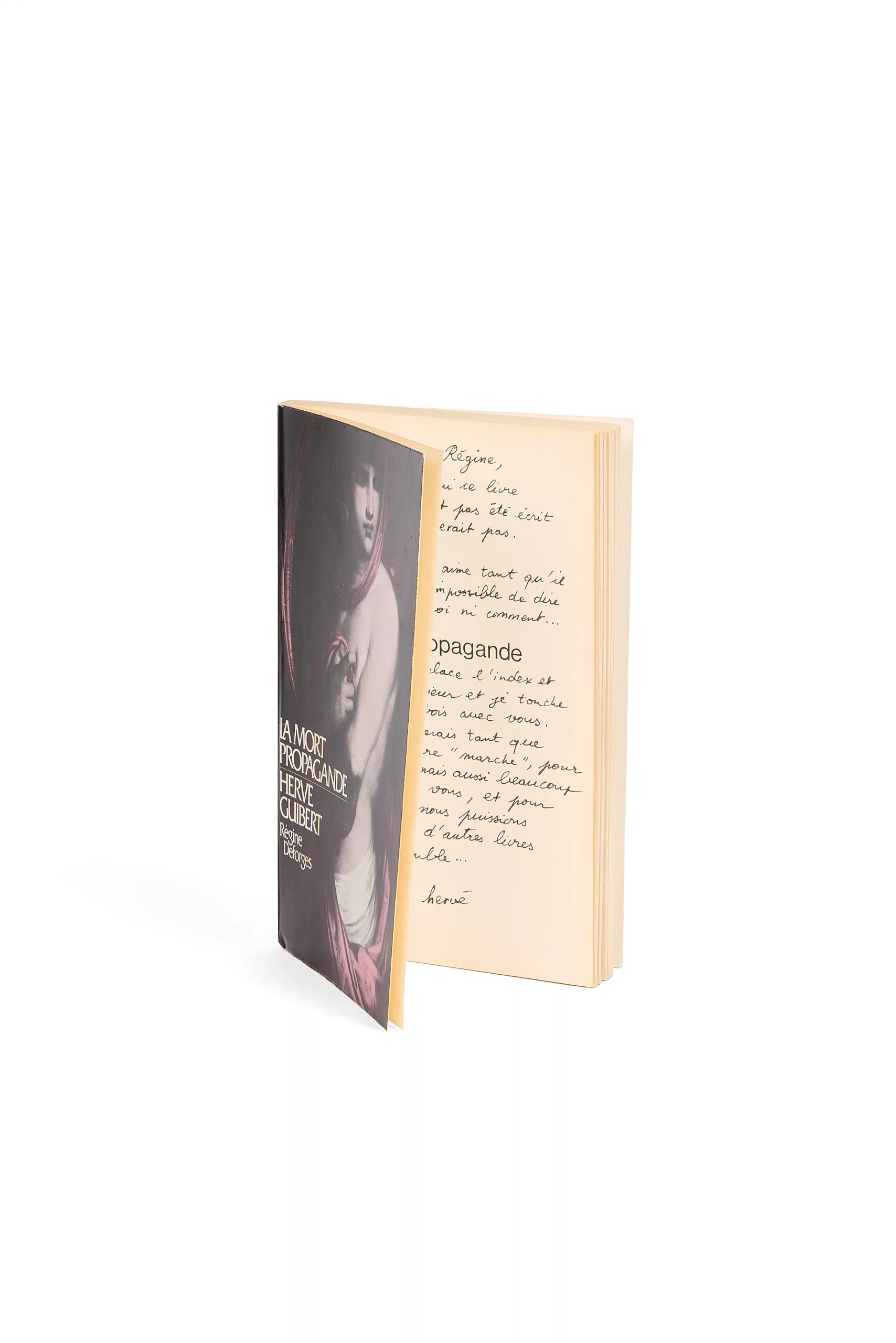
La Mort propagande
Presentation copy inscribed by Hervé Guibert to Régine Deforges: “Pour Régine, sans qui ce livre n'aurait pas été écrit et ne serait pas. Merci. Je vous aime tant qu'il m'est impossible de dire pourquoi ni comment... J'entrelace l'index et le majeur et je touche du bois avec vous. J'aimerais tant que ce livre ‘marche’, pour moi mais aussi beaucoup pour vous, et pour que nous puissions faire d'autres livres ensemble... Hervé.”
Paris, March 1967. Having already opened several bookshops, in Paris and in the provinces, Régine Deforges decided to launch her own publishing house, L’Or du temps, in homage to André Breton (who used to say, “Je cherche l’or du temps”; this is the epitaph inscribed on his tomb). Seeing that few erotic books were being published, she decided to specialize in them, helped by Jean-Jacques Pauvert, who was also her lover, though married at the time. Deforges thus became the first French woman publisher.
She had written to Aragon asking to publish Le Con d’Irène, which was attributed to him. He never replied, and since the book still had no official author, Régine Deforges decided to publish it in 1968 under the title Irène. “That act of self-censorship, the only one I ever committed, did not prevent the book from being seized on 22 March 1968” — forty-eight hours after it went on sale. Régine Deforges was convicted of outrage aux bonnes mœurs and temporarily deprived of her civil rights. This was only the beginning: publishing Pierre Louÿs’s Trois Filles de leur mère and André Hardellet’s Lourdes, lentes led her back, in turn, to the least erotic of chambers: the 17th correctional chamber of the Paris court.
The publishing house then went dormant, before being revived at the end of the 1970s. It was at that moment that she met a young man of seventeen, Hervé Guibert: “He was beautiful as a god, Satan incarnate. No one would have dared publish his book. Then people like Michel Foucault and Roland Barthes fell upon it like a pox on the lower clergy. They loved it for the wrong reasons: because a very pretty young man was talking about gay sex. Hervé was fooled, but not for long. His book was premonitory — it foretold AIDS (…) Of all the books I had published, it was the most dangerous, the most shocking and the most timely. A formidable book, deeply disturbing,” she admitted in L’Enfant du 15 août, her memoirs in which she settled her accounts in 2013, a year before her death.
Jean-Jacques Pauvert was its second reader, after Régine Deforges.
A wonderful copy of the most perfect provenance.
It is accompanied by an original Polaroid, almost certainly taken by Régine Deforges, of her young protégé.
It is probably one of the earliest known photographs of Guibert — we have been unable to trace any image showing him at a younger age.