

La Mort de près
Late in his life, by then a respected regionalist writer and permanent secretary of the Académie française, Maurice Genevoix felt the need to return to the death he had encountered, so distant yet so close, three times in the Meuse, between August 1914 and April 1915.
In the summer of 1971, as the third volume of his Bestiaire was about to appear, Genevoix wrote in a few weeks a short book that has since taken its place alongside the other texts of Ceux de 14: La Mort de près. Through the multitude of details and observations so characteristic of Genevoix’s style, the text places the reader directly within the experience it describes. Joseph Kessel wrote to him: “I was deeply moved. The witness, the professional, the friend — all these figures within me shower you with praise and thank you.” (Letter to Genevoix, 29 July 1972, no. 123 in the BHVP exhibition, 1991).
Death brushed past Genevoix at Les Éparges, a hill in the Meuse contested with the Germans. It happened several times: first in September 1914, when a shell fragment struck him in the stomach and knocked him down. He watched his men continue the charge while he was pulled to shelter under a beech tree; haunted by the image of a comrade he had passed moments before, disemboweled, he felt his own stomach — he was unharmed. The fragment had glanced off a steel button and his belt buckle. The same thing happened again three months later, when a shell exploded a few meters away, tearing the two soldiers beside him to pieces: “I was still unharmed. It took only a few moments for the world to reconstitute itself, in all its hideousness and barbarity.” The third time was decisive: 25 April 1915, the last day recounted in Sous Verdun. Three bullets, fired by the same German soldier, tore through his left arm and one pierced a lung. “Not for one moment, except in the stupor of the shock […] did I lose consciousness. […] I suffered greatly. The sense of danger bore down on me, overwhelmed me, grew more acute.” Stretcher-bearers carried him back behind the firing line, while shells all around them shattered the beech trees of the Hauts-de-Meuse. It took eleven grueling hours to reach a hospital in Verdun. Hospitalized for seven months, he was declared 80 percent disabled and lost the use of his left hand.
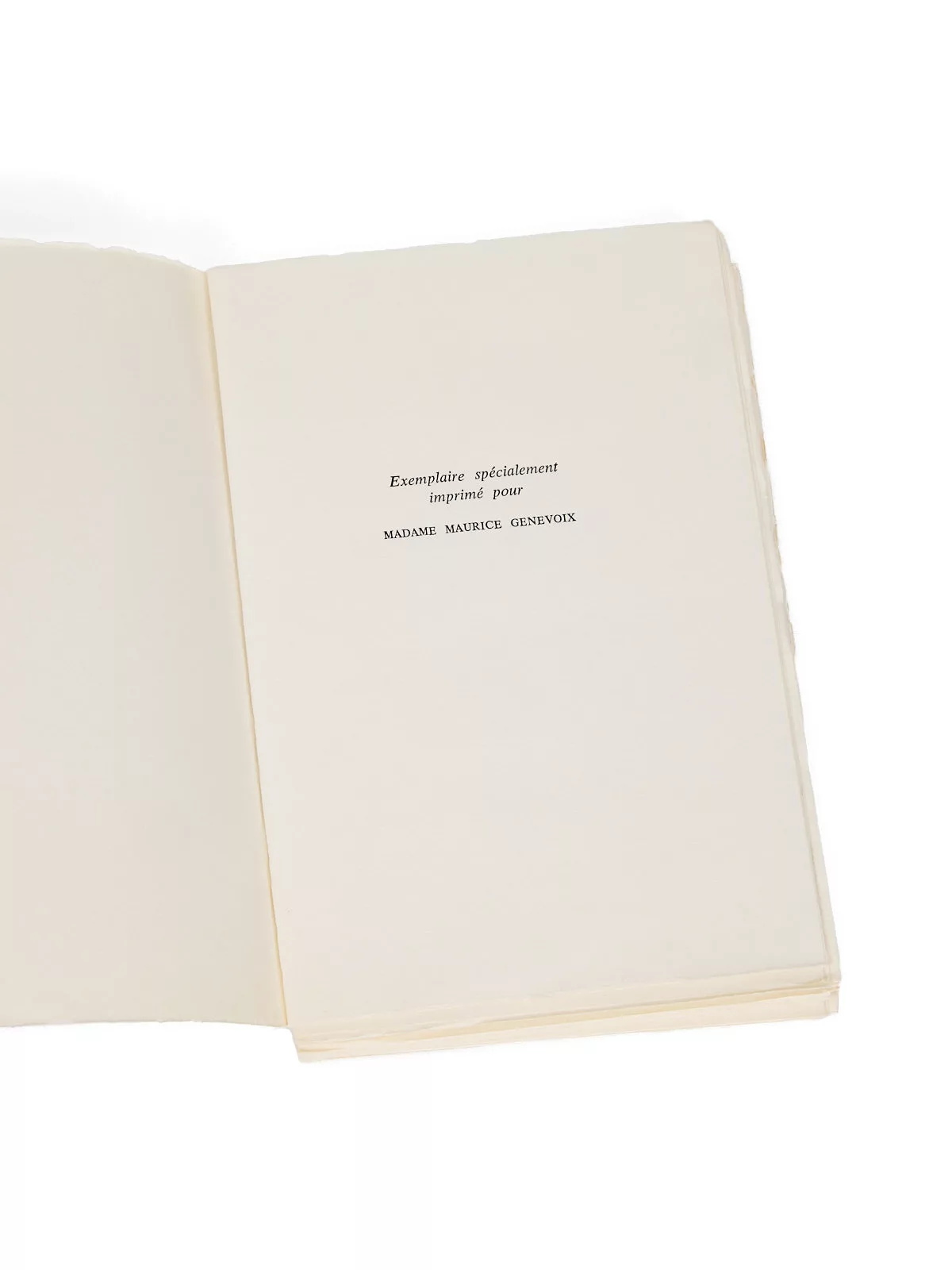
A nominative copy intended for his wife, Suzanne Genevoix.