

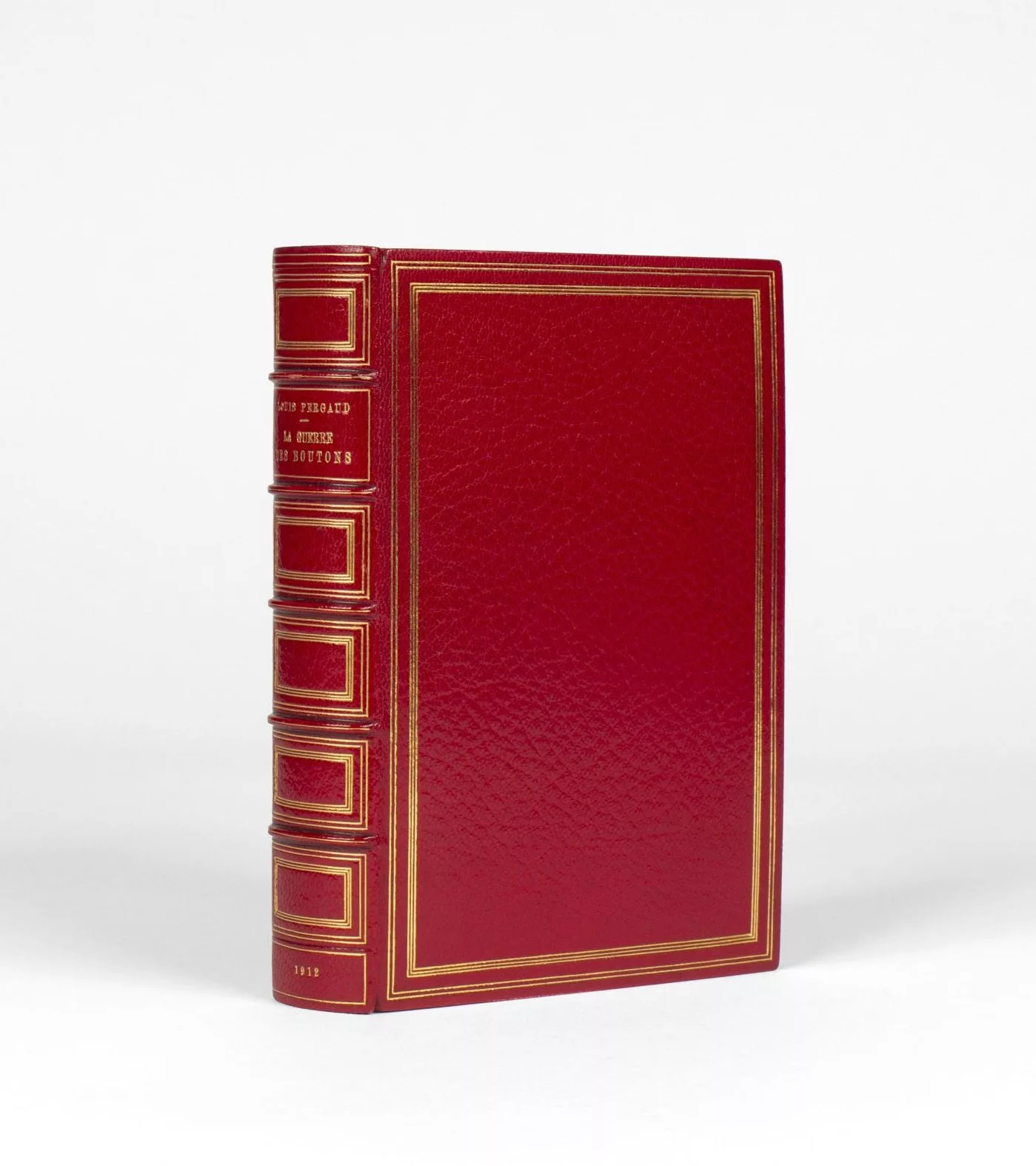
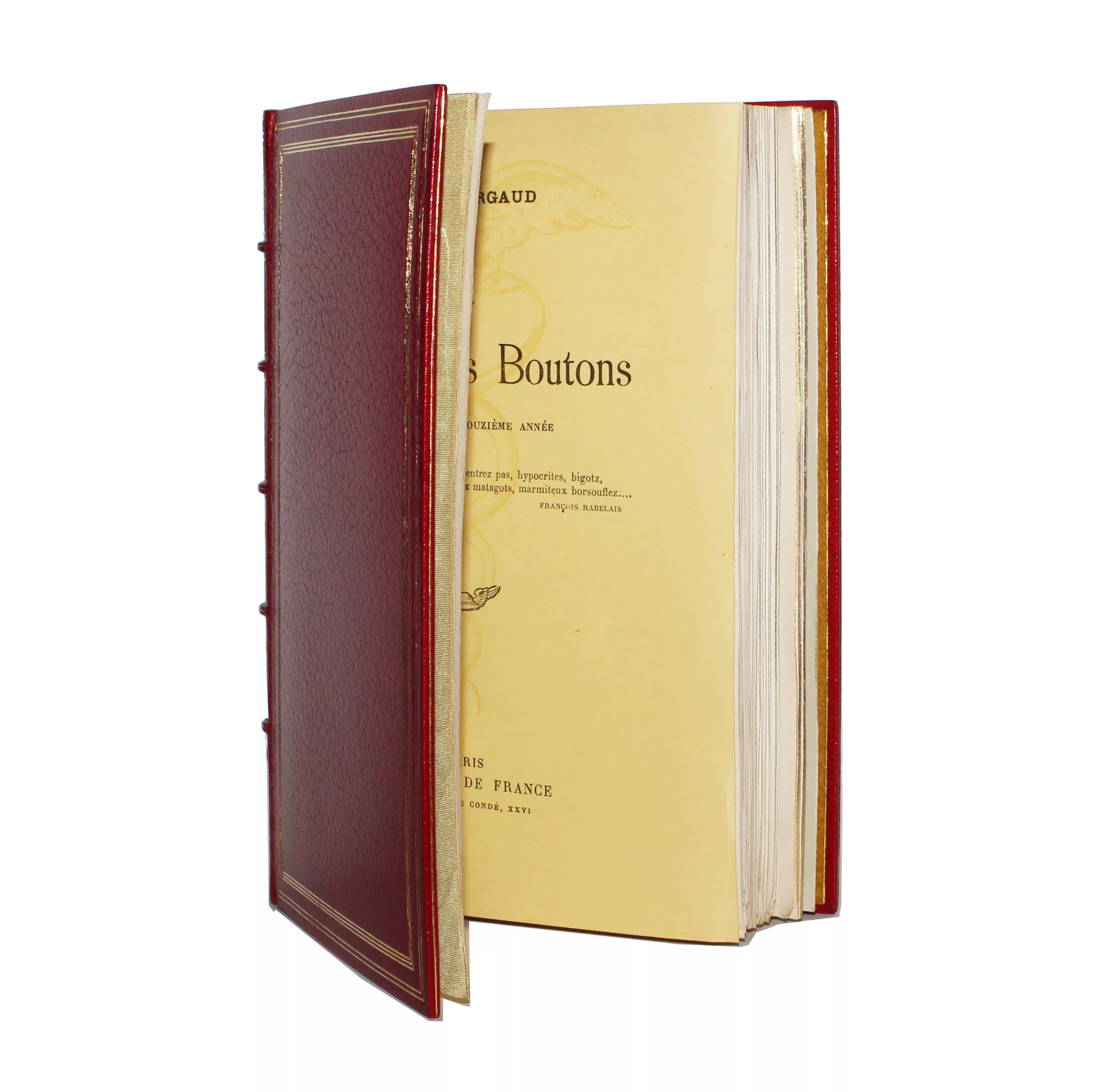
La Guerre des boutons, roman de ma douzième année
One of 19 copies on Hollande, this copy no. 10.
“Cy n’entrez pas, hypocrites, bigotz”: the Rabelais quotation Pergaud places as epigraph sets the tone, and the novelist claimed to have written a “wholesome book,” both “Gallic, epic and Rabelaisian, brimming with the sap of life.” It is a book of childhood memories, recounting the pitched battles between two gangs of boys, one led by the great Braque of Longeverne, the other by l’Aztec des Gués of Velrans. The spoils of war between the two rival armies — trouser buttons and shoelaces — are fiercely and endlessly fought over. Where the 1912 novel set these forest skirmishes in the 1890s, Yves Robert’s 1962 film adaptation gave the story a contemporary setting, at the moment of the “end of the peasantry,” imagining Lebrac fleeing to live for a time in the woods, hunted by respectable townsfolk. Hidden in an oak tree felled by woodcutters, he falls shouting “Vive la liberté!” Sent to a reform school, he is reunited with l’Aztec and makes peace. The children’s “republic” already sensed the coming end of its state of grace: “To think that when we grow up, we might be just as stupid as they are.”
Mobilized in August 1914 as a second lieutenant at Verdun, Pergaud served in Lorraine on the Western Front. On 7 April 1915, his regiment launched an attack on the German lines: caught in the barbed wire, the novelist was shot and wounded. It appears that several hours later German soldiers came to his aid and carried him to a field hospital at Fresnes-en-Woëvre, in the Meuse, which was then destroyed by French artillery fire. His body and those of his comrades were never recovered, and although Pergaud has no grave, a memorial stele honors him at Fresnes, and two villages, Landresse and Belmont, have inscribed his name on their war memorials — a final tribute from both communities to the author of the fratricidal struggle of La Guerre des boutons.
From the libraries of Alexandre Daniel and Dr. André van Bastelaer (bookplates).