

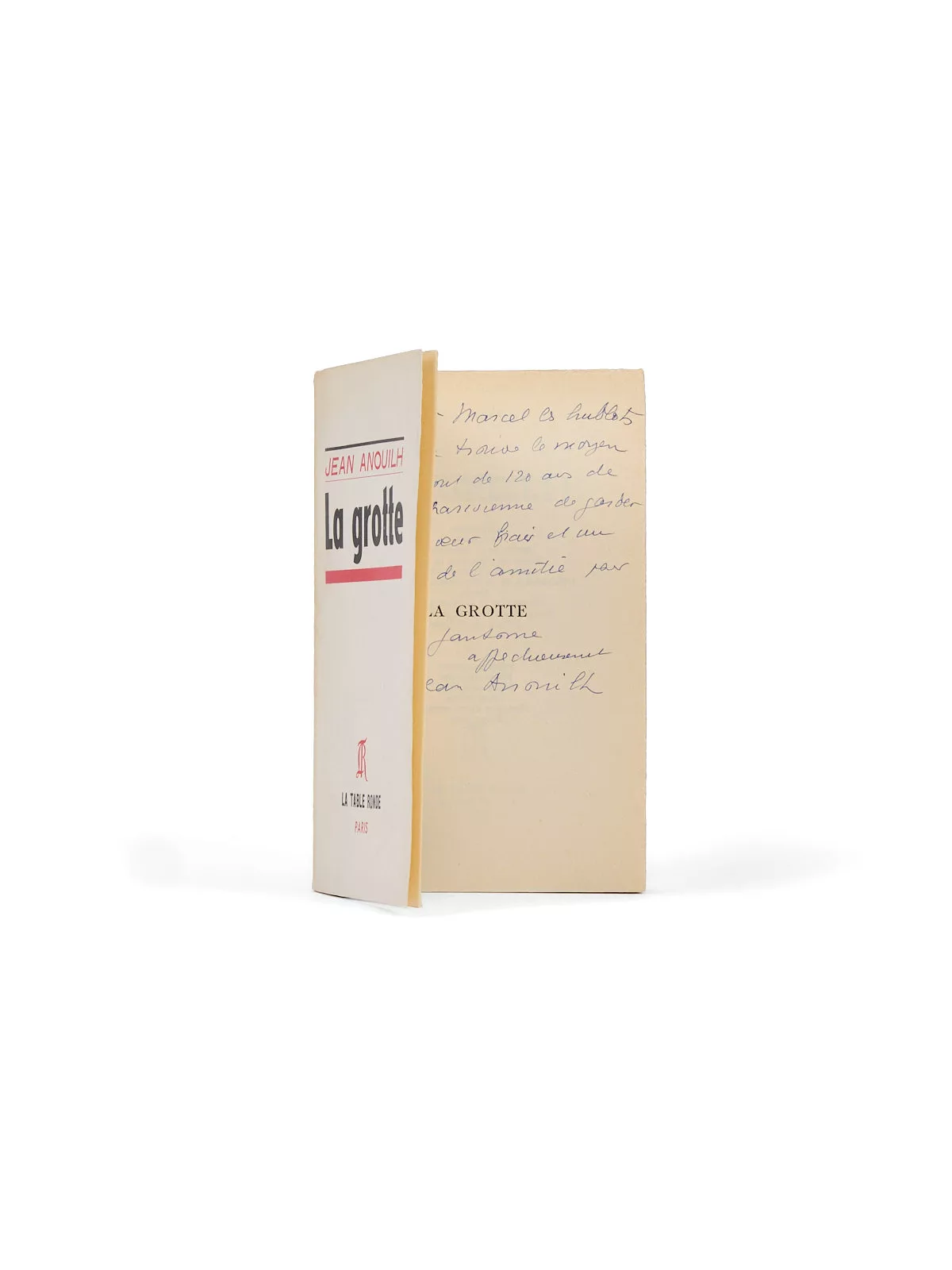
La Grotte
Signed presentation inscription: “Pour Marcel [Achard] les hublots qui a trouvé le moyen au bout de 120 ans de vie parisienne de garder un cœur frais et un sens de l'amitié pour un fantôme, affectueusement, Jean Anouilh.”
Anouilh writes of Marcel Achard’s “120 lives…”! Indeed, his worldly career began early: his first success came in December 1923 with Voulez-vous jouer avec moâ, in which he played the lead role (directed by Charles Dullin) at the Théâtre de l’Atelier, and continued until his last play, La Débauche (January 1973), at the Théâtre de l’Œuvre. In January 1974, following the example of his colleagues Jean Anouilh, Marcel Aymé and René de Obaldia, Achard tried his hand at Café-Théâtre, entrusting the Bec fin with one of his early texts, Celui qui vivait sa mort, first staged by Dullin in 1923.
Juliette Achard, his companion from his early days, summed up their Parisian life — that of “Marcel les hublots,” a nickname referring to his severe myopia and famous round glasses — a close friend of Jean Anouilh, who called himself “the ghost” (an expression found both in this inscription and in the letters he sent his friend), being usually absent from the outings and public events that Achard, for nothing in the world, would have missed:
“We never went to bed before 7 in the morning. It began with the theater every evening. Then, two or three nights a week, we would dine with friends, most often at Henri Bernstein’s; the rest of the time we would turn up at midnight at Maxim’s or Fouquet’s before making the rounds of four or five Russian and Black nightclubs, with Kessel and L. P. Fargue. And on the way out, we would have breakfast at the Palais d’Orsay.”
Anouilh and Achard belonged to the great age of interwar theater, working with the masters of the “Cartel des quatre,” founded in 1927 by Louis Jouvet, Charles Dullin, Georges Pitoëff and Gaston Baty. The two authors shared the Parisian stage with Marcel Pagnol, Sacha Guitry, Édouard Bourdet, Fernand Crommelynck, Jules Romains and Armand Salacrou.
The king of boulevard theater followed, by his own account, two rules in writing his plays: one borrowed from Feydeau — “When two characters must not meet, I put them together” — and the other from Tristan Bernard — “The public likes to be surprised, but only by what it expects.” Anouilh worked in another genre and by other principles, but the two remained steadfast friends.
A fitting provenance.