



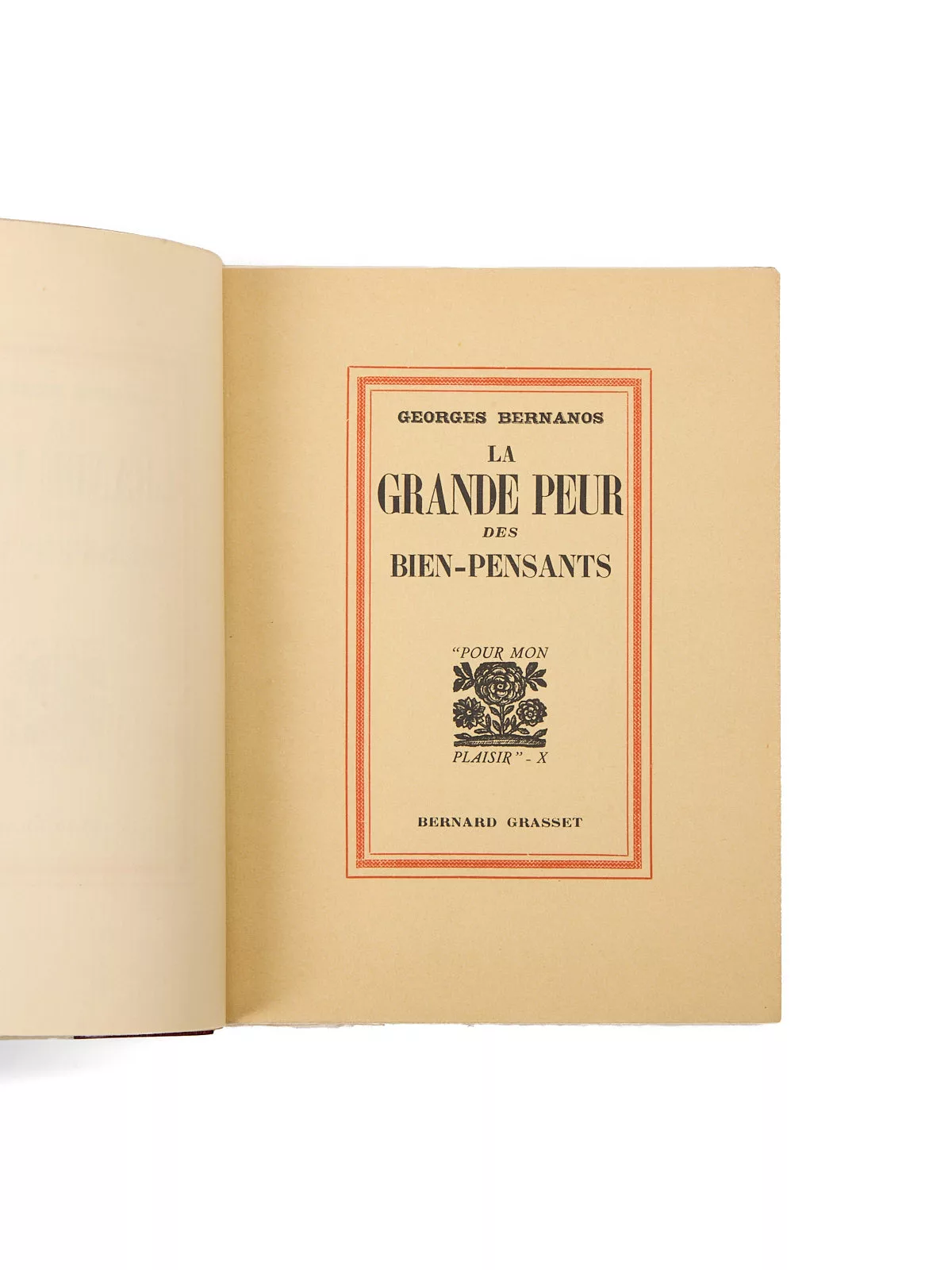
La Grande Peur des bien-pensants
One of the first 6 copies on nacré Japan paper (no. III).
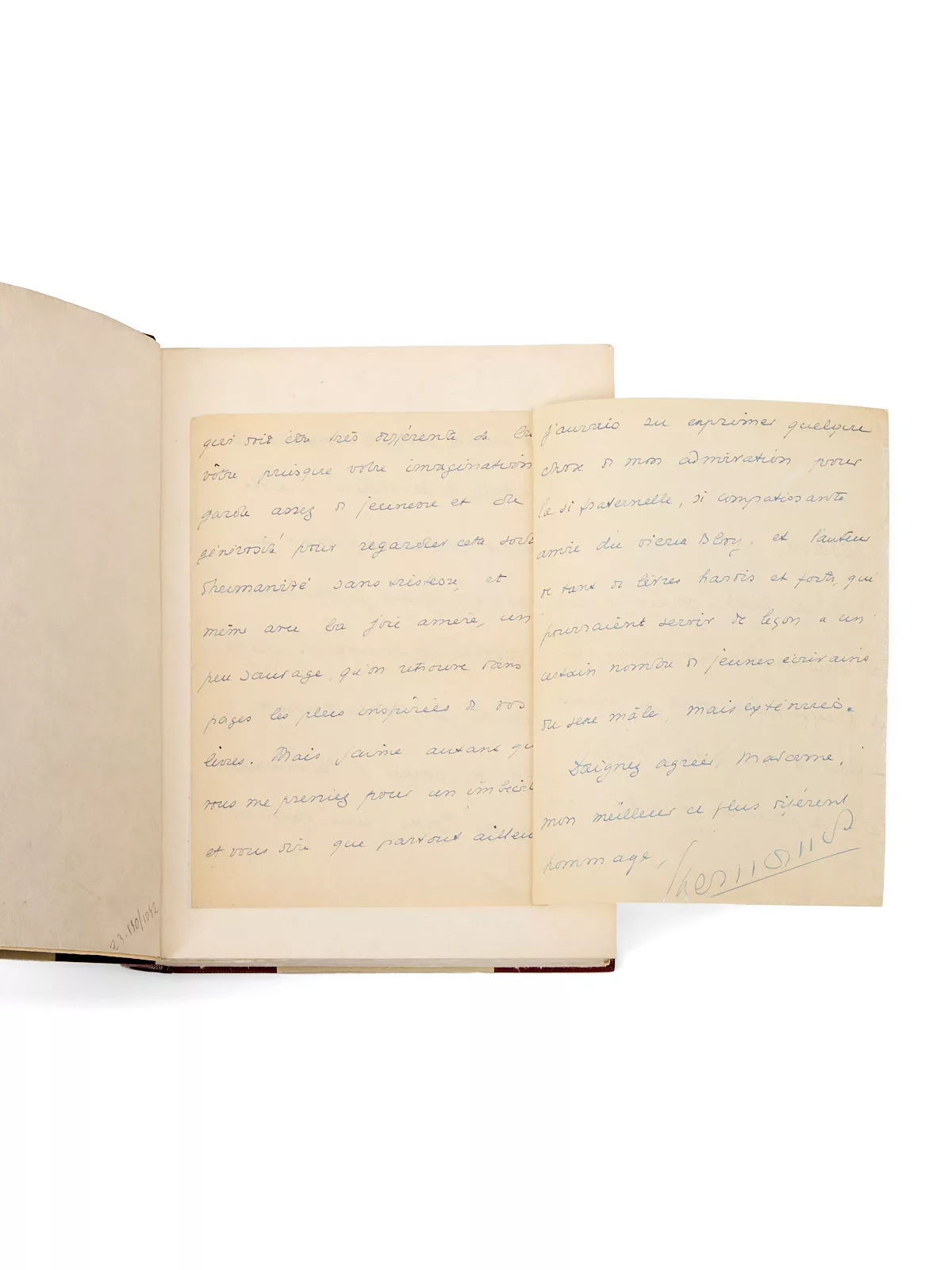
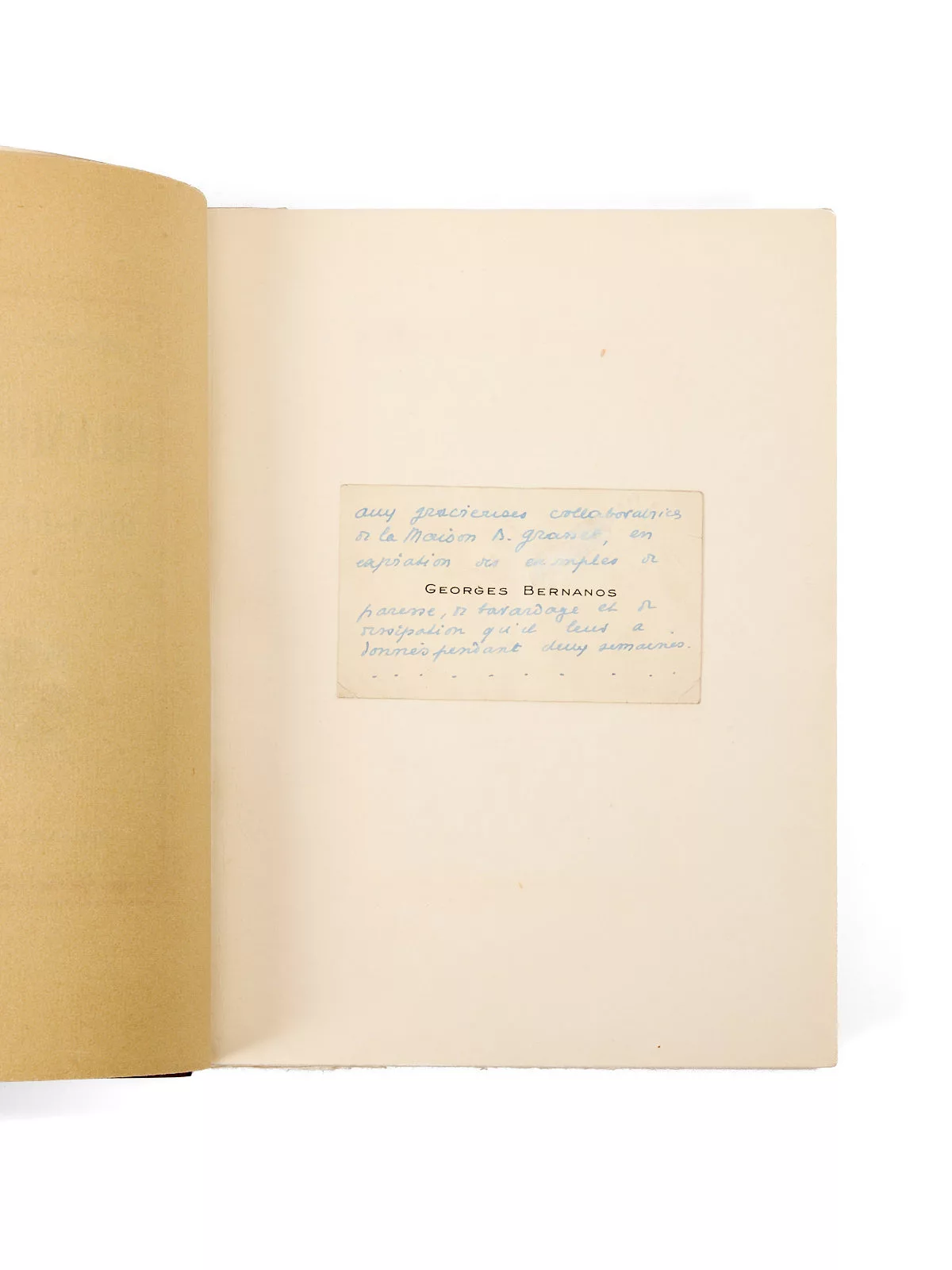
Accompanied by: a fine autograph letter signed, addressed to a “friend of old Bloy” (4 pp.), and a calling card of the author bearing the following inscription: “aux gracieuses collaboratrices de la Maison B. Grasset, en expiation des exemples de paresse, de bavardage et de dissipation qu'il leur a donnés pendant deux semaines.”
The fine, long autograph letter bound in at the front is addressed to a woman writer and friend of Léon Bloy: “Madame, I am sorry — embarrassed and sorry — to have met you yesterday so dreadfully inopportunely — Pioch on my right, Talbois on my left, while that horrible chatterbox put on a display at the podium of vanity worked up to the point of spasm, generously offering his saliva and his sweat. No doubt I am quite wrong to entrust to the postal administration an opinion that must be very different from your own, since your imagination retains enough youth and generosity to look upon this sort of humanity without sadness, and even with the bitter, somewhat wild joy found in the most inspired pages of your books. But I would rather you took me for a fool than fail to tell you that anywhere else I would have known how to express something of my admiration for the so fraternal, so compassionate friend of old Bloy, and the author of so many bold and strong books, which could serve as a lesson to a certain number of young writers of the male sex,… Georges Bernanos.”
La Grande Peur des bien-pensants marks an important turning point in the history of the French right: the text gathers together pieces published between 1929 and 1931, some written for L’Action française, others delivered as lectures. Its publication preceded the break between Maurras and Bernanos, which came in May 1932, when the champion of integral nationalism wrote his famous “Je vous dis adieu, Bernanos” in L’Action française of 16 May.
This was the culmination of an evolution under way in Bernanos for several years, one that would lead him, a few years later, to the salutary position he ultimately adopted.
The book is above all a work in support of the odious Édouard Drumont and his major work La France juive, which nonetheless remains essential reading. But while there was indeed a rupture between Bernanos and Maurras, the nature of the Catholic writer’s antisemitism, very real in this panegyric of Drumont, still stirs passionate debate today. This biography of Drumont is above all a pamphlet denouncing the decline of the nation, fallen into the hands of the conservative bourgeoisie in the early decades of the Third Republic.
“Georges Bernanos is usually seen as a writer very close to L’Action française, if not the Maurrassian writer par excellence. In reality, although he was indeed a convinced Maurrassian in his youth — a militant journalist for L’Avant-Garde de Normandie in 1913–1914, close to the movement at the time of Sous le soleil de Satan and the Vatican’s condemnation of Action française (1926–1927) — his break with Maurras in 1932 reveals the profound distance separating him from the royalist movement. It is logical that Bernanos came to condemn Maurras, guilty of complacency toward the conquering dictatorships at the time of Munich and the Spanish Civil War (…). Opposed to the Maurrassian vision of History because he always chose the romanticism of personal adventure over the positivism of political reason, opposed to the “Christless Catholicism” of Maurrassian France in the very name of the God of the Gospels, he built his work as a writer on a spiritual quest that remained, in the end, entirely foreign to the ideas and values of that journal (…)” (Denis Labouret, Georges Bernanos et l’Action française: histoire d’un malentendu).
A very fine copy.
From the library of Charles Hayoit (Paris, Sotheby’s & Poulain-Le Fur, November 30 and December 1, 2001, lot 942), with bookplate.