

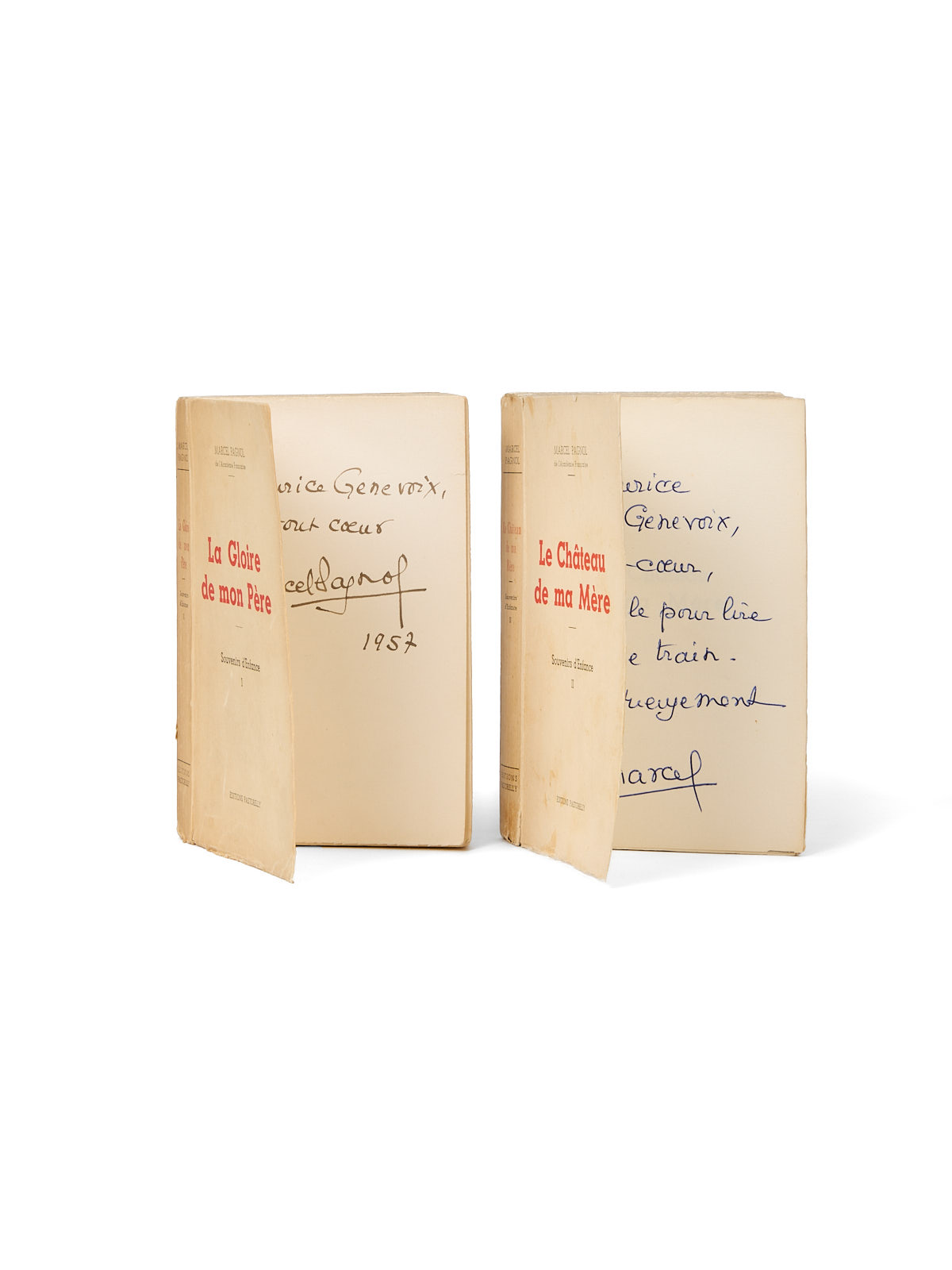
La Gloire de mon père. Le Château de ma mère. Le Temps des secrets.
Signed presentation inscriptions in the first two volumes:
“à Maurice Genevoix, de tout cœur, Marcel Pagnol 1957.”
“à Maurice Genevoix, de tout cœur, garde le pour lire dans le train, affectueusement, Marcel.”
Pagnol preceded his elder colleague at the Académie française, having been elected at the age of only forty-seven, on April 4, 1946. His induction, on March 27, 1947, by Jérôme Tharaud, was filmed — a first in the history of the Académie française. Genevoix, elected in October 1946, was inducted six months after Pagnol, on November 13, 1947.
Their elections to the Académie française reflect their standing as respected literary figures and their influence on French letters.
Pagnol’s “childhood memoir” was born ten years later, when a women’s magazine asked him for a story for its Christmas 1957 issue. Pagnol then wrote the story of the four châteaux, a tale that awakened in him the desire to tell more. “It is only a record of a vanished era, and a little song of filial devotion, which today may perhaps pass for a great novelty.” It did indeed, being warmly received by both the public and the critics: “What I like in La Gloire de mon père, as in Daudet’s masterpiece, is the naturalness that makes it a book for everyone and will win over every reader of good faith … Behind the vivid portrait lies childhood itself, with its games, its illusions and its innocent cruelties, its charming curiosities, excellent scenes such as the making of cartridges and Uncle Joseph’s wedding, and the whole of the Provençal landscape, its hidden springs, its greenery and its vehement scents” (Émile Henriot, in Le Monde, February 5, 1958).
In the following volume, Le Château de ma mère, Marcel Pagnol pays tribute to Augustine, his “dear mother, the only one who never blasphemed against [his] beloved hills.” It is also an ode to friendship, with Lili des Bellons, the young peasant boy met during the morning’s hunt that opens the book; it is he who teaches Marcel to set bird traps and who passes on to him the secret of the springs. An ode to the untouched beauty of nature that inspired both Pagnol and Genevoix, one in Provence, the other in the Val-de-Loire.
Spines slightly rounded and warped, otherwise a good copy, of excellent provenance.
Wrappers bear the date 1958 [i.e. 1957], but with correct printer’s dates.