

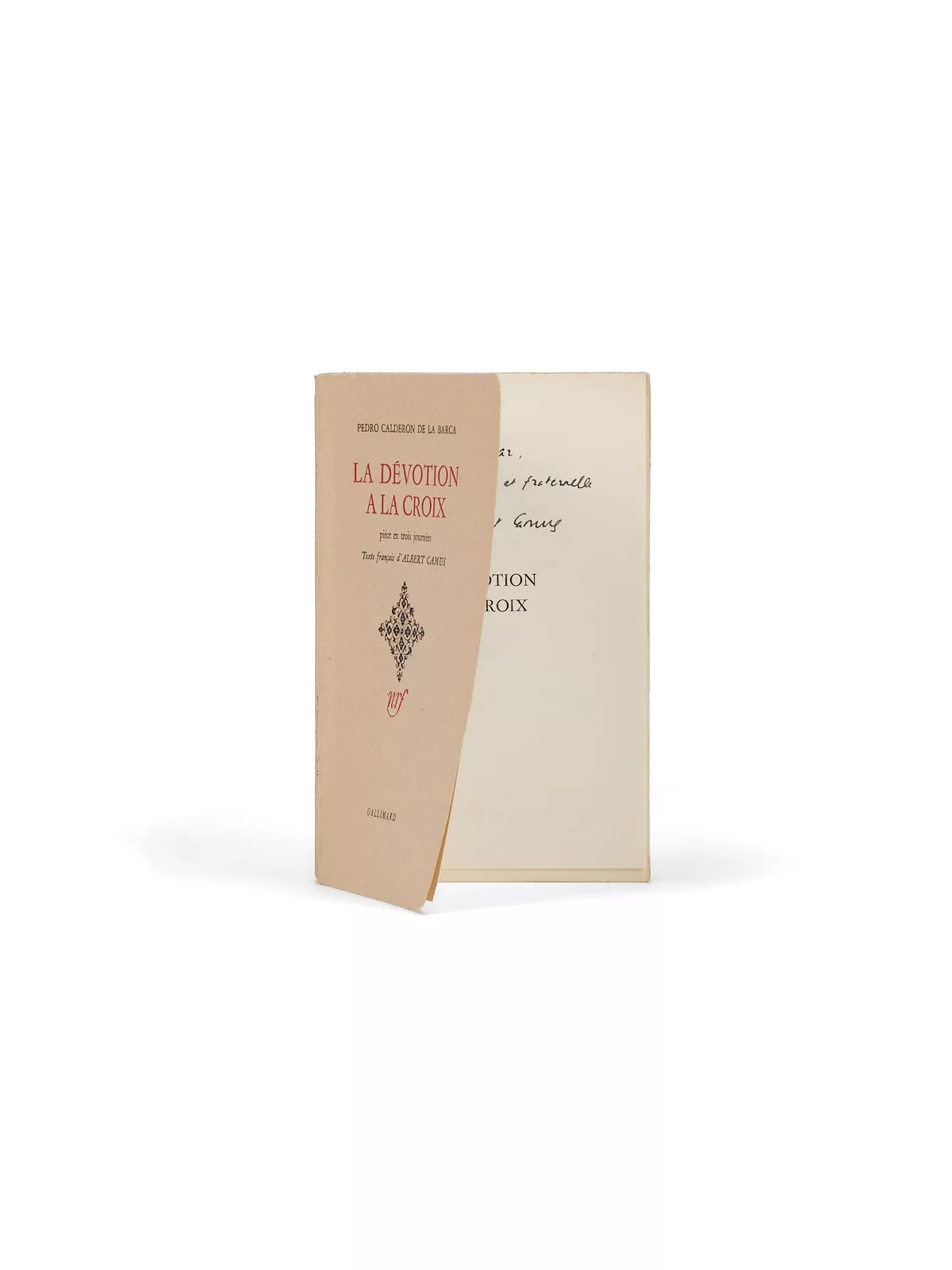
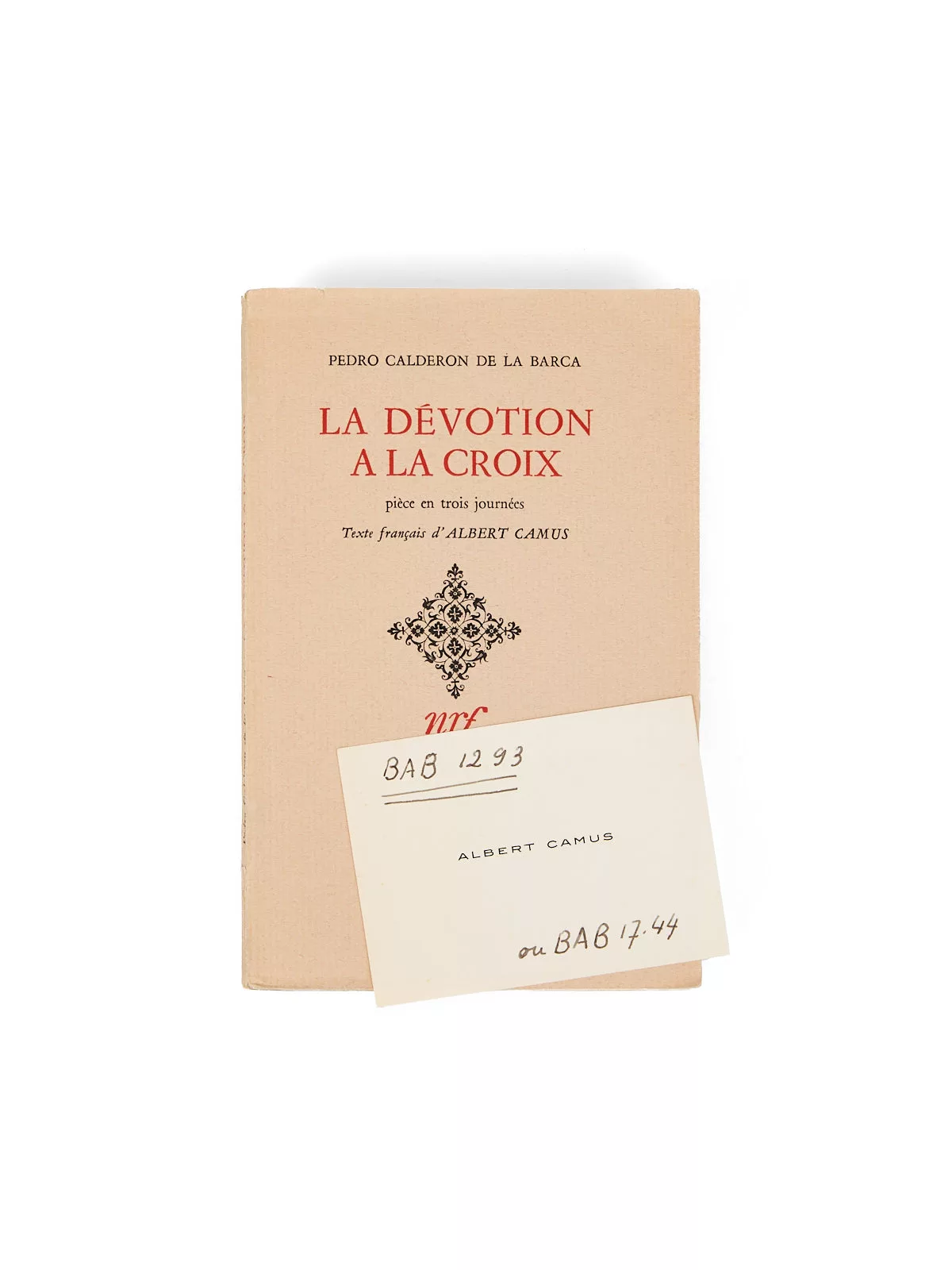
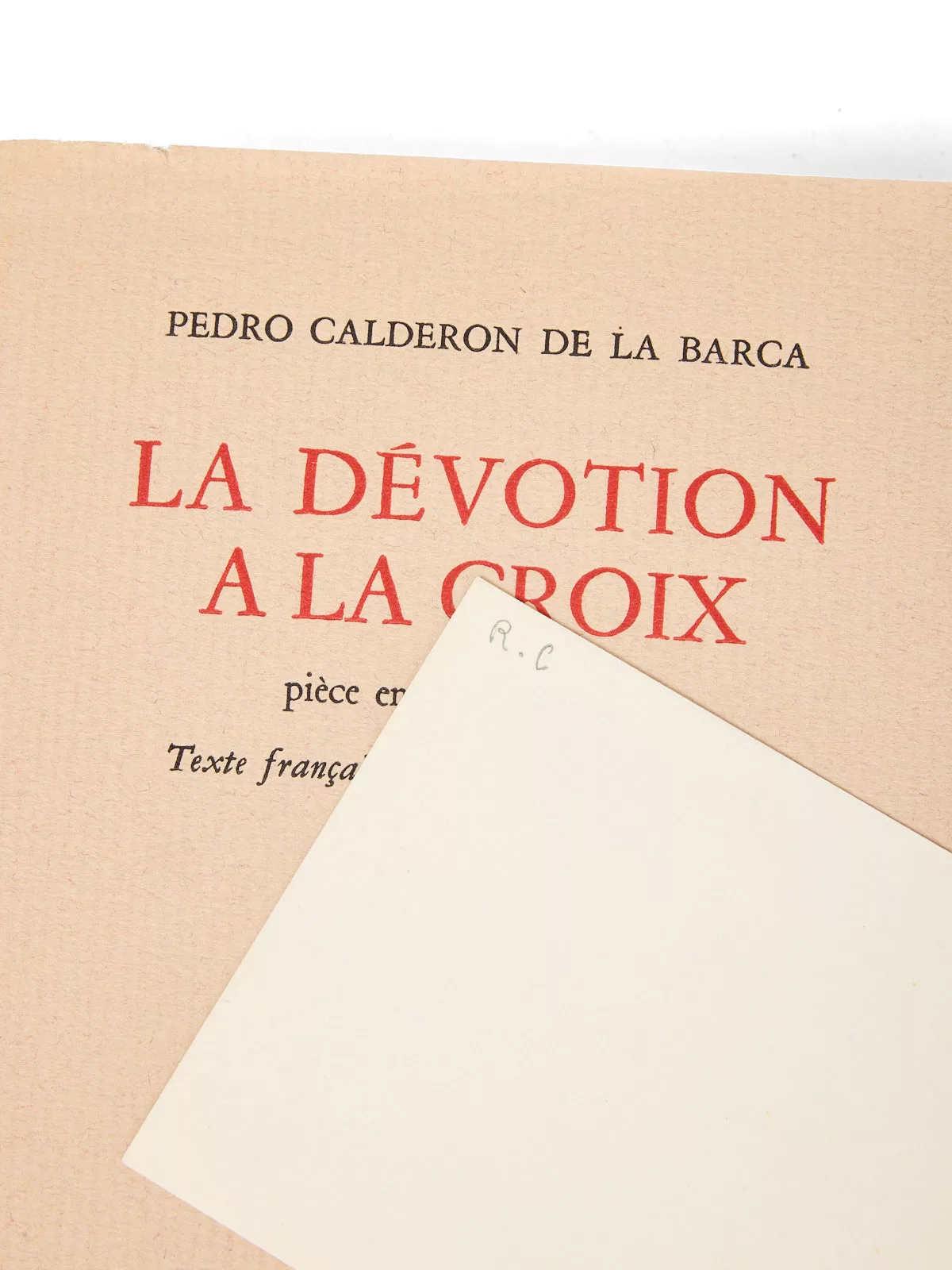
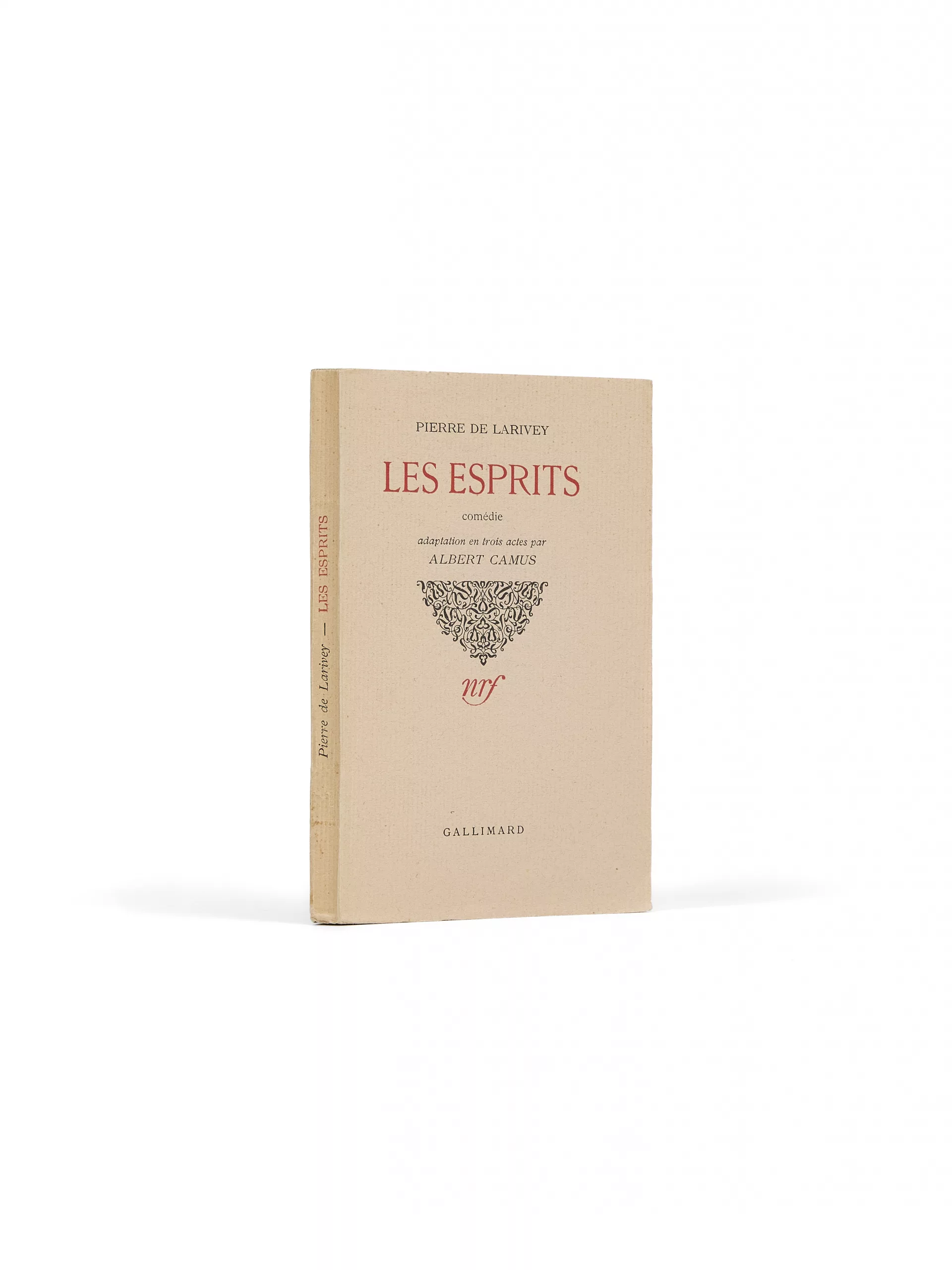
La Dévotion à la Croix. Les Esprits
One of the first 65 copies on vélin pur fil, both copies hors commerce, marked “A.”
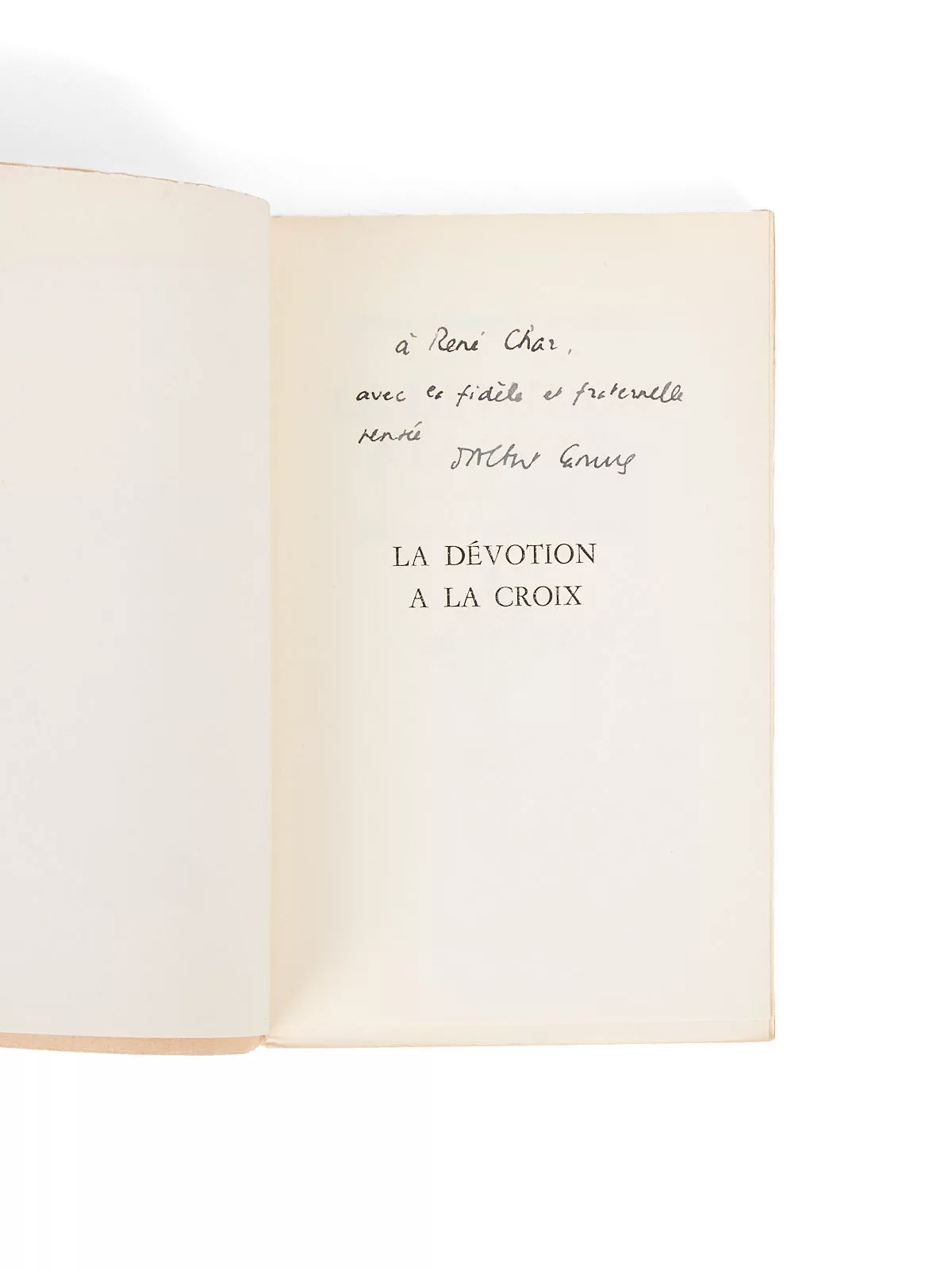
Presentation inscriptions signed by Camus: “à René Char, avec la fidèle et fraternelle pensée d'Albert Camus”; “à René Char, son fraternel ami, de tout cœur, Albert Camus.”
Albert Camus’s involvement with the theater began in earnest in 1936, when he founded the Théâtre du Travail in Algiers with a few friends, in the wake of his brief membership in the French Communist Party; the company was renamed the Théâtre de l’Équipe once he broke with the Party. Why theater? “I no longer remember. Certainly not because of a performance: there were none in Algiers; nor a broadcast, since I had no radio. But the history of the Vieux-Colombier and Copeau’s writings gave me the desire, then the passion, for theater. I placed the Théâtre de l’Équipe, which I founded in Algiers, under the sign of Copeau, and with whatever means we had, took up part of his repertoire. I still believe we owe to Copeau the reform of French theater, and that this debt is inexhaustible.” (Interview for Paris-Théâtre, at the close of the Angers Festival of Dramatic Art, 1957).
In 1953, Marcel Herrand — the man who had first given Camus his chance by staging Le Malentendu at the Théâtre des Mathurins in 1944 — now gravely ill, asked for his help with the Angers theater festival, which he could no longer run alone. Camus agreed to provide him with two adaptations: one of Calderón’s La Dévotion à la croix, and one of Pierre de Larivey’s Les Esprits. Maria Casarès was the star of that year’s festival and took the lead role in both plays, adapted and staged by Camus. Rehearsals took place in the spring at the Théâtre des Mathurins; the festival opened on 14 June with La Dévotion à la Croix, and closed with Les Esprits.
The latter is “an adaptation which Molière was to draw upon extensively for his Avare. We find in it the famous monologue of Harpagon weeping over his stolen strongbox, as well as a miser character already tending toward classical comedy of character. But also, straight from the commedia dell’arte, the buffoonery, the Harlequins, the rogues and the traditional Columbine. Jean Marchat, Maria Casarès, Jacques Amyrian, Paul Œttly and Jean Vincy will play the principal roles, in costumes by Philippe Bonnet.” (Le Monde, 29 May 1953).
Its origin dates back to 1940: Camus finished L’Étranger on 8 May. On the 10th, he published in the journal La Lumière an article entitled “Jean Giraudoux ou Byzance au théâtre,” in which he set out his idea of “great theater,” while Pierre Lazareff brought him onto the staff of Paris-Soir as a layout artist and copy editor. As the paper’s staff fled the advancing German troops, Camus found himself with them in Clermont-Ferrand on 12 June. There he met Gilbert Gil, a young actor who intended to return to Paris and stage works of early theater — a project that was difficult without adaptation. A devotee of Molière, it was Gil who told Camus about Les Esprits; Camus, enthusiastic, decided to adapt the text. He worked on it first in Bordeaux, still with the newspaper staff, then again in Clermont-Ferrand, and finally in Lyon, where he settled on 15 September. There he finished the text, and on 12 November 1940 was able to write to his former companions of the Théâtre de l’Équipe in Algiers, who also wished to resume activity, telling them of his project. In this letter, he described Larivey as a follower of the commedia dell’arte, judging him thus: “An average sort of writer, without genius, but putting into French circulation themes far beyond him… The original text is, naturally, in sixteenth-century French. I have transposed it into modern French. The play has five acts, but five acts in the manner of the period, that is, very short.” Further in his letter to his “dear company,” he described how the play should be performed, giving instructions for the set and costumes: “The play. It is short and has few characters. Only two women, one of them silent, appearing only once. But there are pantomimes indicated. The play should indeed be performed in the style of the commedia.” Camus even enclosed a plan for the set — staging directed from a distance, and so precisely described that the play, following his instructions, was indeed performed in 1946 in Algeria, for popular culture and education associations. This return to theater came through an author Camus admired, and a text he knew through Georges Pillement’s 1946 translation for the “Poésie et théâtre” series — a series Camus himself directed at Éditions Charlot. Camus did not speak Spanish, and so drew heavily on Pillement’s version for his “French text.”
As for La Dévotion à la croix, it belongs to a much older — and more personal — interest: as early as 1936, with Révolte dans les Asturies — his very first publication — and with Le Secret de Ramón Sender (unpublished but performed at the Théâtre du Travail), then in 1937 with Fernando de Rojas’s La Célestine (performed at the Théâtre de l’Équipe), Camus explored Spanish texts. This fidelity runs through his entire body of work: L’État de siège is set in Cadiz, and La Dévotion à la croix, though set in Italy, again allowed him to remain close to this “second homeland” — one also shared by Maria Casarès.
La devoción de la cruz (1633) is a Baroque drama by Pedro Calderón de la Barca, a major figure of the Spanish Golden Age, master of both swashbuckling comedias and religious autos sacramentales. The play raises questions that may have resonated deeply with Camus: as a Christian play, some have seen in it a sign of the author’s growing interest in religion. Yet Camus rejected any hasty interpretation: “If I were translating and staging a Greek tragedy, no one would ask me whether I believe in Zeus.” What interested him, first and foremost, was theater — not a profession of faith. Still, it is undeniable that this play occupies a pivotal place in his stage work. Around the same time, he considered gathering a few major works of the classical Spanish repertoire into a single volume, planning to have renowned writers translate, for the Bibliothèque de la Pléiade, a selection of plays by Tirso de Molina and Calderón. Shortly before his death, as André Malraux was working to entrust him with the direction of a theater, Camus even drew up a program. It included La Dévotion à la croix, Le Chevalier d’Olmedo, L’Alcalde de Zalamea, La vie est un songe, L’Étoile de Séville — but also six plays by Corneille, one by Racine (Bérénice), and Othello, which he had translated but never dared to stage: “As far as theater goes, I’ve only reached my baccalauréat… Shakespeare is the agrégation!”
Camus’s interest in Spain went back to his youth: his maternal grandparents, Étienne Sintès and Catherine Marie Cardona, were both of Minorcan origin. He affirmed this connection in an article published in 1958 in Preuves: “Spanish friends, we share the same blood in part, and I owe your country, its literature, its people and its tradition, a debt that will never be extinguished.”
Marcel Herrand’s proposal was thus quickly accepted: for a Camus who had resigned himself to abandoning original dramatic writing, disappointed by the successive failures of L’État de siège (1948, “a flop”) and the mixed success of Les Justes (1949), these adaptations were the best way to pursue his ambition of creating an ambitious popular theater, faithful to tradition yet open to modern challenges: “When I write my own plays, it is the writer at work… When I adapt, it is the director working according to his idea of theater… I then commission texts, translations or adaptations for myself, which I can then reshape on stage during rehearsals, according to the needs of the production.”
Rehearsals began in the spring and continued until the opening night of La Dévotion à la Croix, on 14 June 1953, with Maria Casarès in the lead role. Three days earlier, on 11 June, Marcel Herrand died. This production thus became a tribute to the man to whom Camus owed so much. Les Esprits was performed two days later, on 16 June.
Camus gave Maria a copy of each volume, inscribed “à Ma Julia” and “à ma Féliciane,” after the names of the leading roles she played in the two plays. But the first copies, lettered A, were reserved for his Friend, his best friend, René Char.
There is little need to dwell further on this fraternal bond. Much has already been said, told and written. Several dozen books exchanged between them, and their correspondence — one of the finest to exist between two authors, who over thirteen years of shared commitment exchanged nearly 200 letters — document and substantiate this unique relationship. Albert Camus sent René Char two manuscripts, and at least 41 of his books: 43 is the number of inscriptions known to date, and these are among the few that had remained unpublished until now.
A magnificent and unique set of the two deluxe copies of the adaptations for the Angers theater — a first milestone, since a second would follow in 1957. There too, Maria Casarès and René Char would take part.
Copies in perfect condition, remarkably fresh.