

La Dévotion à la Croix
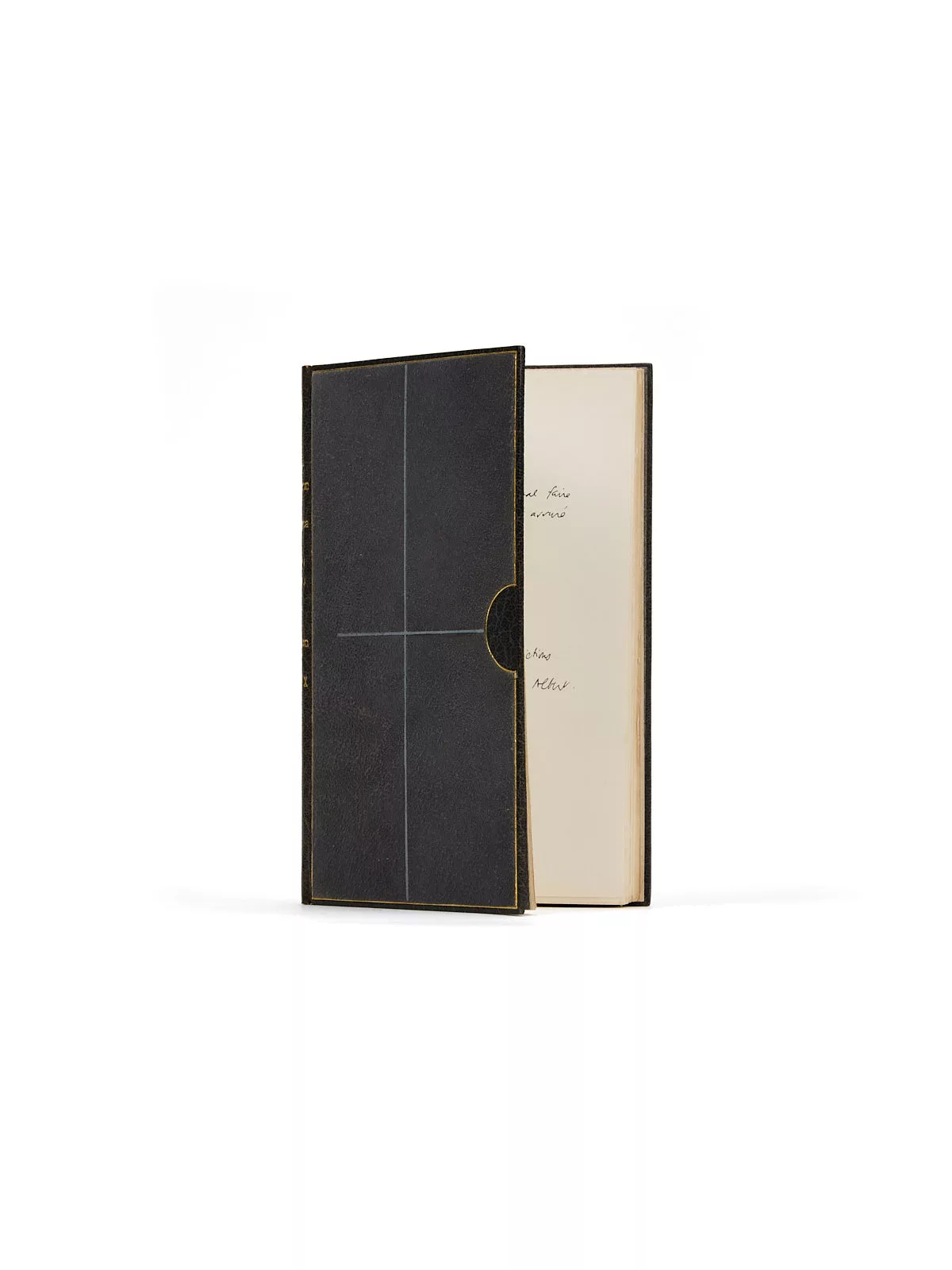
One of 65 copies from the deluxe issue on vélin pur fil, this one hors commerce, marked “E.”
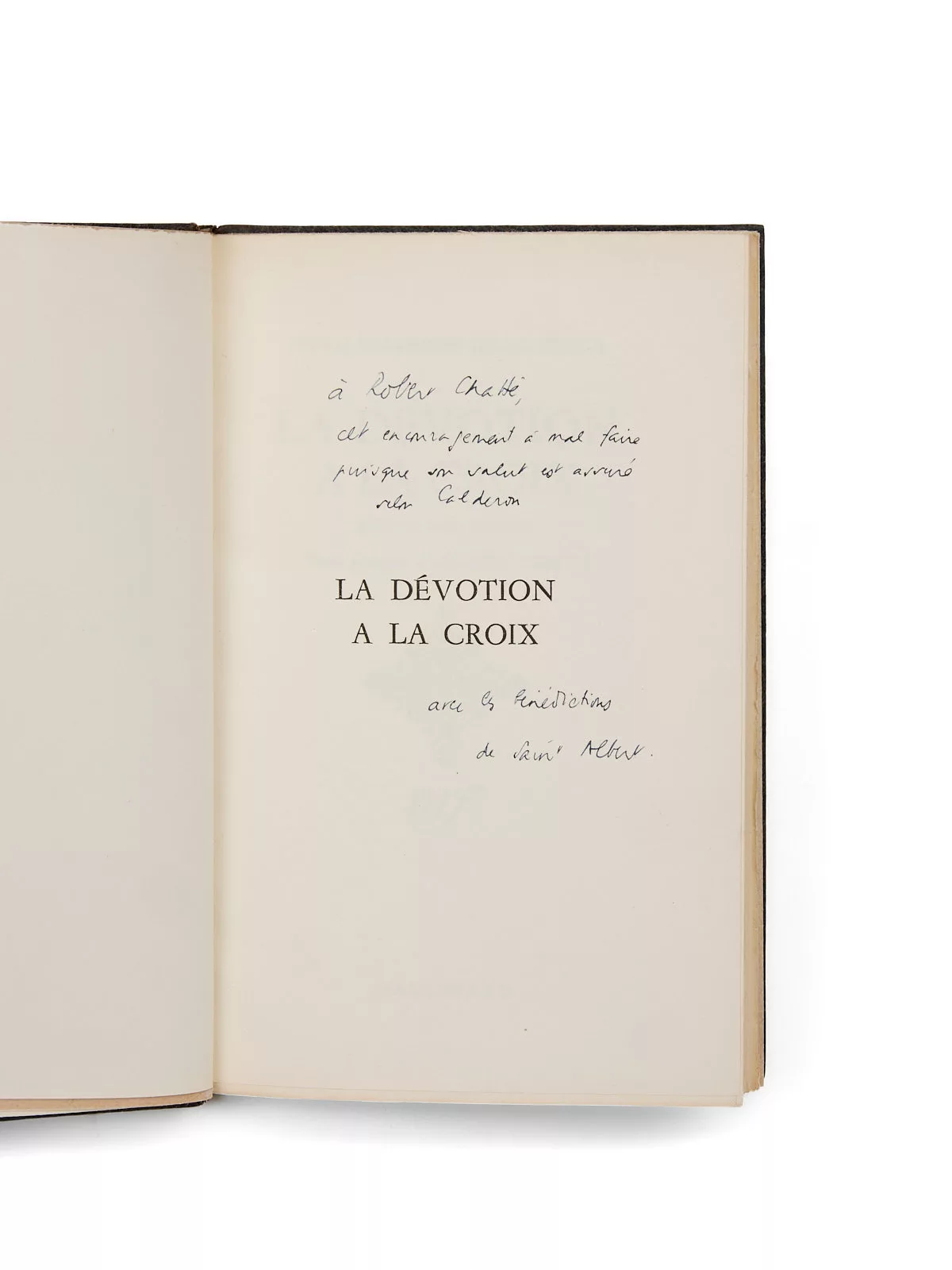
Signed presentation inscription: “à Robert Chatté, cet encouragement à mal faire puisque son salut est assuré selon Calderon, avec les bénédictions de Saint Albert.”
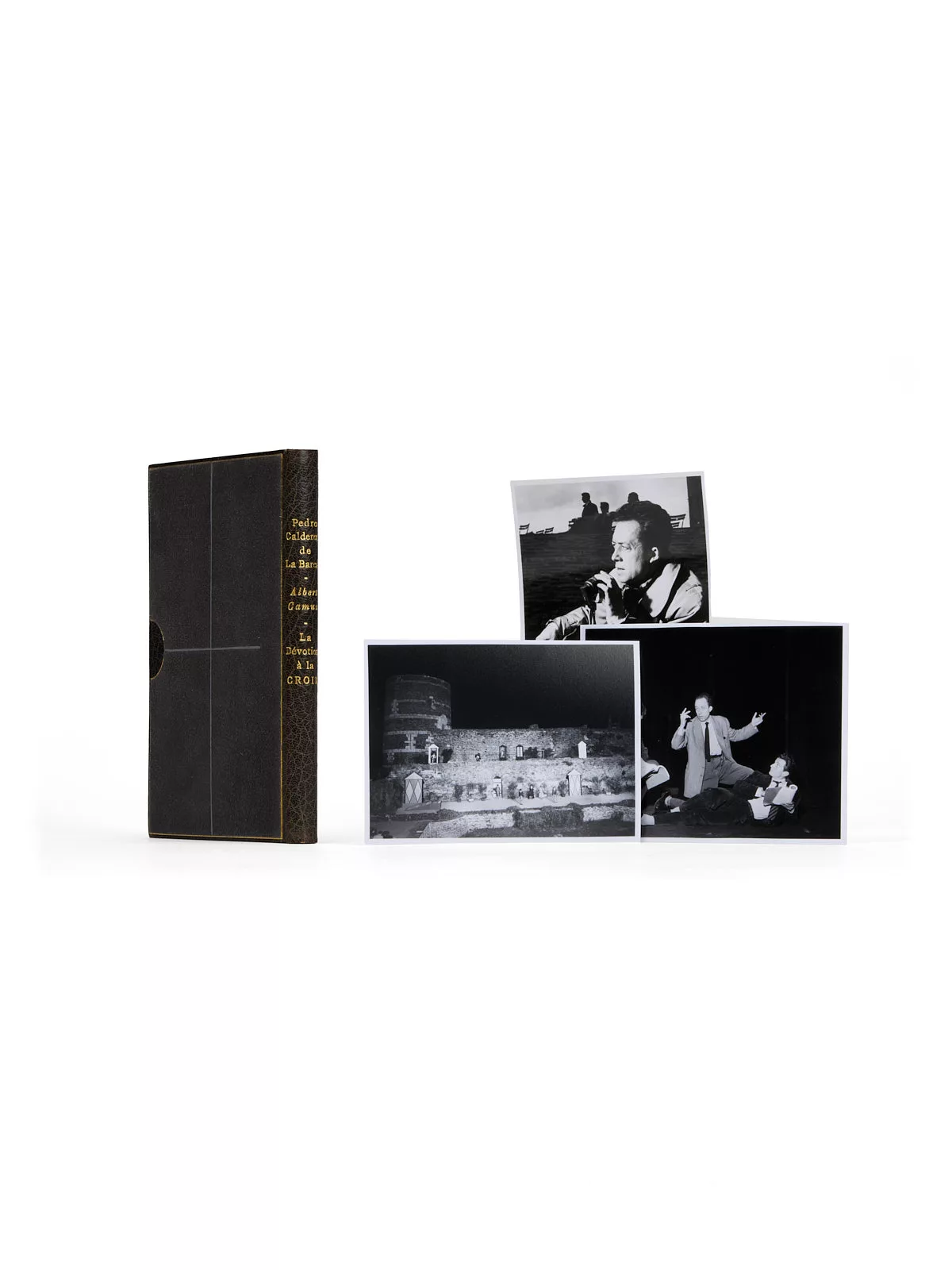
In 1953, Marcel Herrand — who had given Camus his first opportunity by staging Le Malentendu at the Théâtre des Mathurins in 1944 — asked him for help with his Angers theater festival, which he could no longer run alone due to serious illness. Camus agreed to provide two adaptations: one of Calderón’s La Dévotion à la croix, and one of Pierre de Larivey’s Les Esprits. Maria Casarès was the festival’s star that year and took the lead role in both plays, adapted and directed by Camus. Rehearsals took place that spring at the Théâtre des Mathurins; the festival opened on 14 June with La Dévotion à la Croix and closed with Les Esprits.
As early as 1946, Camus had considered gathering major works of the Spanish classical repertoire in a single volume, hoping to have renowned writers translate a selection of plays by Tirso de Molina and Calderón for the Bibliothèque de la Pléiade. Shortly before his death, while André Malraux was working to entrust him with the direction of a theater, Camus even drew up a program. It included La Dévotion à la croix, Le Chevalier d’Olmedo, L’Alcade de Zalamea, La vie est un songe, L’Étoile de Séville — as well as six plays by Corneille, one by Racine (Bérénice), and Othello, which he had translated but never dared to stage: “As for theater, I’m still only at my baccalauréat… Shakespeare is the agrégation!”
La Dévotion à la Croix also connects to a much older and more personal interest: as early as 1936, with Révolte dans les Asturies, Camus was exploring Spanish texts. This attachment runs throughout his work: L’État de siège is set in Cadiz, and La Dévotion à la croix, though set in Italy, allowed him once more to remain close to this “second homeland,” which was also that of Maria Casarès and her maternal grandparents, Étienne Sintès and Catherine Marie Cardona, of Minorcan origin. He affirmed this loyalty in an article published in 1958 in Preuves: “Spanish friends, we are in part of the same blood, and I owe your homeland, its literature and its people, its tradition, a debt that will never be extinguished.”
Rehearsals for the Angers festival began in spring 1953 and continued until opening night on 14 June 1953, with Maria Casarès in the lead role. Three days earlier, on 11 June, Marcel Herrand died. The production thus became a tribute to the man to whom Camus owed so much. Camus gave Maria a copy of each volume, inscribed “à Ma Julia” and “à ma Féliciane,” the names of the leading roles she played in the two plays. The first copy, lettered A, was reserved for René Char.
Our copy — the last of the five hors commerce copies — belonged to Robert Chatté, one of the great figures of the clandestine book trade. Jean-Jacques Pauvert recalls him in his Souvenirs as “the mysterious Montmartre bookseller, […] tall, thin, very well-mannered, with strikingly protruding ears, […] who operated out of an apartment, took extreme precautions, and had access at Gallimard, where he had started as a mere clerk. He would only open his door if a certain signal was used. He had also printed the original edition of Bataille’s Madame Edwarda in 1941.”
His relationship with Camus was early and enduring, until his death on 8 September 1957, which the writer noted in his Carnets: “Death of Robert Chatté. Alone, at the Villejuif hospital.” (III, p. 198).
This copy was included in the centenary exhibition, “Albert Camus de Tipasa à Lourmarin” (no. 155, reproduced).
From the library of Professor Millot (with a note on the back board naming P.-L. Martin).
A very fine copy.