

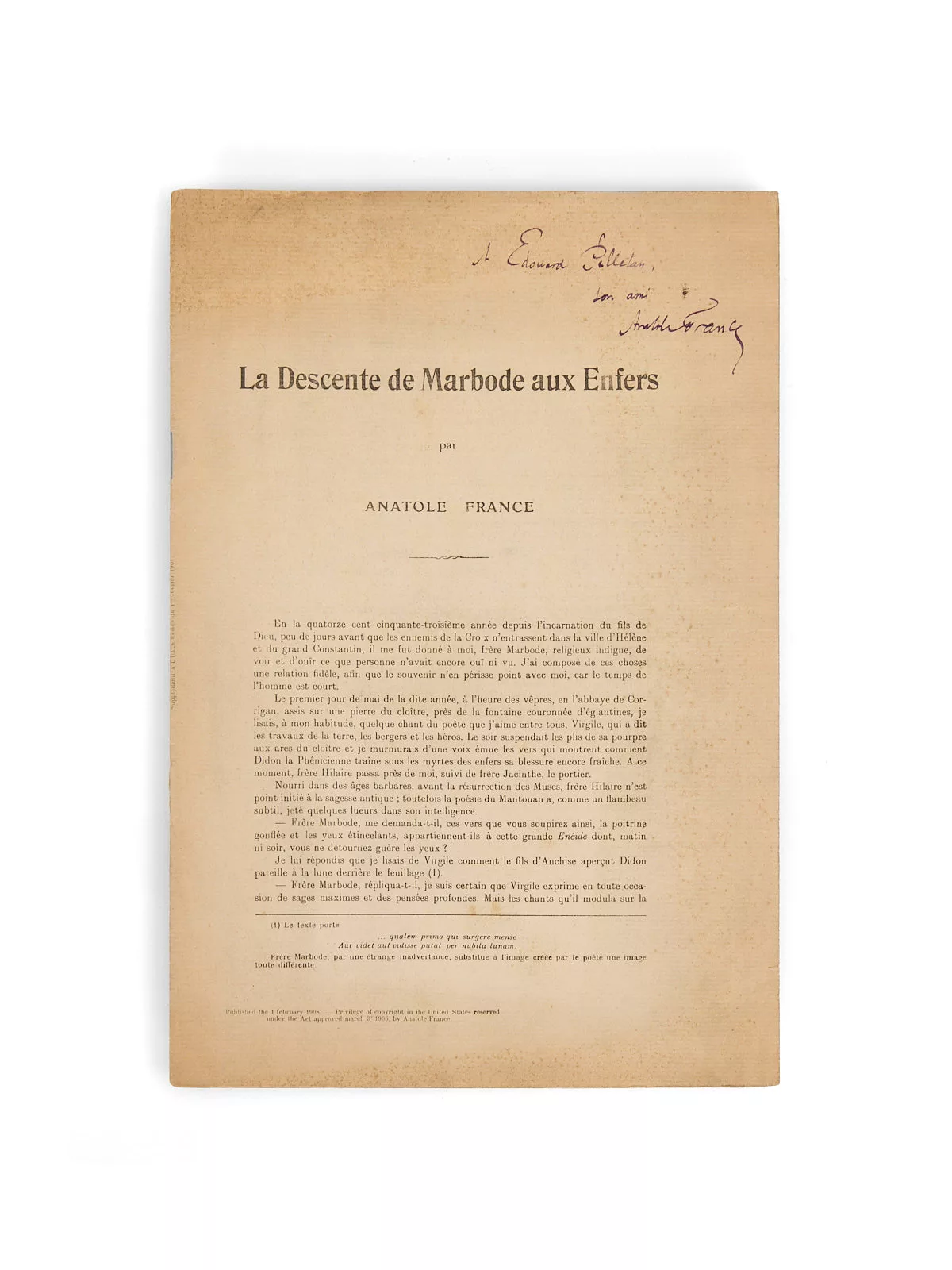
Offprint on laid paper.
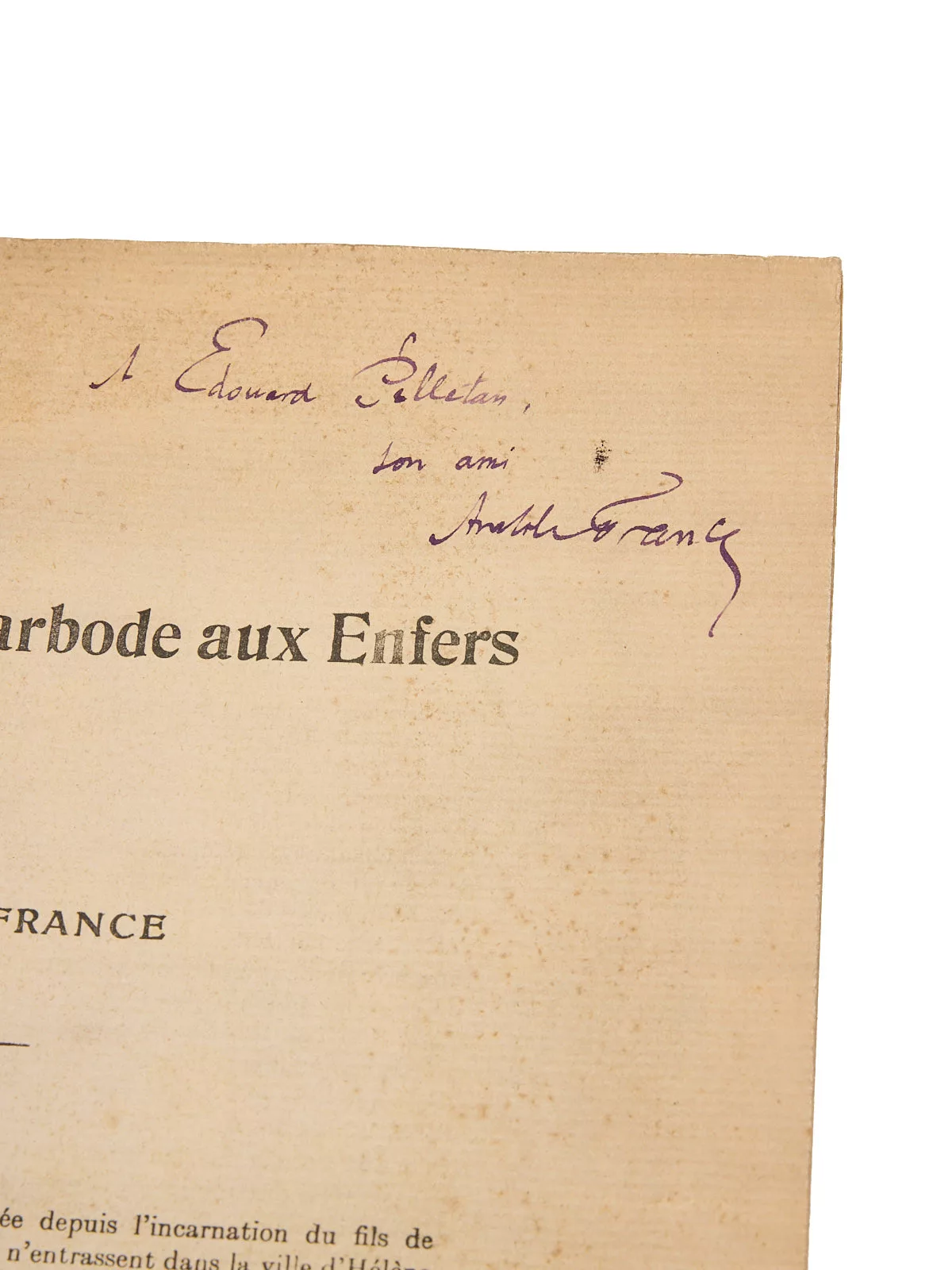
Inscribed and signed: “À Édouard Pelletan, son ami Anatole France.”
L’Île des Pingouins (Penguin Island) is one of Anatole France’s great historical satires. Cast as a mock national chronicle, the novel tells the story of the penguin people from their fabulous origins to modern times. A holy man, Maël, having mistakenly baptized a colony of penguins he had taken for men, God is obliged to transform the birds into human beings. From this initial theological absurdity unfolds an entire history of Penguinia — a parody of France, its founding myths, its institutions, its wars, its clergy, its political passions and its impostures.
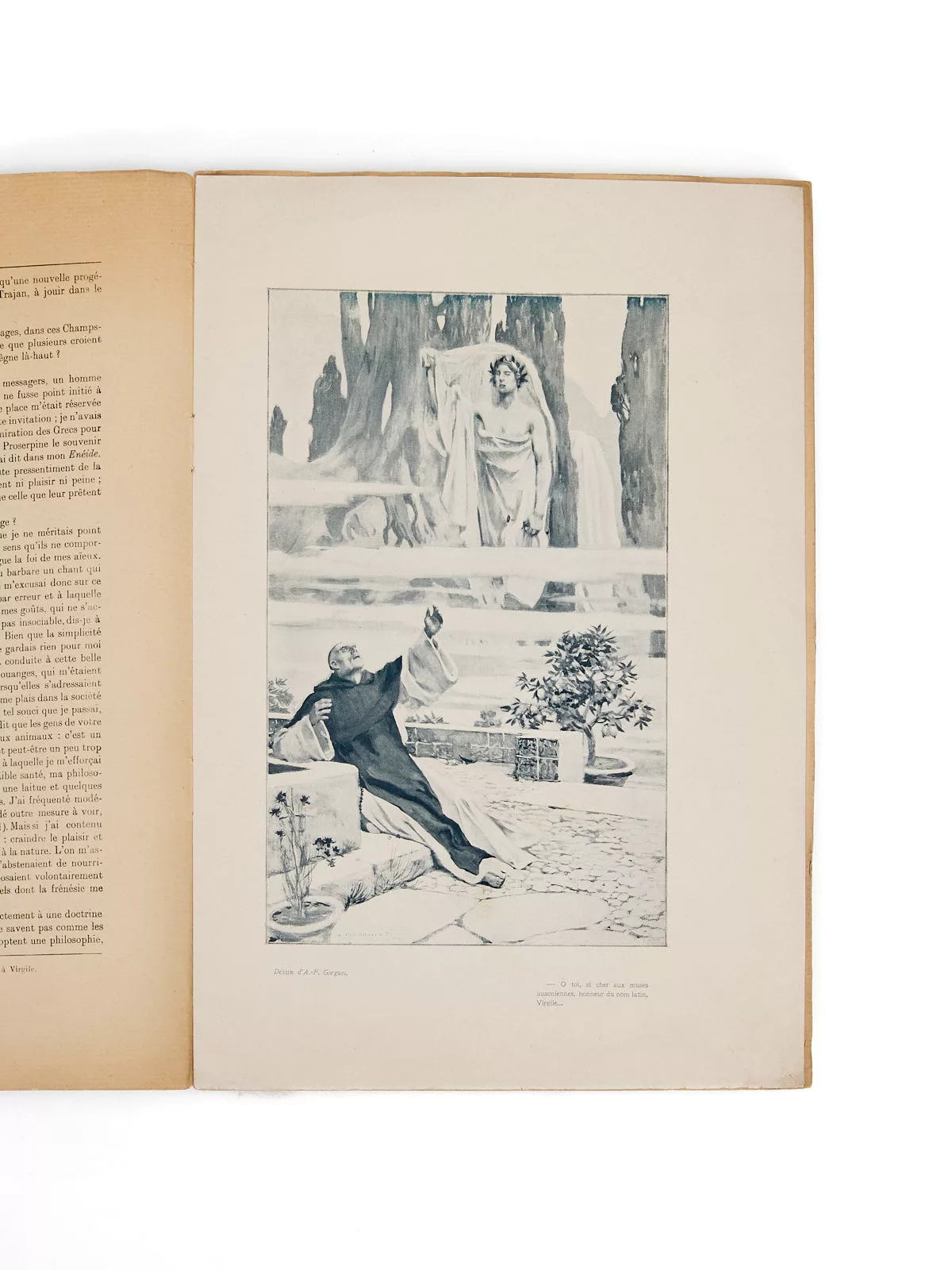
The Marbode chapter belongs to the medieval part of the novel. Anatole France presents it as the supposed French translation of a precious monument of fifteenth-century Penguin literature: the account of a journey to the underworld undertaken by the monk Marbode, a Benedictine steeped in Virgil. Everything is constructed as a scholarly document: the narrator discusses the Latin text, its editor, and its parallels with the Voyage of Saint Brendan, the Vision of Alberic, Saint Patrick’s Purgatory and the Divine Comedy. But this erudition is, of course, a trap: Anatole France imitates historical scholarship in order to expose its seductions, its blind spots and its facile habits.
Marbode descends into the underworld like so many Christian visionaries before him, but his testimony is wrapped in a mischievously suspect critical apparatus, epitomized by the novel’s famous formula: “such is the sad condition of the historian of the penguins, that he cannot avoid one error without falling into another.”
The chapter also stands at the pivotal point of the book: still belonging to the medieval world, it already announces the great modern satire of forgery, rigged dossiers, blind authorities and manufactured truths. Like Sade claiming never “in any way whatsoever to have altered the truth of the facts,” Anatole France plays with the codes of historical narrative to construct a fiction of authenticity, and the historian of the penguins is condemned to produce error with the very instruments of proof.
Published as an offprint supplement to L’Illustration, ahead of the 1908 book edition, this slim ten-page fascicle is extremely rare. It is offered here inscribed to the formidable printer-publisher Édouard Pelletan, for whom Anatole France would publish several titles.
Marginal foxing to the first leaf.