

La Danza macabra europea
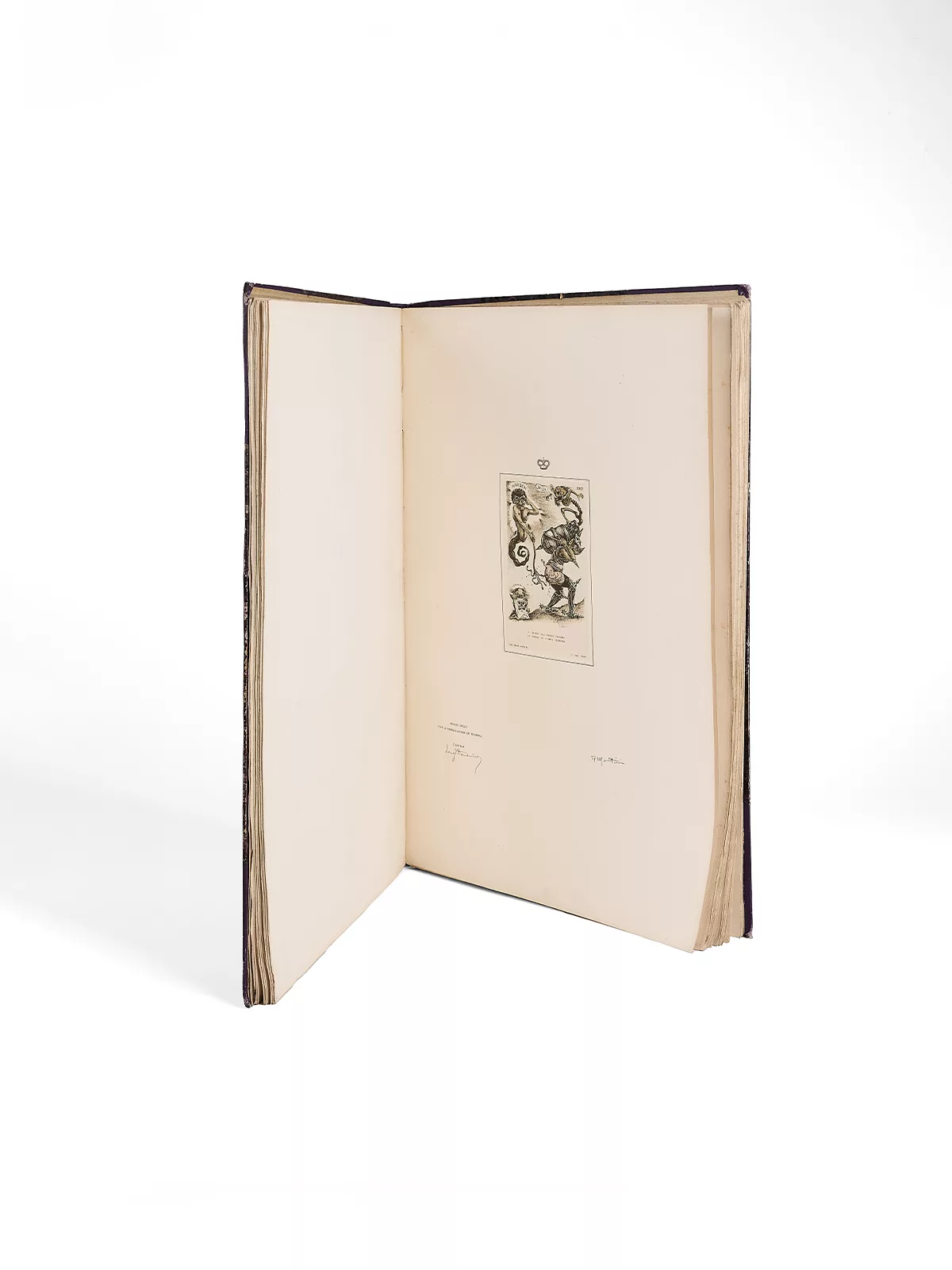
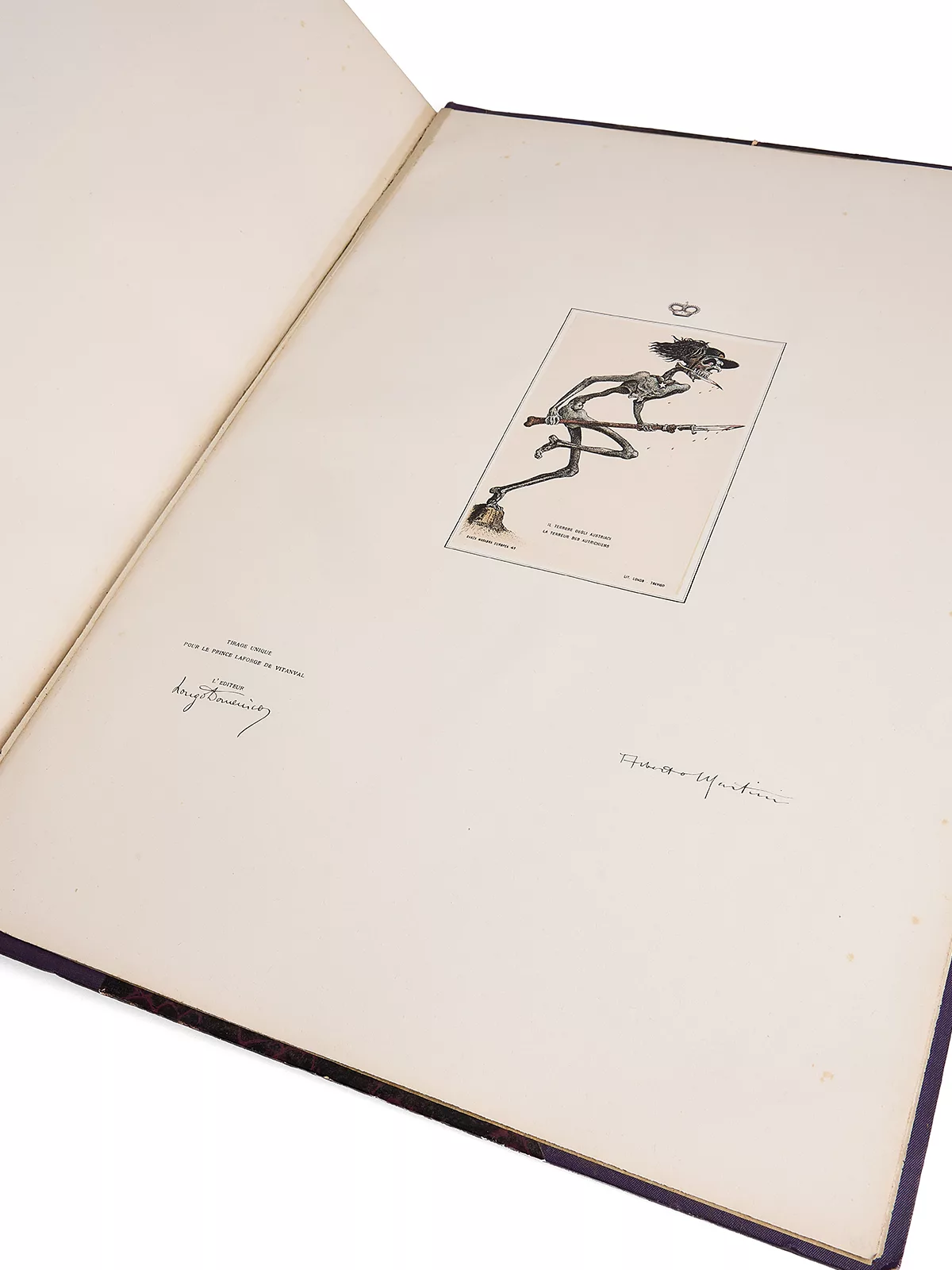
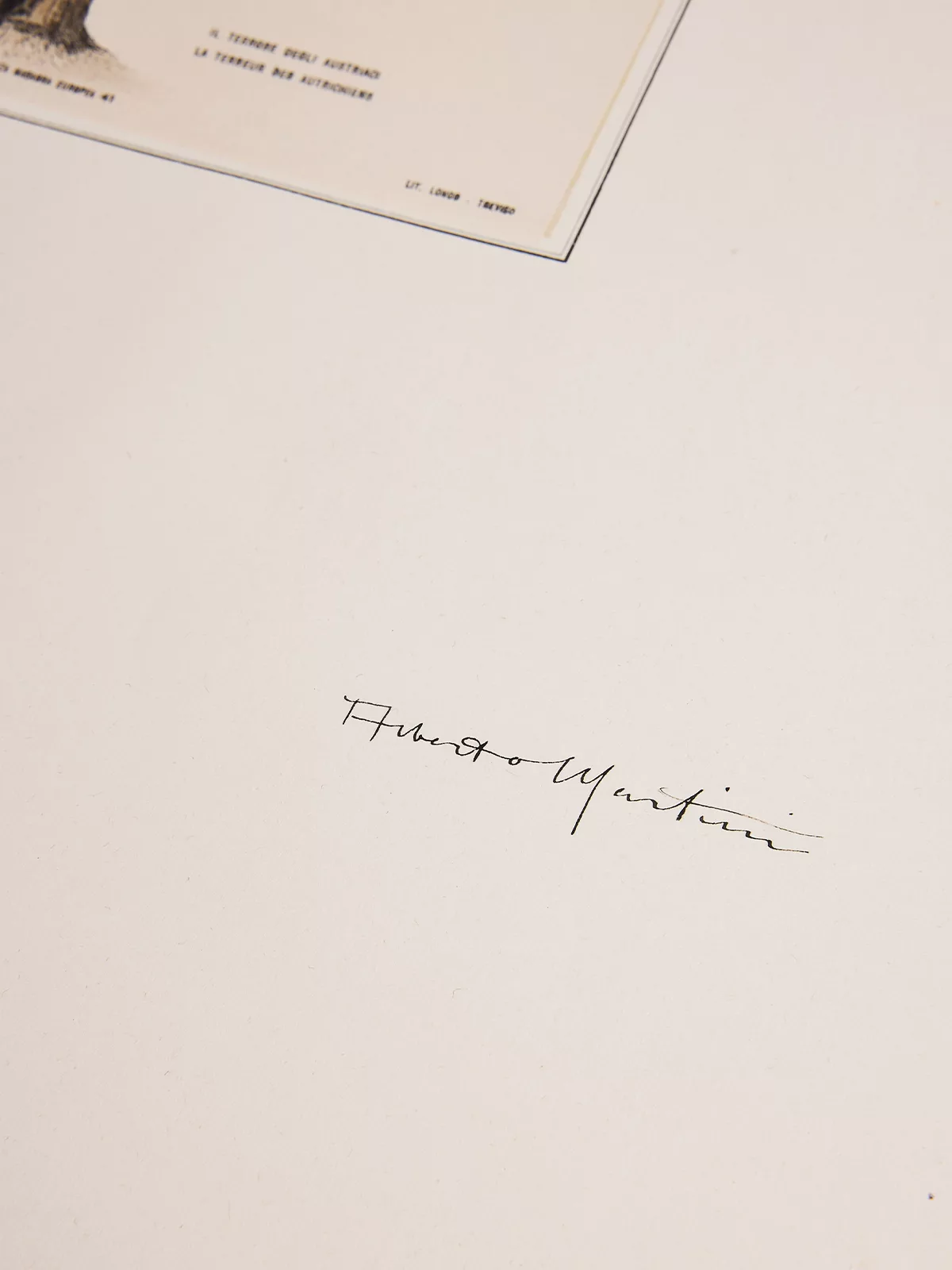
Each of these lithographs, in postcard format (140 x 90 mm), is mounted within a black-fillet frame, surmounted by an imperial crown, on a sheet of pure rag vellum paper watermarked “A. BINDA C. MILAN,” with the printed statement: “Tirage unique pour le Prince Laforge de Vitanval”; each plate is signed in pen by the publisher, Longo Domenico, and by the artist, Alberto Martini.
At the head of each part is a descriptive, annotated notice, captioning and numbering each card, on a leaf interleaved before each series. A title page was specially made for this album.
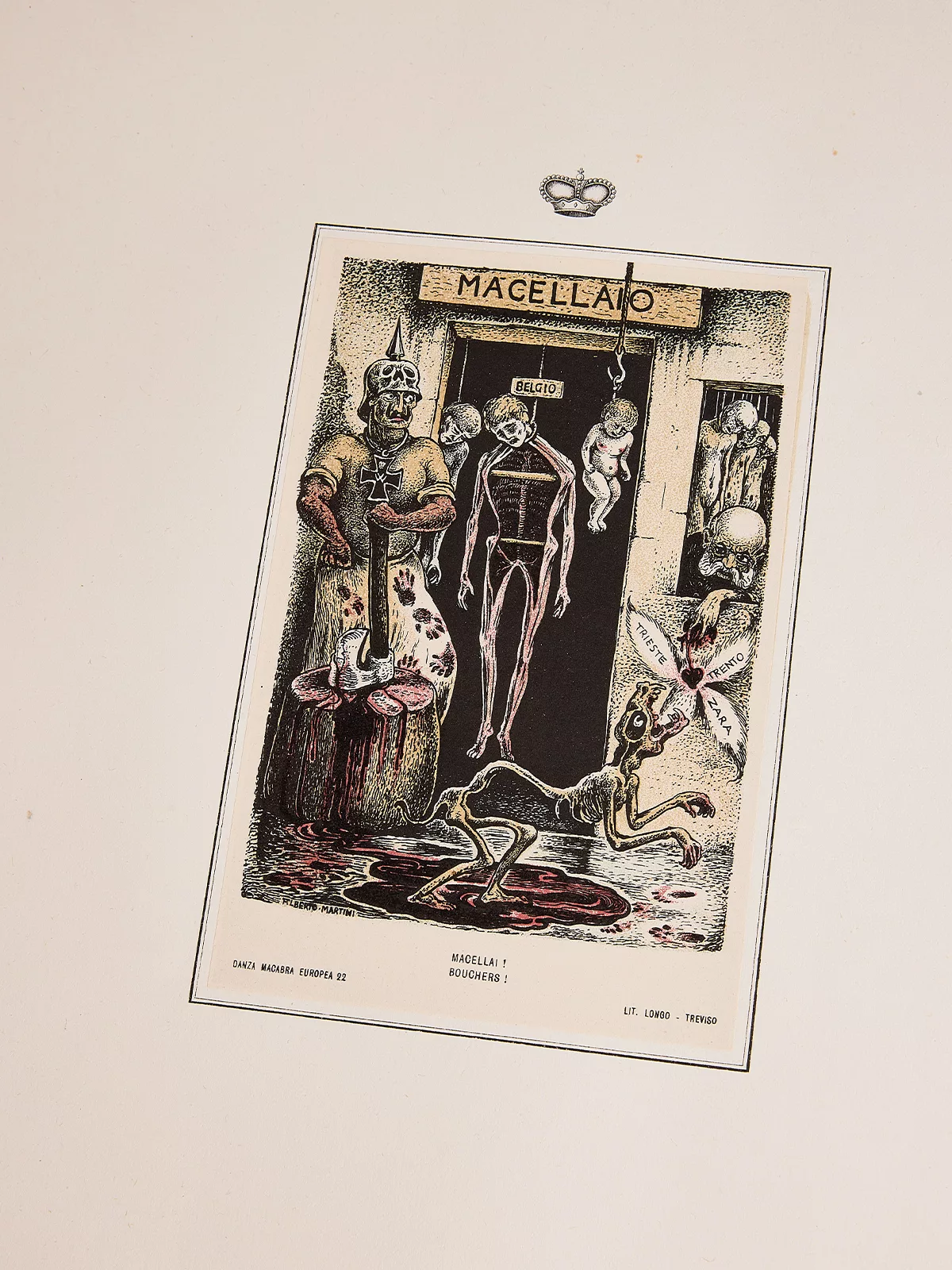
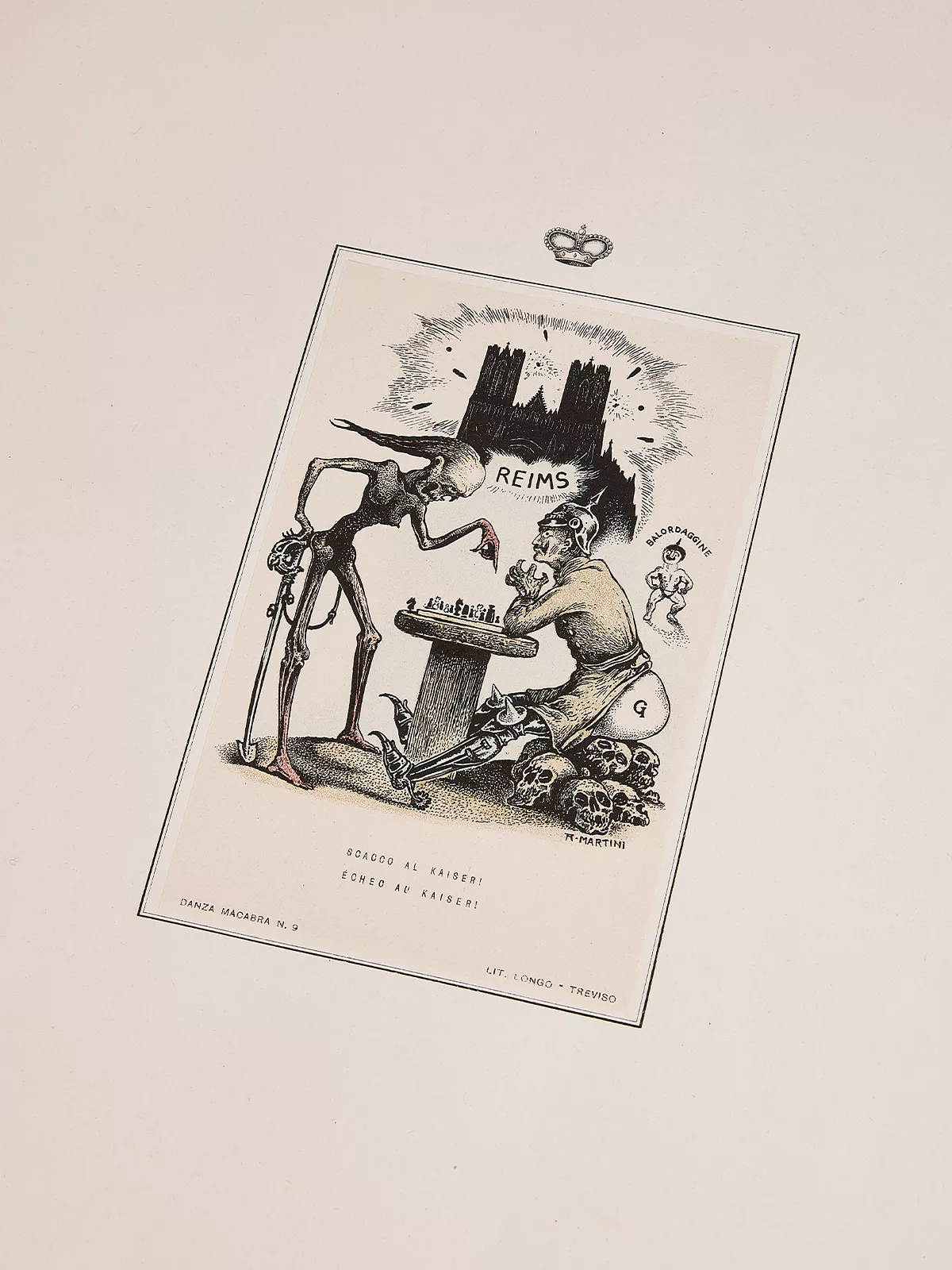
These hallucinatory satirical caricatures are by the Italian artist and illustrator Alberto Martini (1876–1954), who in 1915 produced a series of Allied propaganda postcards inspired by the medieval “dance of death.”
Artists in every country involved in the conflict devoted themselves to glorifying their homeland and mocking and dehumanizing enemy troops, depicting them as butchers and deformed, grotesque rapists. It was in this context that Martini conceived and produced the postcard series Danza Macabra Europea with the Treviso publisher Longo. Published between October 1914 and the early months of 1916, the project was initially planned as 36 pen lithographs which, given their success, were divided into three series of twelve postcards, followed by a fourth series of only six. The series were sold in envelopes with an explanatory leaflet inside and captions in Italian and French on the front.
The success of the lithographs prompted the publisher to print two further series in August 1915, but with captions in Italian only.
Alberto Martini, a painter and lithographic engraver, is regarded as a precursor of Surrealism. He mixed with members of the movement and lived in Paris from 1928 onward. He produced portraits of André Breton, Francis Picabia, Max Ernst and Miró, among others. An excellent caricaturist, Martini here excoriates the inhumanity of war through surreal attacks on the Austro-Hungarian Empire. The series proved so successful that the print run eventually reached 450,000 copies.
A unique copy, specially composed for “Le Prince Laforge de Vitantval.”
It contains all four series, complete, printed between October 1914 and February 1915: Martini’s drawings are reproduced as lithographs and mounted on a sheet of vellum paper bearing a printed limitation statement and, on each plate, the artist’s signature.
Born Léon Laforge in Honfleur in 1873, this self-styled nobleman, son of the director of the town’s sugar refinery, moved in the well-off circles of the region. A skilled talker, he left Normandy for Paris, where he invented for himself the life of a prince.
Learned and keenly interested in science (he claimed to have invented an aerobrake for military aircraft and a rifle bayonet), he authored several books of history (including a Mac-Mahon, chevalier sans peur et sans reproche, published by Mame in 1890) and literature (signing his poems “Babilas de La Briche à Retors”), before adorning himself with titles, distinctions and honors. He created the order of the “Avocats de Saint Pierre” and the “Palmes académiques du Saint Siège,” and, having apparently obtained the blessing of Pope Leo XIII, founded the princely Order of the “Chevaliers de Saint Léon.” A veritable chameleon, he assumed every possible costume and was arrested several times for illegally wearing military uniforms. In 1901, several defrauded and humorless aristocrats, suspecting the imposture, had him arrested: he was sentenced to six months in prison for illegally wearing decorations and for fraud (he charged dearly for trinkets, diplomas and honorific ribbons). Once released, he traveled through Northern Europe, Italy and Spain, resumed his titles, seduced numerous countesses, and devised subtle military-engineering swindles backed by fake printed brochures, in order to obtain public or private funds.
The Italian publisher Domenico Longo, publisher of Martini’s cards, fell under the Prince’s spell and agreed to publish for him a booklet on one of his “inventions,” the great combat aircraft Vitanval. In business with this eccentric figure, he produced for him this unique, lavishly composed album, crowning each lithograph with the “imperial crown of Vitanval.”
After the war, the Prince proclaimed himself King of Transcaucasia under the name Louis I, informing the great powers and requesting the admission of his kingdom to the League of Nations. The court of Nice sent him back to prison once again for identity fraud. It is not known whether his days ended in an asylum or in prison…
An extraordinary and unique gathering of the first 42 series, complete, in double state (color and black), all captioned and signed by the artist.