

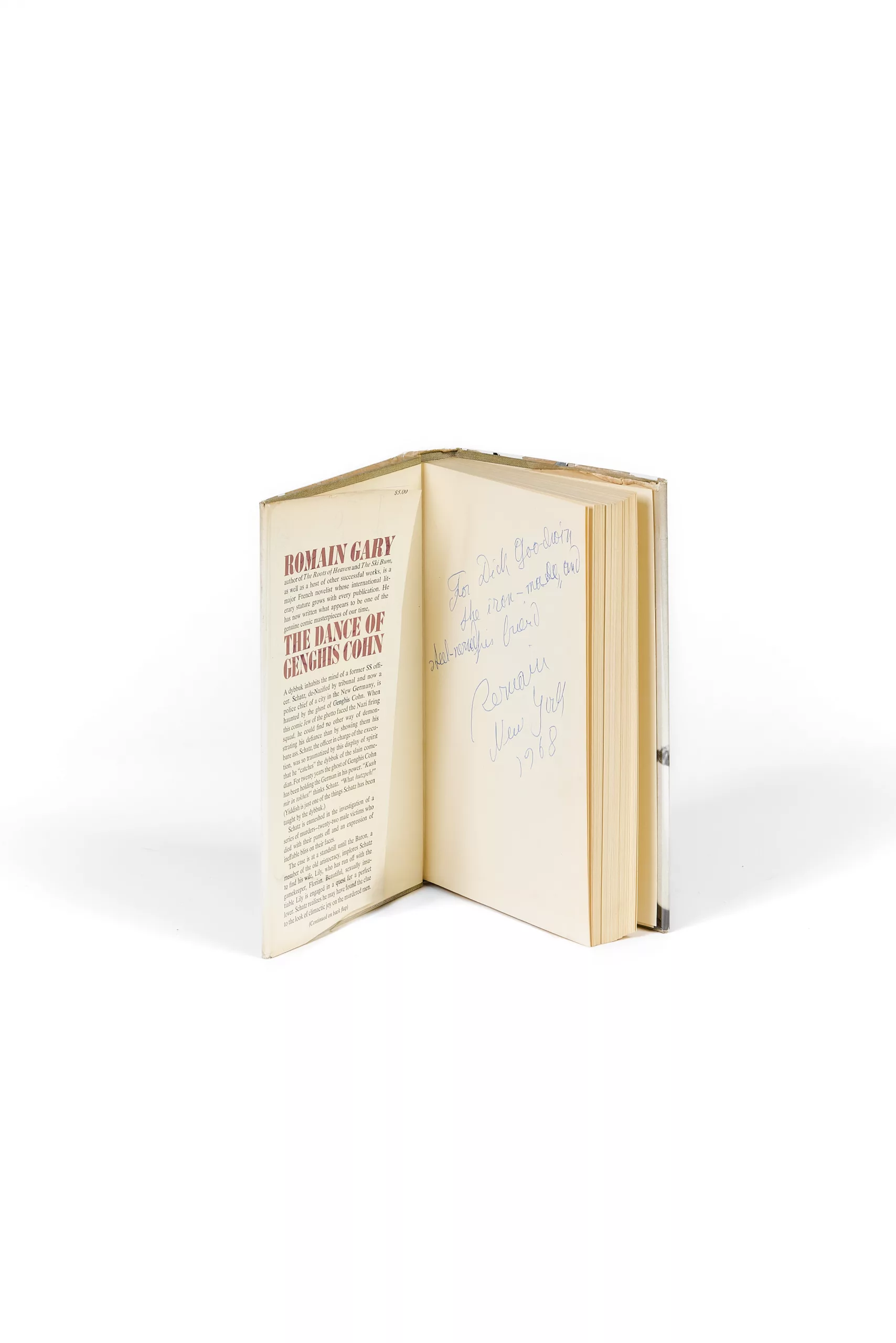
La Danse de Gengis Cohn
Signed presentation inscription: “To Dick Goodwin, the iron-made, and steel-nerved, his friend, Romain, New York, 1968.”
In 1958, Richard Naradof Goodwin worked as special counsel to the Legislative Oversight Subcommittee of the U.S. House of Representatives, which investigated the television quiz show Twenty One on suspicion that it was rigged. After an initial dismissal, Goodwin single-handedly revived the investigation, which led to admissions that the show had indeed been fixed, triggering a major scandal. Goodwin’s autobiography, published thirty years later, formed the basis for Robert Redford’s 1994 film Quiz Show, starring John Turturro, Ralph Fiennes and Rob Morrow as “Dick” Goodwin.
His tenacity caught the attention of Senator John Kennedy, who brought him onto his Senate staff and, once elected as the 35th President of the United States, assigned him to special affairs at the State Department, specifically in charge of Latin America. Goodwin became a close presidential adviser on the subject and one of the foremost experts on Che Guevara, whom he met in 1961. He later served as a speechwriter for Kennedy and then for his successor, Lyndon Johnson, from 1963 to 1965.
He left public service in 1965, returning briefly in 1968 to write speeches for three presidential candidates: Robert F. Kennedy, Eugene McCarthy (eliminated at the Democratic Convention) and Edmund Muskie (future Vice President). But after the assassination of Robert Kennedy on June 5, 1968, Goodwin, too affected to continue, withdrew permanently from politics. It should be noted that Romain Gary had met Senator Kennedy fifteen days before his assassination. It was almost certainly during this campaign that Gary sent him this volume, a pointed tribute to his tenacity, “iron-made and steel-nerved.”
La Danse de Gengis Cohn is the second volume of the “Frère Océan” trilogy, following Pour Sganarelle and preceding La Tête coupable. Only one film adaptation was made, an American production of 1983 featuring Robert Lindsay, Diana Rigg and, in his very first screen appearance, a young British actor named Daniel Craig. Here Gary tackles the Shoah for the first time, in a burlesque register, ridiculing the officer Schatz, an SS man haunted by the spirit of the Jew Gengis Cohn whose execution he had ordered. “Humor has been my fraternal companion all along the way: I owe it my only true moments of triumph over adversity.” Beneath the comedy lay a painful experience that left Gary feeling he would “never be the same,” as he confided shortly afterward: “During a trip to Warsaw, I visited the museum of the uprising. I knew everything about the murder of six million Jews […]. But although I often spoke of my Jewish origins, deep down I did not feel Jewish, despite my attachment to my mother’s memory. Yet standing before the section of the museum devoted to the Ghetto revolt, I suddenly collapsed and remained unconscious for twenty minutes. Perhaps I had not realized how heavily this immense, massive absence — that of the Jews — had weighed on me, in the very city where I had been raised. At that moment, I felt more than Jewish.” (interview with Jelenski, Livres de France, March 1967).
A precious and remarkable provenance.