

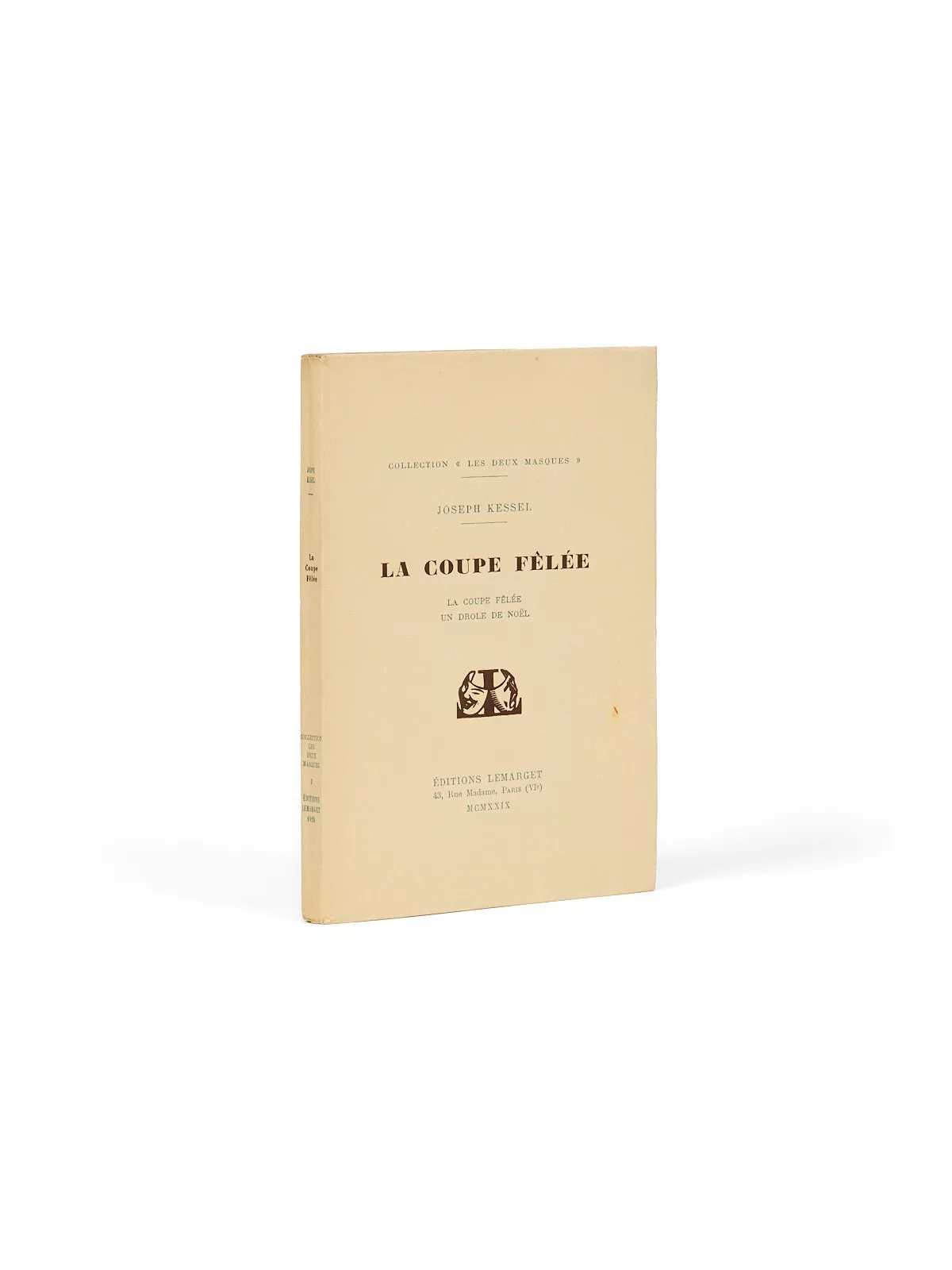
La Coupe fêlée
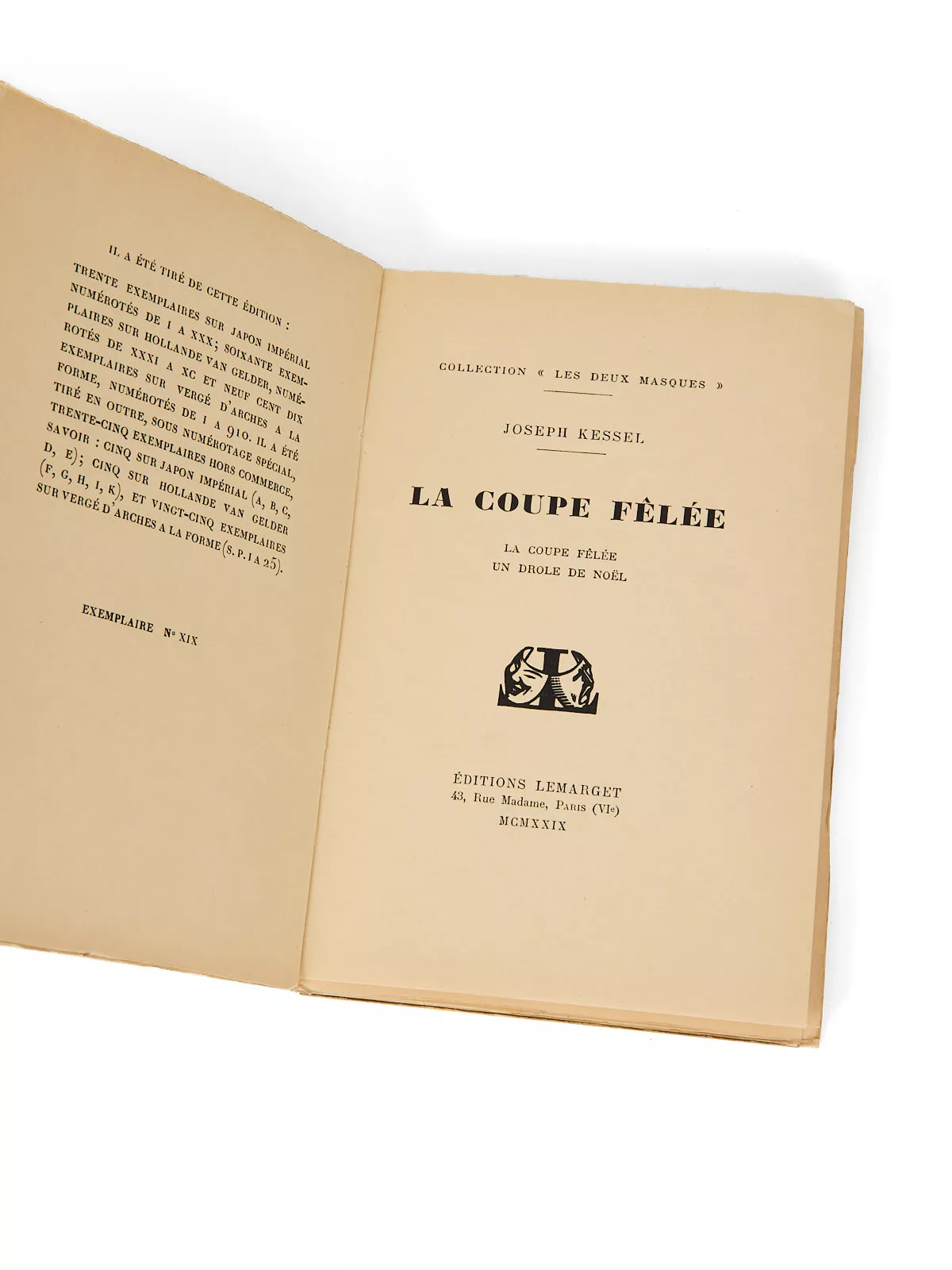
One of 30 copies on Imperial Japan paper, this copy no. XIX.
When he was not off adventuring abroad, Joseph Kessel still nursed an inexhaustible thirst for adventure and a longing to live outside the ordinary. Pigalle was where he satisfied it. There he spent his nights, boisterous but literarily fruitful, between “le Caveau caucasien,” his favorite gypsy cabaret, run by and frequented by Russian émigrés in Paris, and “Chez Nine,” an underworld restaurant where crooks, lawyers and politicians mixed freely. In both places he counted only friends among the déclassé heroes who told him their tragic or dramatic stories. Jef drew La Coupe fêlée from the extraordinary career of la Davidova, a voice of brass and bronze, whose path led from Moscow glory to Parisian mediocrity, from her marriage to an obscure and immensely wealthy general-count — later found working as a taxi driver — to running a small boarding house for émigrés without a future. As for Un Drôle de Noël, it consists of the moving and troubled confessions of a big-hearted crook, Gros Albert, alias Albert Aflalo.
“At that time, I spent my nights with the Russians of Montmartre… Amid an artificial people fueled by alcohol, light, exhaustion and misfortune, I forgot even my own existence…” More than a return to his Russian memories, this is also an occasion for Kessel to revisit the horrors of triumphant Bolshevism, through the touching story of Vera Petrovna, a gypsy bar singer whose life was shattered by the arbitrary arrest of her husband, who died in prison. This “cracked cup,” a symbol of an exiled community finding in the world of night and music the sustenance needed to keep the “Russian soul” alive, is also a moving tribute to the world of cabaret song; Kessel, passionate about music and the atmosphere of basement piano bars, was the companion of Germaine Sablon, who clearly inspired much of the character of Vera.
Before being published in book form, these stories fed into Kessel’s latest publishing venture: Détective, a crime weekly, the first of its kind, which he had just launched with the help of Maître Maurice Garçon and funding from Gaston Gallimard.