

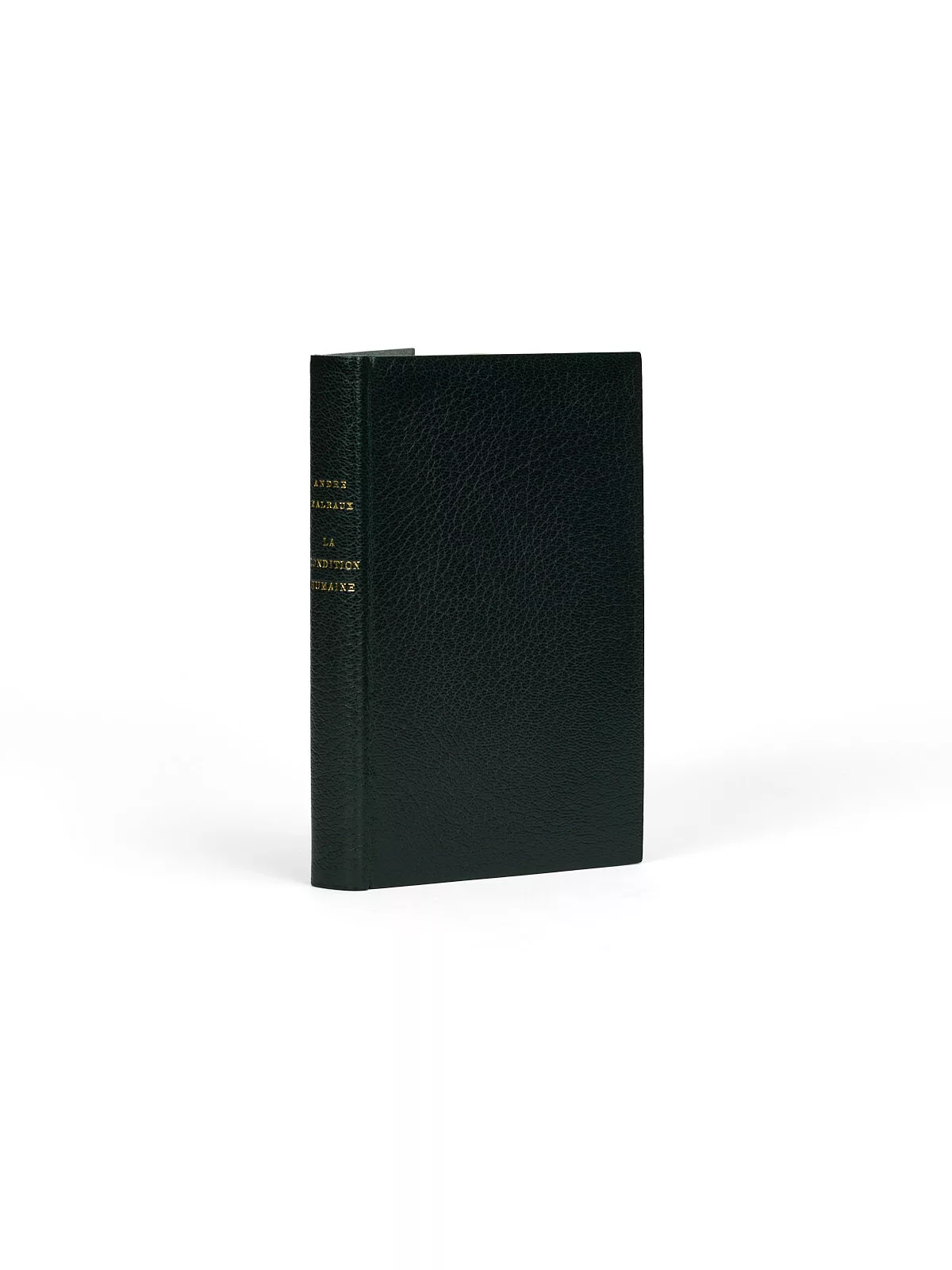
La Condition humaine
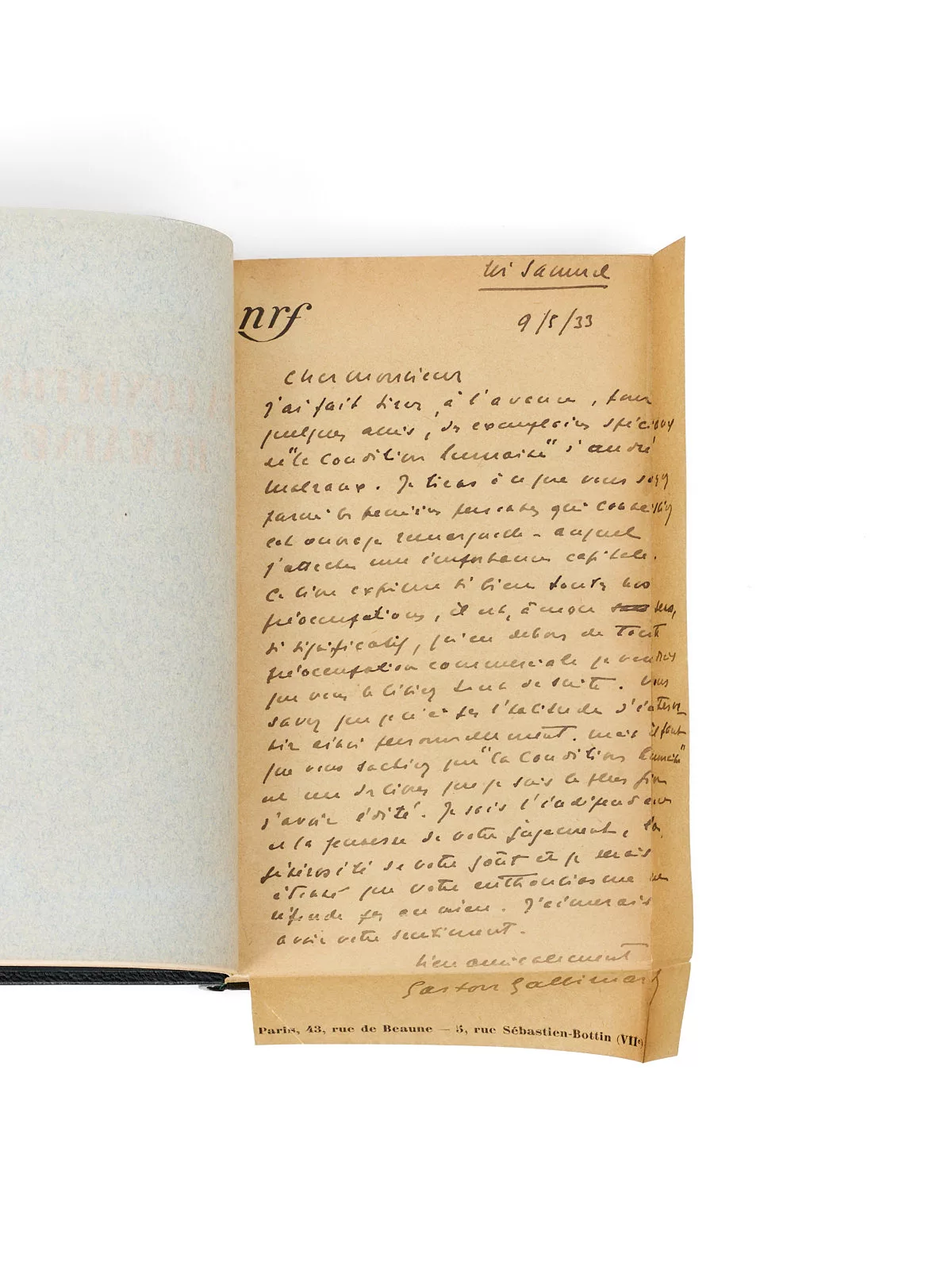
It contains, bound in at front, an important letter from Gaston Gallimard explaining the origin of this wholly particular issue.
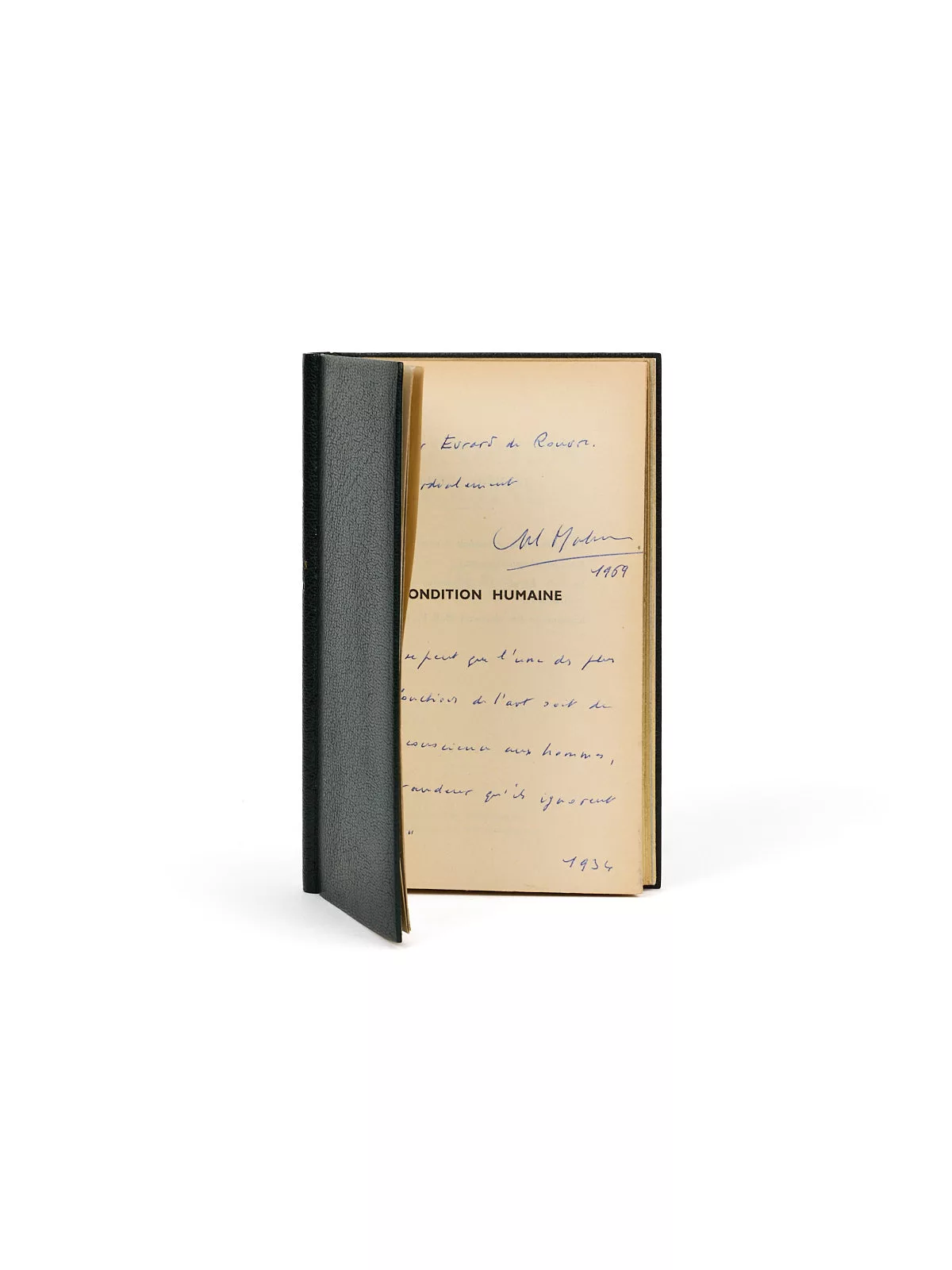
Signed presentation inscription: “Pour Monsieur Evrard de Rouvre, bien cordialement André Malraux, 1969,” with an autograph note following: “… il se peut que l'une des plus hautes fonctions de l'art soit de donner conscience aux hommes de la grandeur qu'ils ignorent en eux. 1934.”
Evrard de Rouvre, a film producer and screenwriter, was above all a celebrated Parisian antique dealer who welcomed connoisseurs, the curious and great collectors to his gallery, Présence des arts, at 38 avenue Pierre Ier de Serbie. A man of letters and friend to several Surrealist artists, he also founded the Éditions Vrille, whose first number, La Peinture et la littérature libres, illustrated by Oscar Dominguez and published in 1945, brought together texts and works by Georges Bataille, Henri Michaux, Max Ernst, Pablo Picasso, Salvador Dalí and others. In the second half of the twentieth century he undertook a series of journeys, principally to Iran, Mexico, Peru and several African countries. It was during these years that he had this copy inscribed by André Malraux, then Minister of Cultural Affairs, though the two men had probably known each other for much longer: de Rouvre’s contacts with the Surrealist writers and the publishing world date back to the immediate postwar period.
A precious copy: it contains, bound in at front, an important autograph letter from Gaston Gallimard (1 page, 125 x 210 mm, on NRF letterhead), dated 9 May 1933, only a few days after the printing of the volumes of La Condition humaine: “Cher Monsieur, j’ai fait hier à l’avance, pour quelques amis, des exemplaires spéciaux de La Condition humaine d’André Malraux. Je tiens à ce que vous soyez parmi les premières personnes qui connaissiez cet ouvrage remarquable auquel j’attache une importance capitale. Ce livre exprime si bien toutes nos préoccupations, il est, à mon sens, si significatif, qu’en dehors de toutes préoccupations commerciales je voudrais que vous le lisiez tout de suite. Vous savez que je n’ai pas l’habitude d’intervenir ainsi personnellement mais il faut que vous sachiez que La Condition humaine est un des livres que je suis le plus fier d’avoir édité. Je sais la justesse de votre jugement, la générosité de votre goût et je serais étonné que votre enthousiasme ne réponde pas au mien. J’aimerais avoir votre avis sincèrement. Bien amicalement, Gaston Gallimard.”
These few “special copies” are the ones bound in a wholly distinct and unique gray wrapper, illustrated with a woodcut depicting a skull from whose eyes emerge two burning torches. The design was almost certainly created by Démétrius Galanis (1882–1966), whose drawing and lines closely resemble the logo he had created a few years earlier, at Malraux’s request, for the vignettes of the “Du monde entier” series. It is probably for this reason, and because of the NRF director’s affection for both men — who had known each other for nearly fifteen years — that Gallimard commissioned this special issue. How many copies were made is not specified in the letter and will probably remain unknown.
Only four other copies are known to date, all in wrappers:
– a copy inscribed to the Marquise de Crussol (Catalogue du centenaire Gallimard, 2011, no. 242, offered by our colleagues Henri Vignes, Les Libraires Associés and Jean-Étienne Huret; subsequently Librairie Walden, 2021);
– a copy inscribed to Janine Bouissounouse (Alde, 2023);
– a copy inscribed to Emmanuel Boudot-Lamotte (Librairie Yvinec, 2023);
– a copy without inscription (Librairie Faustroll, 2021).
The friendship between Malraux and Galanis dates back to 1919, when the young Malraux visited the painter’s studio in Montmartre. Malraux’s first piece of art criticism, published in 1922, was written as the preface to the catalogue of an exhibition of the Greek painter’s work — a foundational friendship that would lead to a fruitful collaboration. Throughout his editorial ventures, both on behalf of Simon Kra and on his own account (with his childhood friend Louis Chevasson, founding “À la sphère,” later “Les Aldes”), Malraux repeatedly called on Galanis to illustrate books, notably those of Georges Gabory, Paul Morand and Albert Samain. After La Tentation de l’Occident in 1926, Malraux left Grasset for good to join Gallimard, where, already a “house” author since Royaume-farfelu, he now also served as a member of the reading committee and, above all, as artistic director. He brought Galanis with him, who produced his first work for the house the following year: sixty-five etchings illustrating Le Grand Meaulnes, followed in 1930 by André Gide’s Les Nourritures terrestres.
A year before the launch of Gallimard’s foreign-authors series, “Du monde entier,” for which Malraux entrusted Galanis with designing the cover vignette — the series being intended to “bring together some of the best foreign novels, presented by well-known French writers whose authority would guarantee readers, among the considerable number of translations from every language, a certain literary quality.” The design created for the series was used, without exception, as the central cover ornament for every title until 1961, when it was replaced by a photographic design by Georges Guimbertaud, adapted by Massin.
If Malraux’s first piece of art criticism had been devoted to Galanis, so too was one of his last: a few months before his death, on 23 November, Malraux wrote a few lines in honor of his friend, placed at the head of the catalogue for the Hommage à Demetrius Galanis, held from 1 June to 18 September 1976 by the Centre culturel hellénique de Paris, at the Musée de Montmartre. Too weak to attend, Malraux could not be present.
A very fine copy.