

La Condition humaine
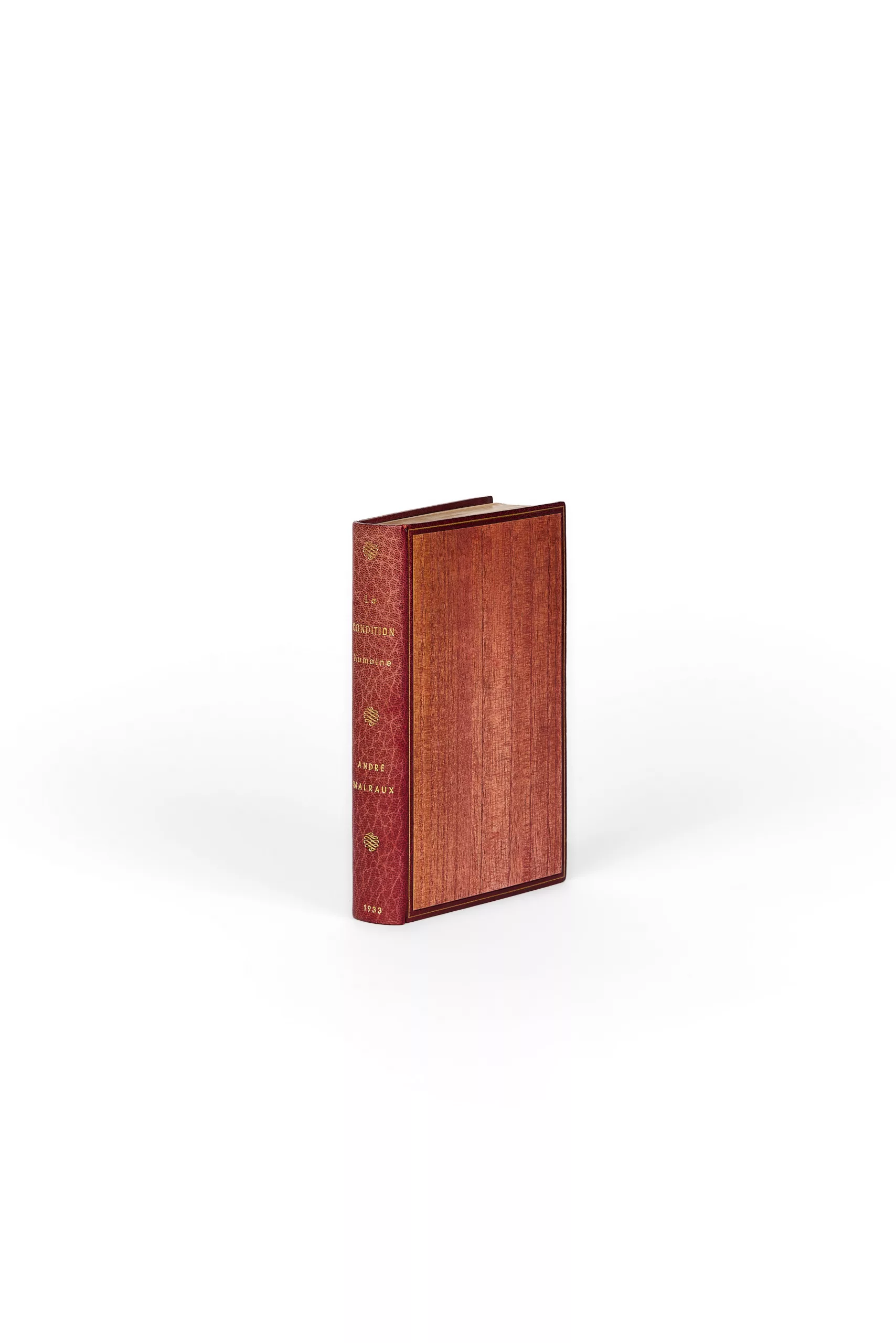
One of 309 copies on pur fil paper (this copy no. I of the hors commerce copies) — the only deluxe-paper printing after 40 réimposé copies in quarto Tellière format: 1 on China paper and 39 on vélin pur fil.
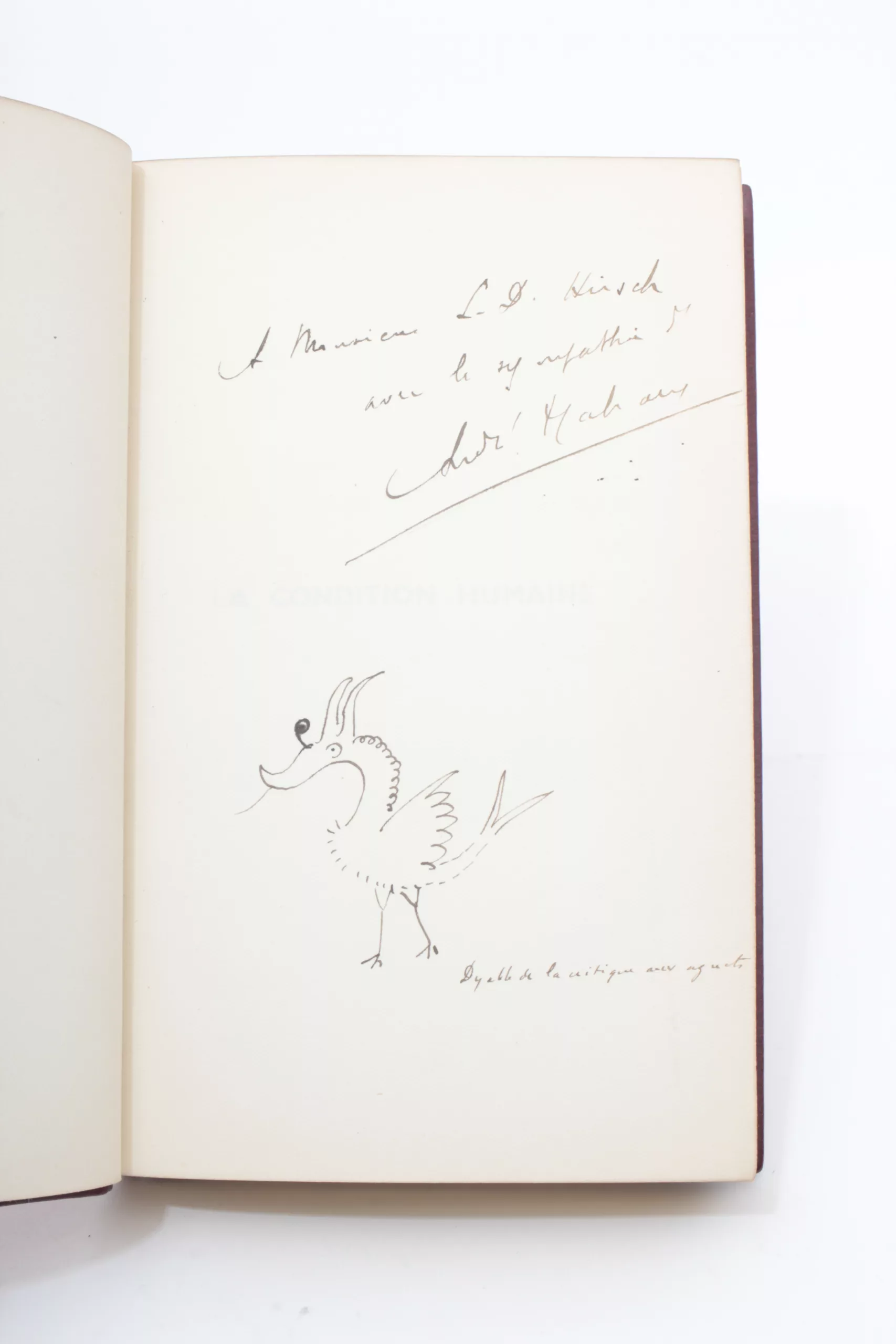
Signed presentation inscription: “À Monsieur L.D. Hirsch avec la sympathie d'André Malraux,” enriched with a “dyable” — a small fantastical drawing with which the author liked to embellish his letters and inscriptions — here captioned: “Dyable de la critique aux aguets.”
This was Malraux’s second book with the N.r.f., after Royaume farfelu, and his first novel. Anticipated and closely watched, it was actively promoted by Gaston Gallimard, who, a year after Les Loups had won the Goncourt against Céline, wished to consolidate his success with a title by an already celebrated “house” author. The gamble paid off: the Prix Goncourt was awarded to Malraux on 7 December 1933. In his official statement, the thirty-two-year-old writer declared: “It is customary, after any literary prize, to explain how and why the book one has written should appeal to everyone. I want there to be no ambiguity about mine. I have tried to express the only thing that matters to me, and to show a few images of human grandeur.” The prize was awarded, on the fourth ballot, to André Malraux with five votes, against three for Charles Braibant’s Le Roi dort, one for René Béhaine’s La Solitude et le silence, and one for Paul Nizan’s Antoine Bloyé.
The historical framework of the novel is probably only a pretext for its deeper subject, revealed by the title itself. As Jean Guéhenno wrote, it is ultimately a long meditation on Man, staged by the novelist: “Some complain that the author had to go all the way to China to find the means of defining our condition. On the contrary, it is precisely this that, in my view, makes this book exemplary.” He explains that this exoticism makes it so that “all our disorders, all our greatness appear to us transported beyond the world, distanced from us as though in a spectacle” (in Europe, December 1933).
In 1842, Shanghai became one of five ports opened to foreign ships. China soon allowed the creation of foreign concessions within the city. These districts, no longer under Chinese authority, held around forty thousand people at the time of the novel: businessmen such as the arms dealer Clappique, intellectuals such as Professor Gisors, workers, industrialists such as Ferral, but also political refugees from every country, who made Shanghai the crucible of China’s political turmoil in the 1920s. Malraux drew on the tragic events of spring 1927, when the Communist cells of Shanghai were crushed on the orders of General Chiang Kai-shek, leader of the Kuomintang. As the novel opens, the militants of the Chinese Communist Party are on the verge of launching an insurrection. At their head stands Kyo, the emblematic hero as conceived by the author. “I sought,” Malraux said, “images of human grandeur, and I found them among the ranks of the Chinese Communists, crushed, murdered, thrown alive into furnaces…”
A fine copy, finely bound by Devauchelle père.
Contemporary inscriptions on deluxe-paper copies of this edition are rare. This one is particularly significant: Louis-Daniel Hirsch was the commercial director of Éditions Gallimard from 1925 onward. A member of the reading committee, he was close to several authors, notably Malraux and Giono.