

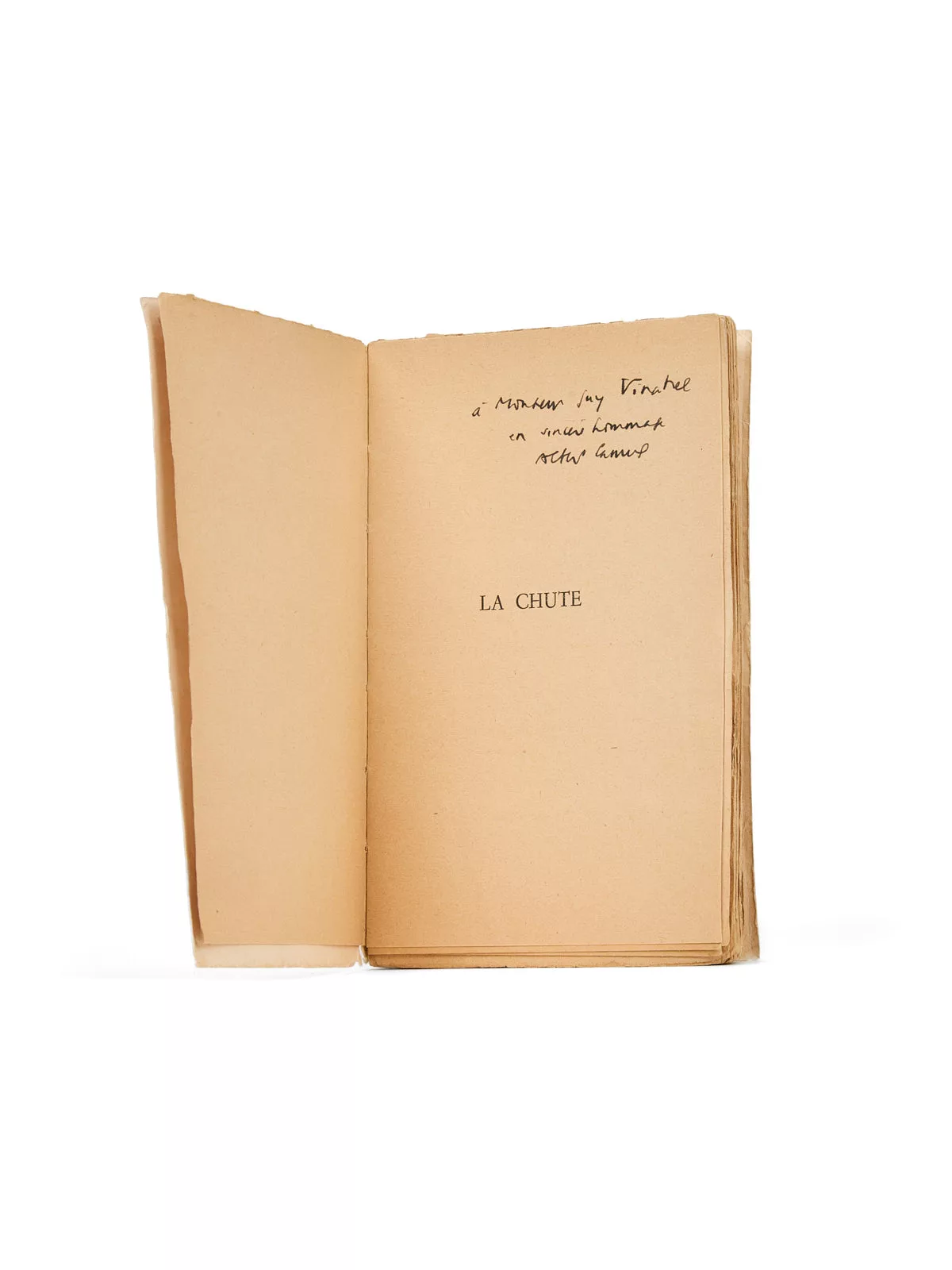
La Chute
Press copy, stamped as such.
Inscribed and signed by Camus to Guy Vinatrel: “à Monsieur Guy Vinatrel, en sincère hommage, Albert Camus.”
In 1956, alongside his journalistic work, Albert Camus was writing for the theater and producing a series of short stories between 1954 and 1956, intended for L’Exil et le Royaume, published the following year. What would become his last published novel emerged directly from one of these stories — its original title unknown — set aside from the collection and developed further: a key text that grew into a confession set in Amsterdam, where the “judge-penitent” Jean-Baptiste Clamence reconstructs, in a monologue of implacable precision, the inner chain of guilt and lucidity. The title, suggested by Roger Martin du Gard, was adopted at the stage of final proofs, and the book’s commercial success was immediate. Camus rejected the biographical identification critics were quick to make: “My only point in common with Jean-Baptiste Clamence — with whom people insist on identifying me — would be his lack of imagination,” he declared.
This copy was presented to Guy Vinatrel (pseudonym of Gilbert Pradet), an essayist and journalist who served as a correspondent in Moscow before the war, later claiming involvement in the Resistance before settling into an early and outspoken anti-totalitarian and anti-communist stance. An active Freemason, he ran the Association fraternelle des journalistes and Les Lettres mensuelles, publishing under his pen name in Dimanche-Matin, Les Écrits de Paris and Juvénal numerous articles denouncing the Soviet camps and defending a socialist democracy of responsibility — positions that closely echoed Camus’s own views on the USSR, capital punishment and freedom of thought.