

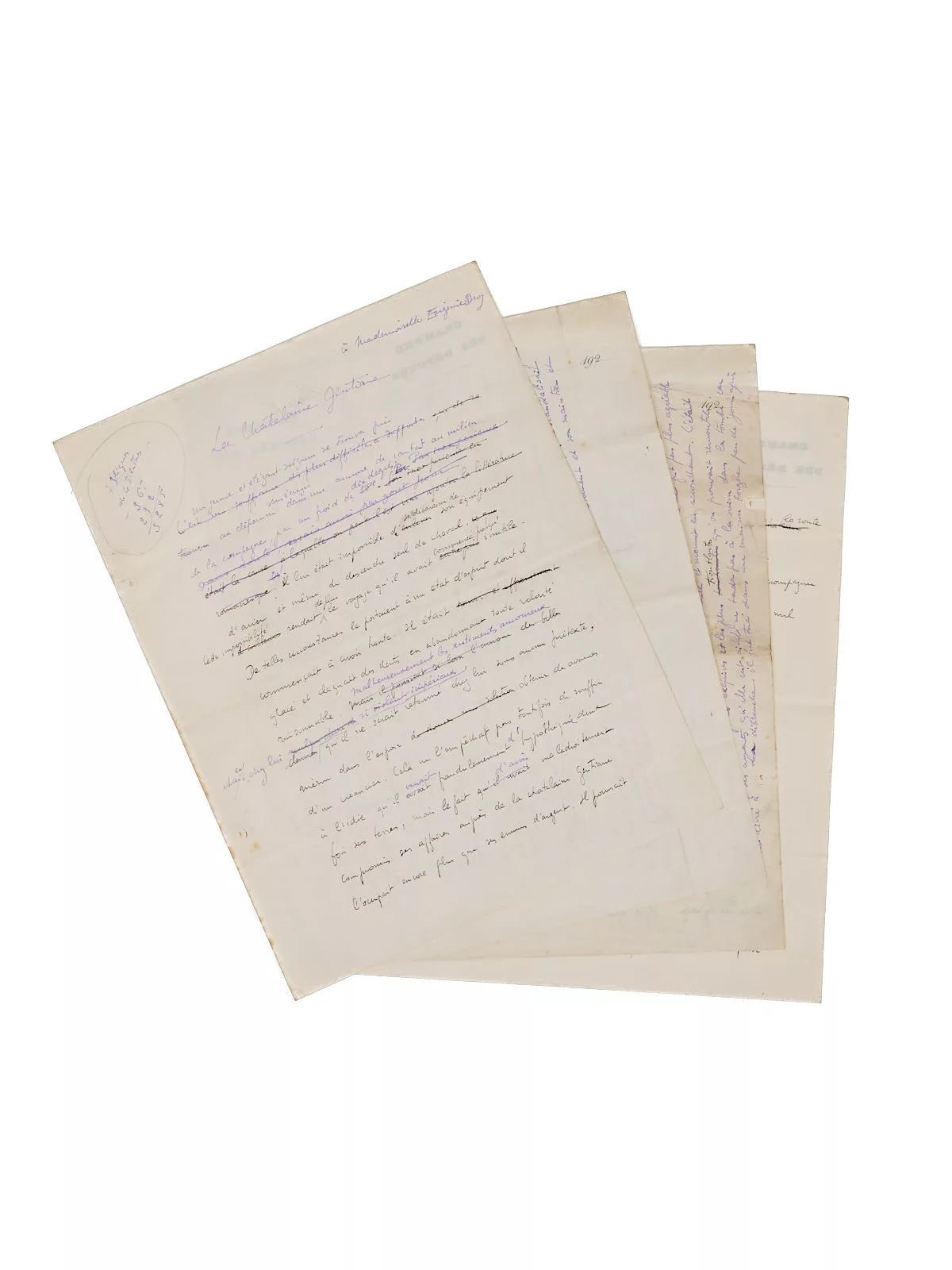
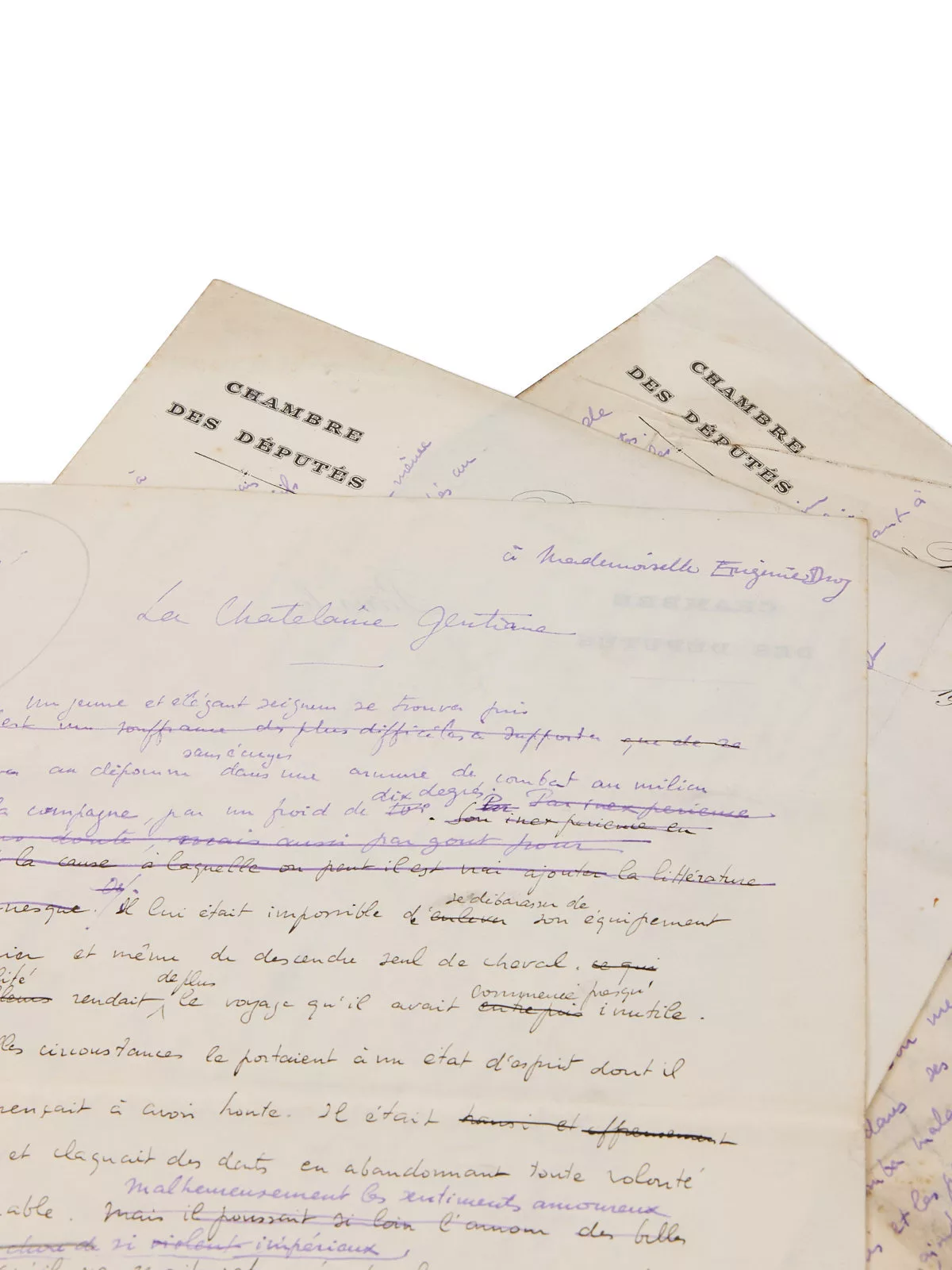
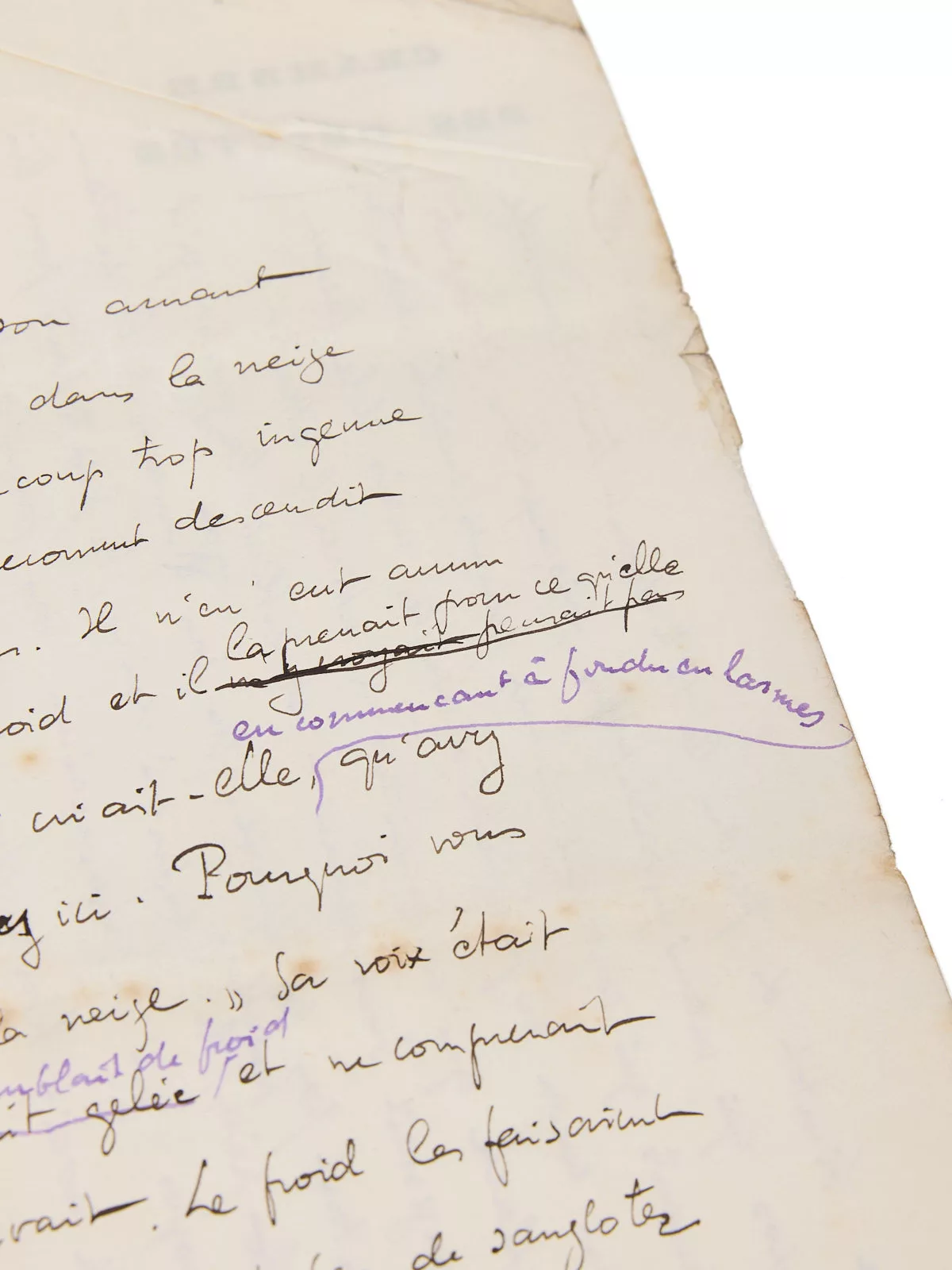
La Châtelaine Gentiane
The only witness to the author's first work of fiction. After his youthful text on Reims Cathedral, this is the earliest known writing by Georges Bataille. It remained unpublished during his lifetime.
La Châtelaine gentiane is set in the world of the Middle Ages and chivalry, themes central to the concerns of Georges Bataille as a young student. Since 1919 a student at the École des chartes, he was then preparing his thesis on an edition of L’Ordre de chevalerie, a thirteenth-century verse tale drawing on the First Epistle of Saint Paul to the Thessalonians. Immersed in Léon Gautier’s La Chevalerie, he sought to dissociate the chivalric spirit from Christianity. This idea is strongly present in La Châtelaine gentiane, suggesting that it was written during these early years at the École des chartes, also influenced by the travels and research he was then undertaking, notably in London and the south of England.
Several elements of Bataille’s later fiction are already present here, such as the setting of the story, the château of Louvres-haut, the first of the ominous, imaginary castles that would recur throughout many of his novels.
This precious text remained unpublished for a long time, only coming to light in 2004, when Bataille entered the Bibliothèque de la Pléiade. Although certain passages are stylistically awkward, “one cannot deny the documentary and ‘prophetic’ value of the narrative which, despite its slightness, constitutes through its very subject a first sketch of what the writer would later call ‘the society of consumption of lovers’; La Châtelaine can be read as an illustration of the formula that would open L’Érotisme in 1957, ‘the approval of life even unto death’: an isolated château amid a bleak, snow-covered countryside, the setting for an initiation into the dark love between the châtelaine Gentiane and her young lover. Moved by contradictory feelings, both are destined, in a delirious final impulse, to meet again in death.” (from the “Notes” of the Pléiade edition).
This text had only been communicated to the editors of the Bataille edition via a photocopy, and is presented in the section of “Rediscovered narratives,” alongside two other early manuscripts: “Ralph Webb” and “Evariste.”
An interesting provenance and inscription: the first page bears, in the upper right corner, “à mademoiselle Eugénie Droz,” one of his fellow students at the Bibliothèque Sainte-Geneviève. A graduate of the École pratique des Hautes Études, this young woman from Neuchâtel founded her small publishing house in December 1924, with its address at 13 avenue Félix-Faure, in the fifteenth arrondissement, her personal address, before moving to rue Serpente and then to 25 rue de Tournon, in a house that a king had once given to a poet: the one François I gave to Clément Marot in 1539. Nothing less. The learned young woman, who would soon publish several works of paleography and diplomatics, remained in Paris until 1947, when she moved to 8 rue Verdaine in Geneva; it was from this latter address that she would direct the celebrated publishing and scholarly house that endures to this day. Eugénie Droz died in 1976 in Geneva, leaving behind a lasting legacy in academic publishing.
The title page bears, in Bataille’s hand, a few further notes intended for a future fair copy for publication: “73 lignes / de 45 lettres.” Was he considering, with this dedication in mind, having his chivalric novel published by the young woman’s fledgling publishing house?
A historic and foundational document.