

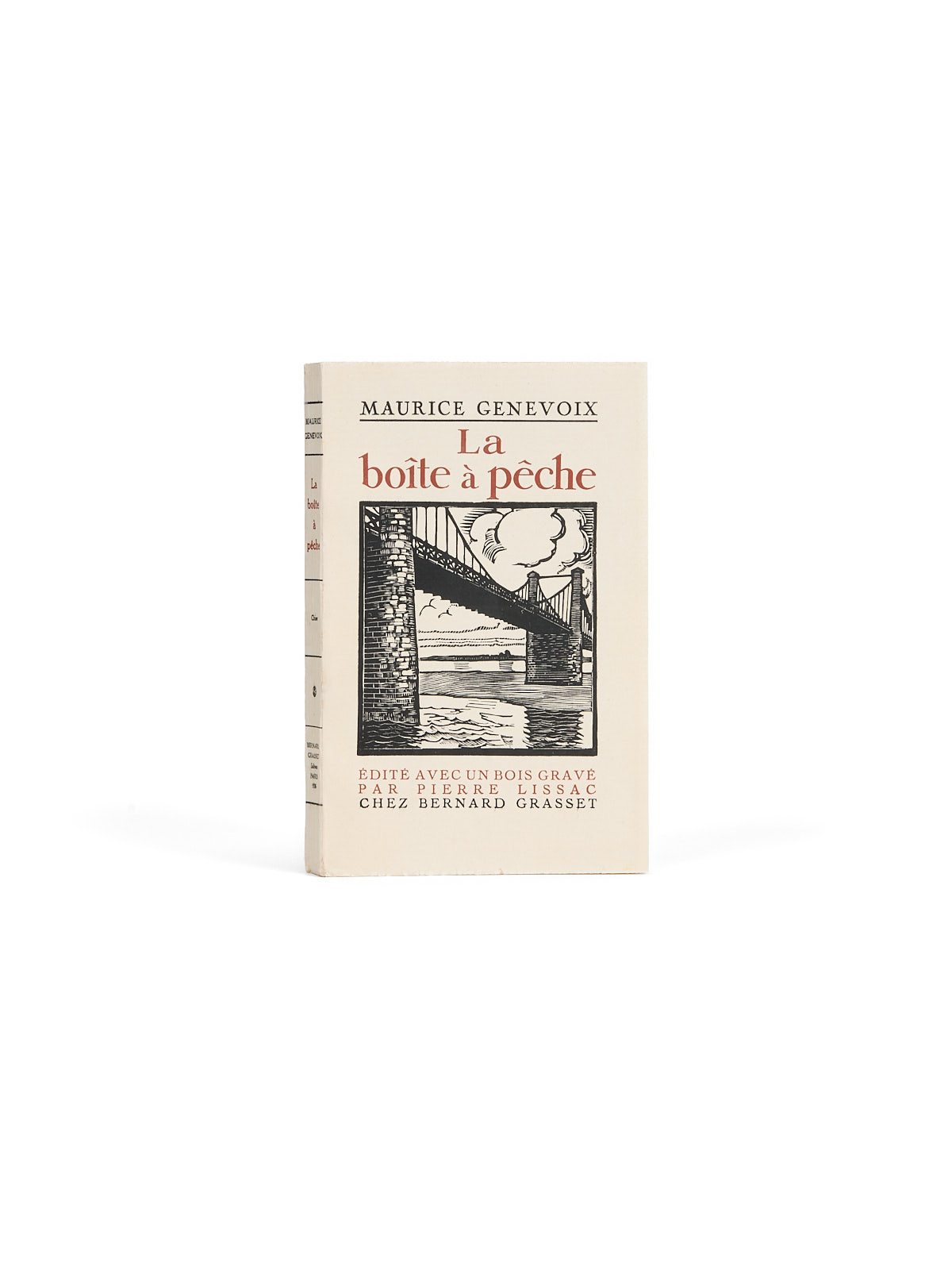
La Boîte à pêche
One of 11 copies from the deluxe issue on China paper.
A passe copy, unnumbered, reserved for Maurice Genevoix.
A year after Raboliot (Prix Goncourt, 1925), Genevoix turned from the Sologne toward the Loire. After 1919 he had returned to live at Châteauneuf-sur-Loire, near the places he had already celebrated four years earlier in the wonderful Rémi des Rauches, which had joyfully staged the river-king through the figure of a cooper, offering the reader magnificent descriptions that are so many invitations to travel. The Loire was even the dedicatee of that novel.
La Boîte à pêche is, at first sight, an almost ethnographic evocation of the various forms of fishing and the pleasure they provide: a novel “of the terroir,” which the Parisian intellectual milieu, with its habitual blinkers, dismissed as “regionalist.” Genevoix himself justified it by the need to exorcise the still vivid memory of the barbarity of the First World War, as he explains in his foreword, paying tribute to his fishing master, Najard, and to his schoolfellows and fishing companions, Bailleul and Jeanneret.
It was thanks to the success of Raboliot, Rémi des Rauches and La Boîte à pêche — three texts steeped in a vocabulary of exceptional sensory richness — that Genevoix was able, in 1927, to purchase the house at Les Vernelles, in Saint-Denis-de-l’Hôtel. There he set up a study facing the Loire, where he would write much of his future work.
A precious deluxe copy, from the author’s own library at “Les Vernelles,” with his bookplate.