

La Belle Dame sans mercy
The term proverbial rarity is not misused here: it is neither more nor less than the only known copy of this rare edition - formerly part of the Fairfax-Murray collection.
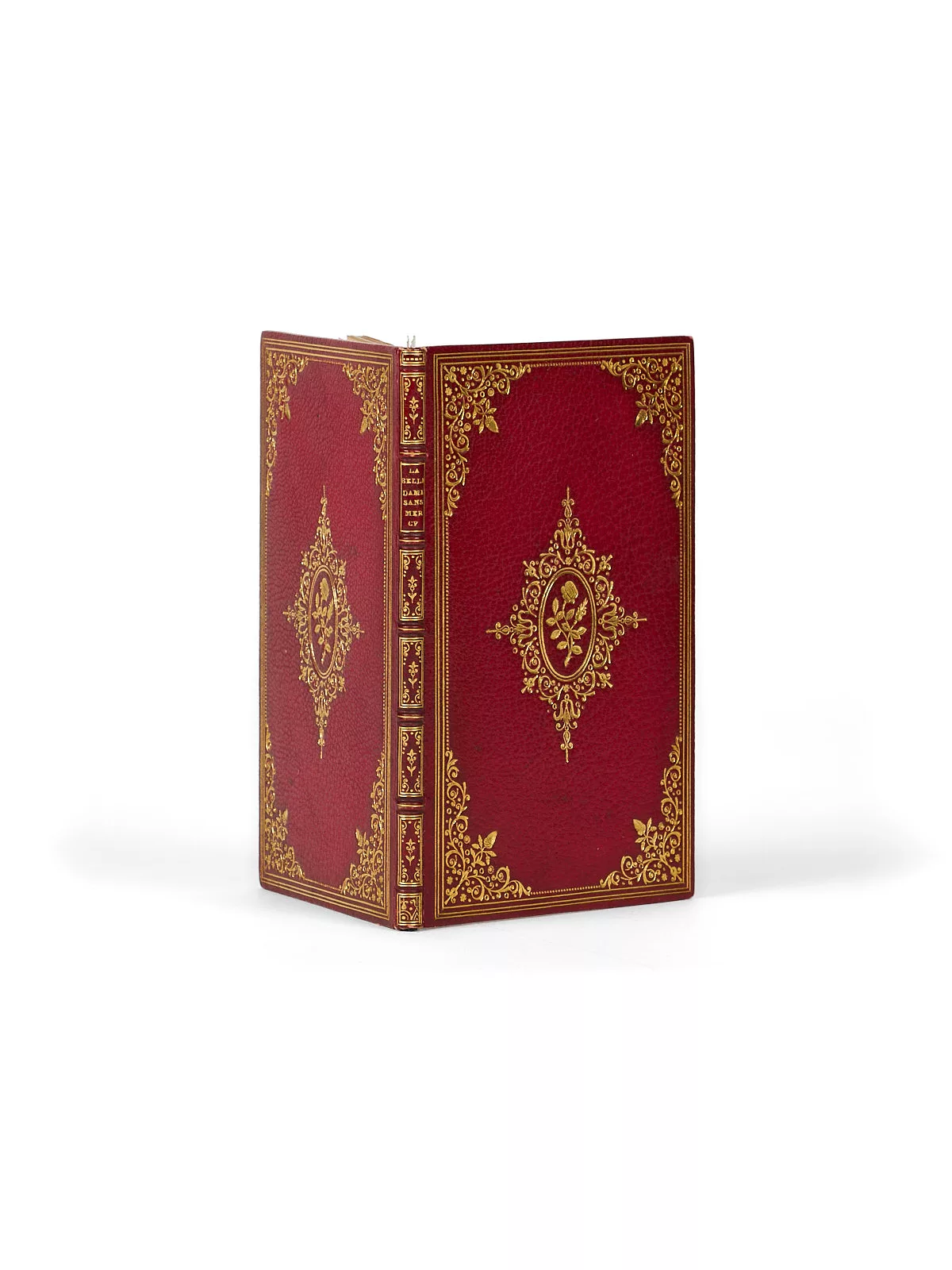
This delightful copy was carefully compiled in the 19th century by Bauzonnet, in a delicate and refined red morocco binding.
One of the most celebrated works of medieval courtly love.
“Proverbially rare” is hardly an exaggeration here: this is the only known copy of this edition, formerly in the celebrated Fairfax Murray collection and beautifully bound in the nineteenth century by Bauzonnet.
It is also the earliest copy of the work remaining in private hands: all seven known copies of the earlier editions, printed between 1488 and 1515, are preserved in public collections in France, Britain and the United States. Only one other copy of an early edition remains privately owned, from the edition of 1530.
Why did Chartier’s poem enjoy such immediate and enduring success when its theme — the beautiful, virtuous but inaccessible woman, indifferent to the lover who is dying for her — had been familiar to lyric poets since the thirteenth century? Pierre Champion offered a wonderfully simple explanation: “It was quite simply the first time anyone had spoken so subtly of love.”
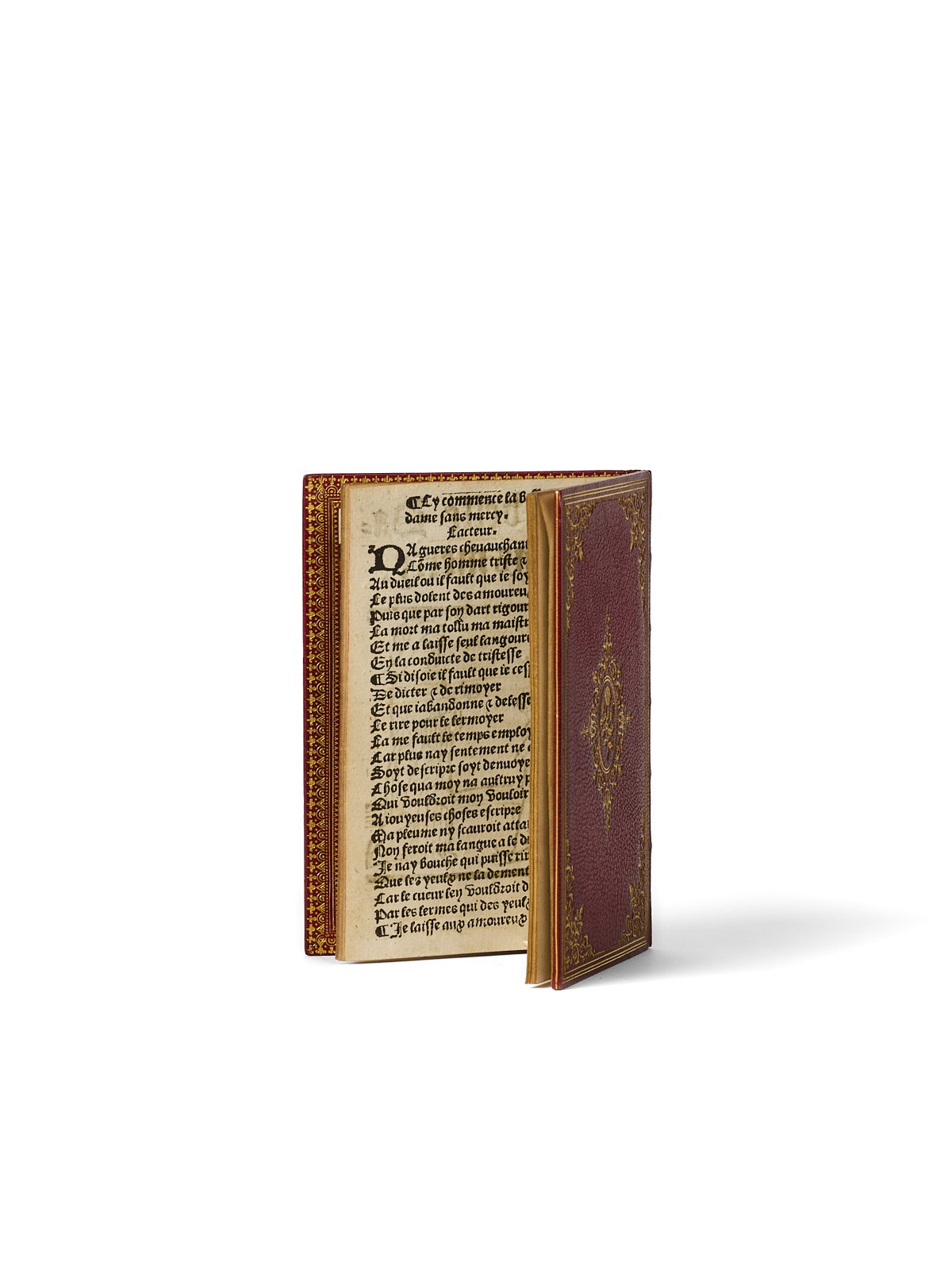
Written around 1424, La Belle Dame sans mercy consists of one hundred octosyllabic stanzas. Its celebrated dialogue opposes a rejected Lover to a Lady who refuses the conventions of courtly love. As A. Pagès observed, its incisive exchanges are matched by a remarkable subject: a poem in which, “perhaps for the first time, women’s rights in matters of love were vigorously defended.”
The poem caused a genuine scandal. The women of the Court, among its earliest readers, addressed a Lettre des Dames to Chartier threatening that he would be “dead or captured” for having created a woman capable of remaining free from love and becoming truly sans mercy. The controversy generated answers, continuations and counter-poems.
Chartier, born in Bayeux around 1385, studied at the University of Paris before entering royal service. Secretary to the Dauphin, the future Charles VII, he participated in important diplomatic missions and wrote political works in Latin alongside his French poetry.
La Belle Dame sans mercy became his most enduring work and one of the most famous courtly poems of the late Middle Ages. Its reputation soon crossed the Channel: around 1450 it was translated into English by Sir Richard Ros, a courtier of Henry VI.
Copied repeatedly throughout the fifteenth and sixteenth centuries, the poem survives in some fifty manuscripts. It was first printed in 1488 and included in Antoine Vérard’s 1498 edition of the Fais d’Alain Chartier. Only five further separate editions appeared during the sixteenth century, all of them exceptionally rare.
Its influence proved remarkably long-lived. Nearly four centuries later, its title and tradition echoed through John Keats’s celebrated 1819 ballad La Belle Dame sans Merci, which in turn became a favourite subject of the Pre-Raphaelites.
The only known copy:
This edition survives solely in the copy offered here. Both Renouard and Bechtel record the edition from this very copy. The USTC likewise records a single copy, its present location previously unknown: almost certainly the present example.
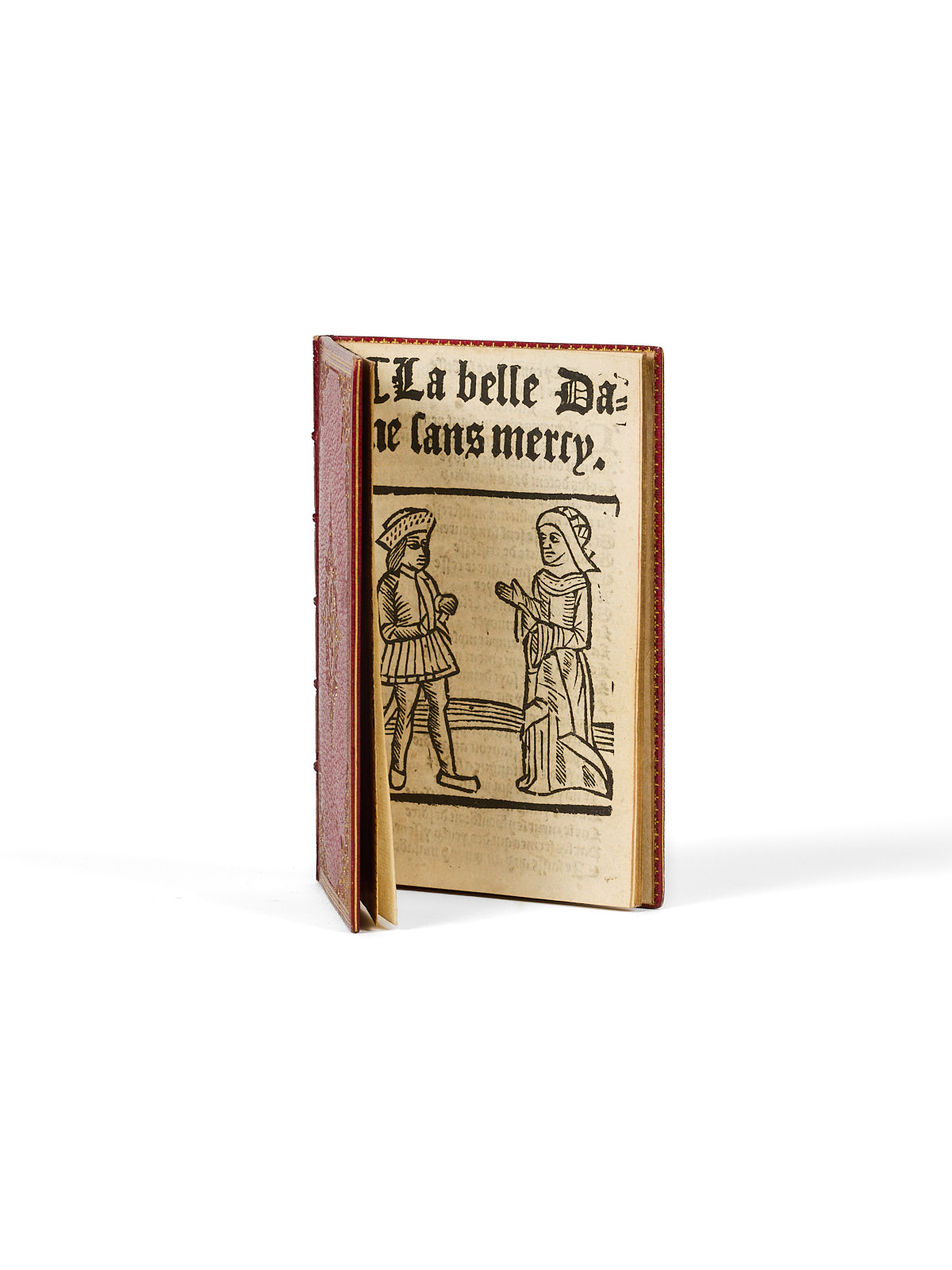
Printed in Paris by Julien Hubert in Gothic type, the title page is illustrated with a charming woodcut depicting a man and woman in conversation — an image perfectly suited to Chartier’s poetic dialogue. The privilege is dated 27 August 1529.
The other early editions recorded are:
Lyon, 1488: three copies — BnF, Bibliothèque Mazarine, British Library
Paris, 1500: no copy known
Rouen, 1505: two copies — BnF, Harvard, Houghton Library
Lyon, 1515: one copy — Yale, Beinecke Library
Paris, 1530: one copy — this copy.
Provenance: Charles Fairfax Murray (Early French Books, London, 1961, no. 633, with inventory label); Jean Bourdel (sale I, Paris, 2024, with bookplate).
Bound by Bauzonnet.
Bechtel, Catalogue des gothiques français 1476–1560, C-263; H. W. Davies, Catalogue of a Collection of Early French Books in the Library of C. Fairfax Murray, London, 1961, II, pp. 967–972, no. 633 (this copy); Renouard–Moreau, Inventaire chronologique des éditions parisiennes du XVIe siècle, 1697; Tchemerzine-Scheler, II-314; USTC 73209; Piaget, La Belle Dame sans merci et les poésies lyriques, Droz, 1949.