

La Ballade de la geôle de Reading
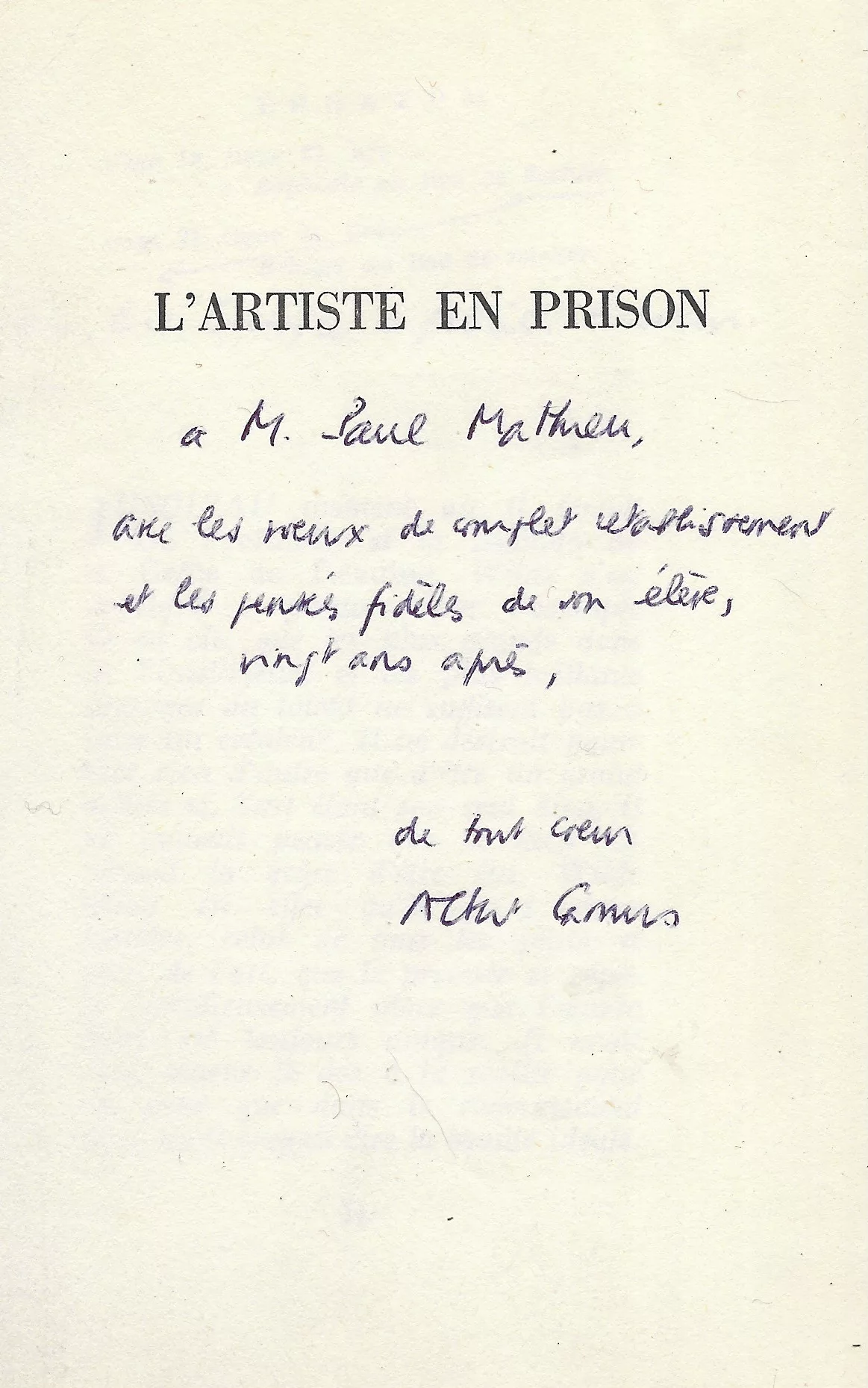
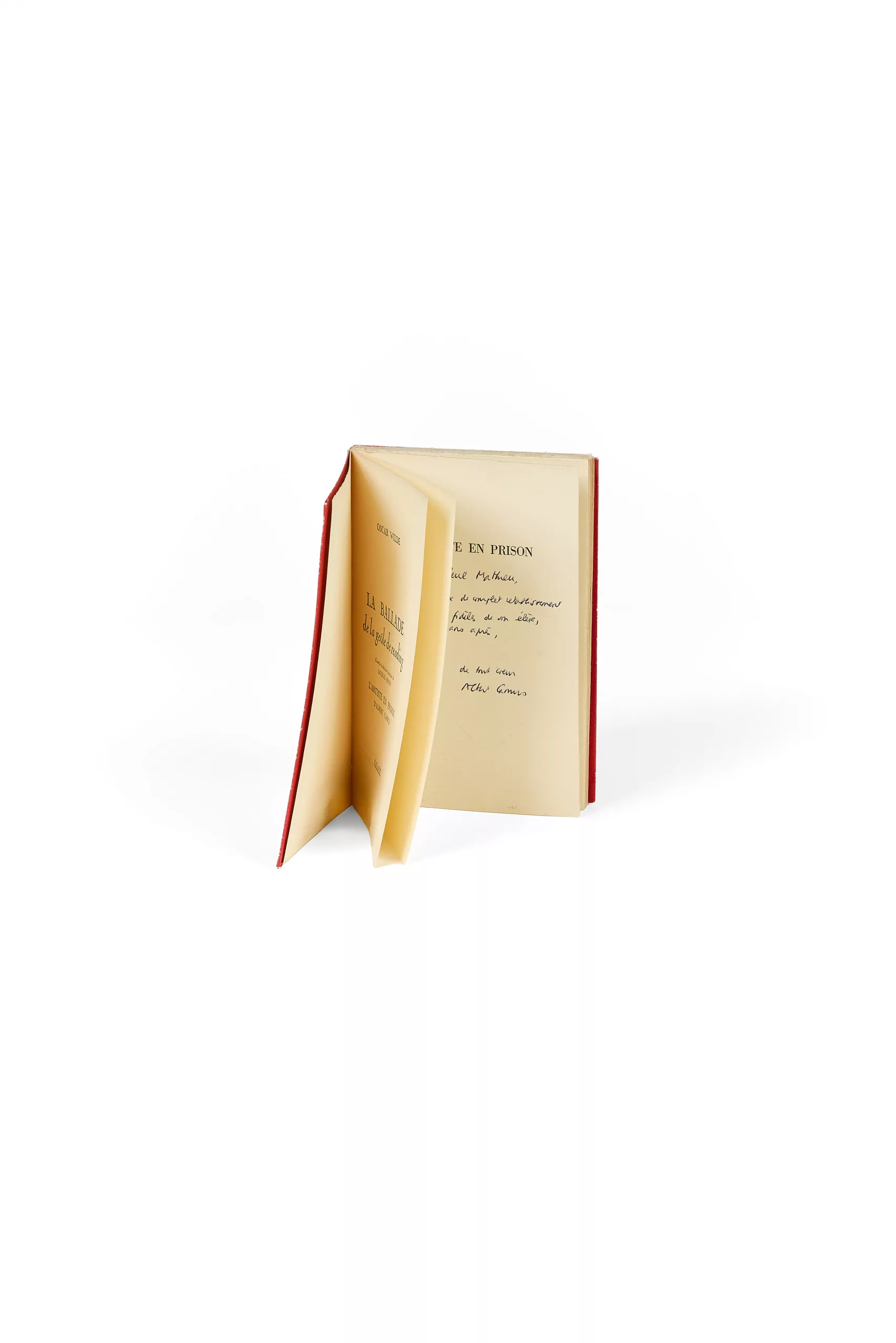
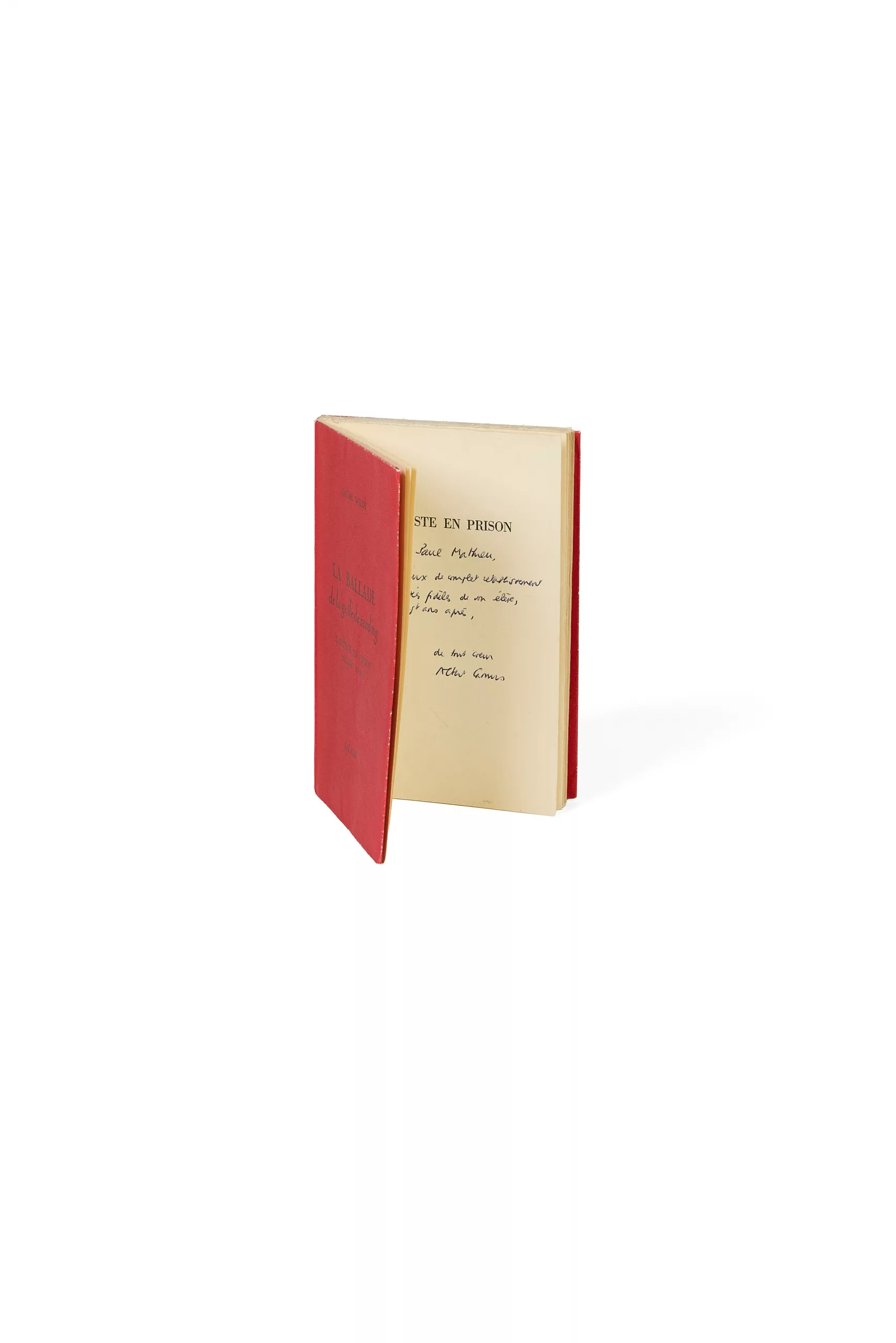
Presentation copy inscribed by Camus to Paul Mathieu: “A M. Paul Mathieu avec les vœux de complet rétablissement et les pensées fidèles de son élève, vingt ans après, de tout cœur Albert Camus.”
With an autograph correction on the erratum slip (mounted on the first leaf of Camus's text): “lire Sophocle au lieu de Eschile : Ici, lire Eschyle et féliciter l'éditeur.”
Oscar Wilde wrote this work a few months after his release from prison, in Berneval near Dieppe and then in Naples, during the summer of 1897. All his usual publishers shunned him, except Leonard Smithers, a bookseller-publisher of pornographic works, who brought out the book in January 1898 in 800 copies, without the author’s name. After the Ballad, Wilde never wrote anything else. Camus imagines that he “no doubt knew the unspeakable misfortune of the artist who knows the paths of genius but no longer has the strength to take them. Poverty, hostility or indifference did the rest.”
The first French translation was by Henry Davray, for Le Mercure de France, made in collaboration with Wilde himself, who wrote of his Ballad: “It is my swan song… I have become the ruin, the collapse of what was once marvelous, brilliant and terribly improbable in me… I do not think I shall ever write again: the joy of living has fled, and with the will, that is the very basis of art.” At his death, Wilde “left us, as a royal inheritance, De Profundis and the Ballad…” This inheritance, Camus predicted, “announced to those in the know that a great artist, only recently born, had just died.”
The text held great importance for Camus. In late autumn 1954, he traveled to Italy at the invitation of the Association culturelle italienne, a country he had not visited since 1938 and to which he looked forward eagerly. He delivered a lecture there, repeated six times: L’Artiste et son temps. Three years later, the same text was taken up again in Stockholm during the Nobel Prize ceremonies: it became the major address given at Uppsala University on 14 December 1957, published in Discours de Suède, following the speech given at the close of the Nobel banquet on 10 December. A dedication to his Algerian schoolteacher, Louis Germain, was added at that time. An earlier draft of the text had appeared as the conclusion to Actuelles II, in the form of interviews grouped under the same title, L’Artiste et son temps: “We must accept the perils: the age of the seated artist is over.”
Paul Mathieu, along with Jean Grenier, was Albert Camus’s teacher in 1932–1933, in the hypokhâgne class at the Lycée Bugeaud in Oran, today the Lycée Émir Abdel Kader. Fifteen years later, Camus wrote to him: “I recently heard the case being made against secondary education… And I said that, for my part, I could only defend the two or three teachers to whom I owed my formation. What remains to you, I was asked, of your years of study? I replied: the taste for truth. It was of you that I was thinking, because it was in you that I saw examples of that rarest and most difficult intellectual honesty. That is the reason for my loyalty and my gratitude.”
Éditions Falaize had been founded in 1949 by Georges Fall, a native of Tunis, formerly literary director under Edmond Charlot, Camus’s first publisher.