

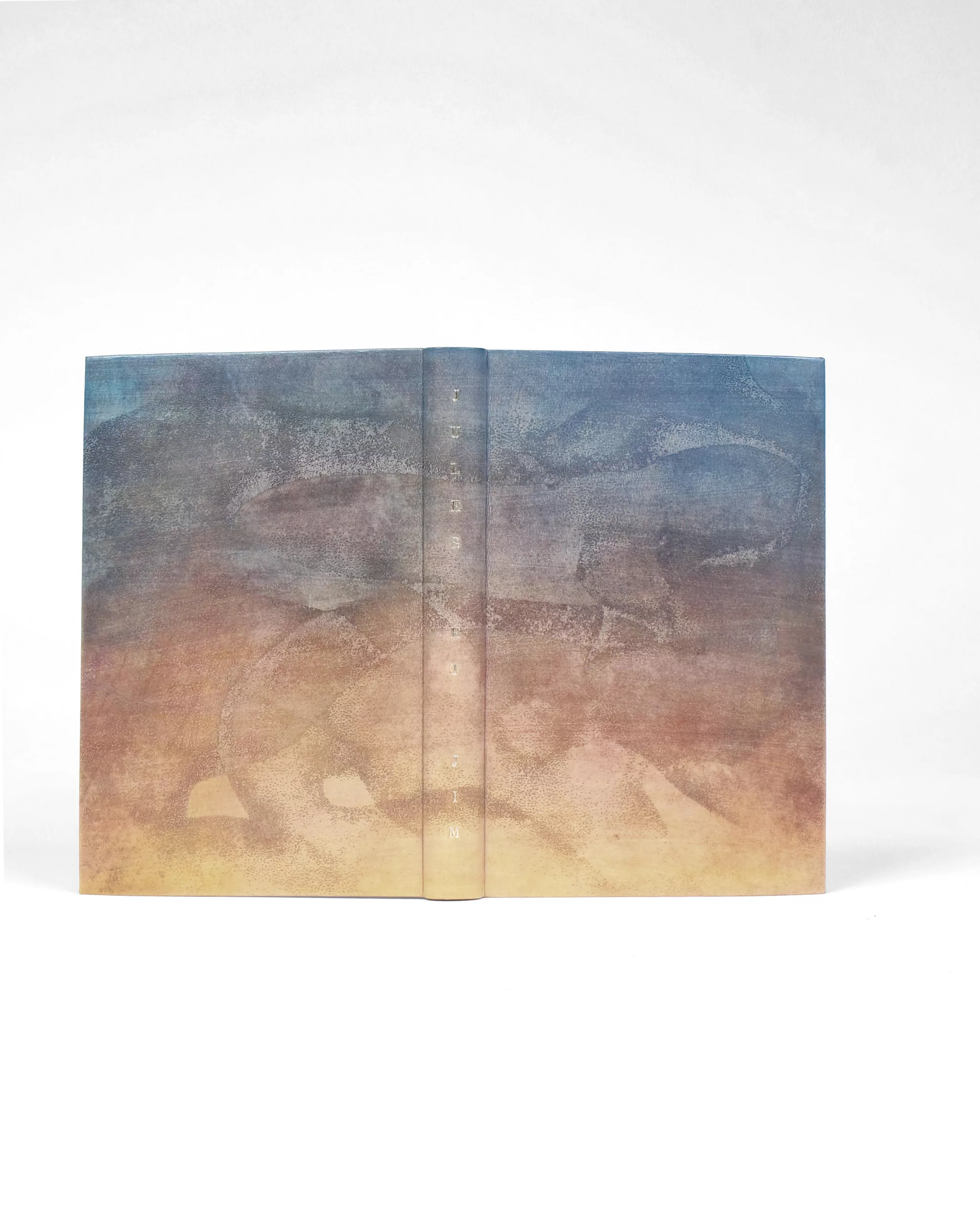
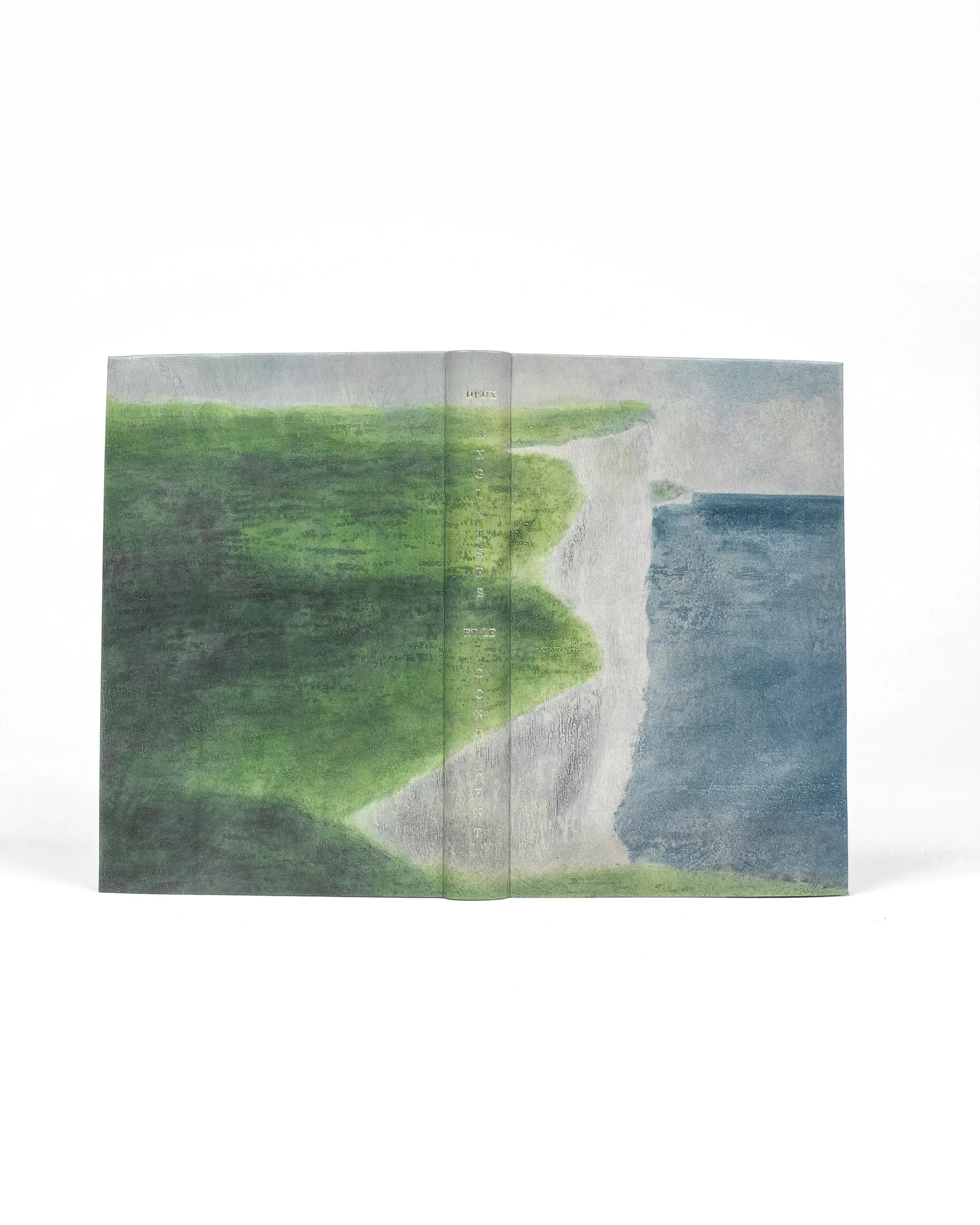
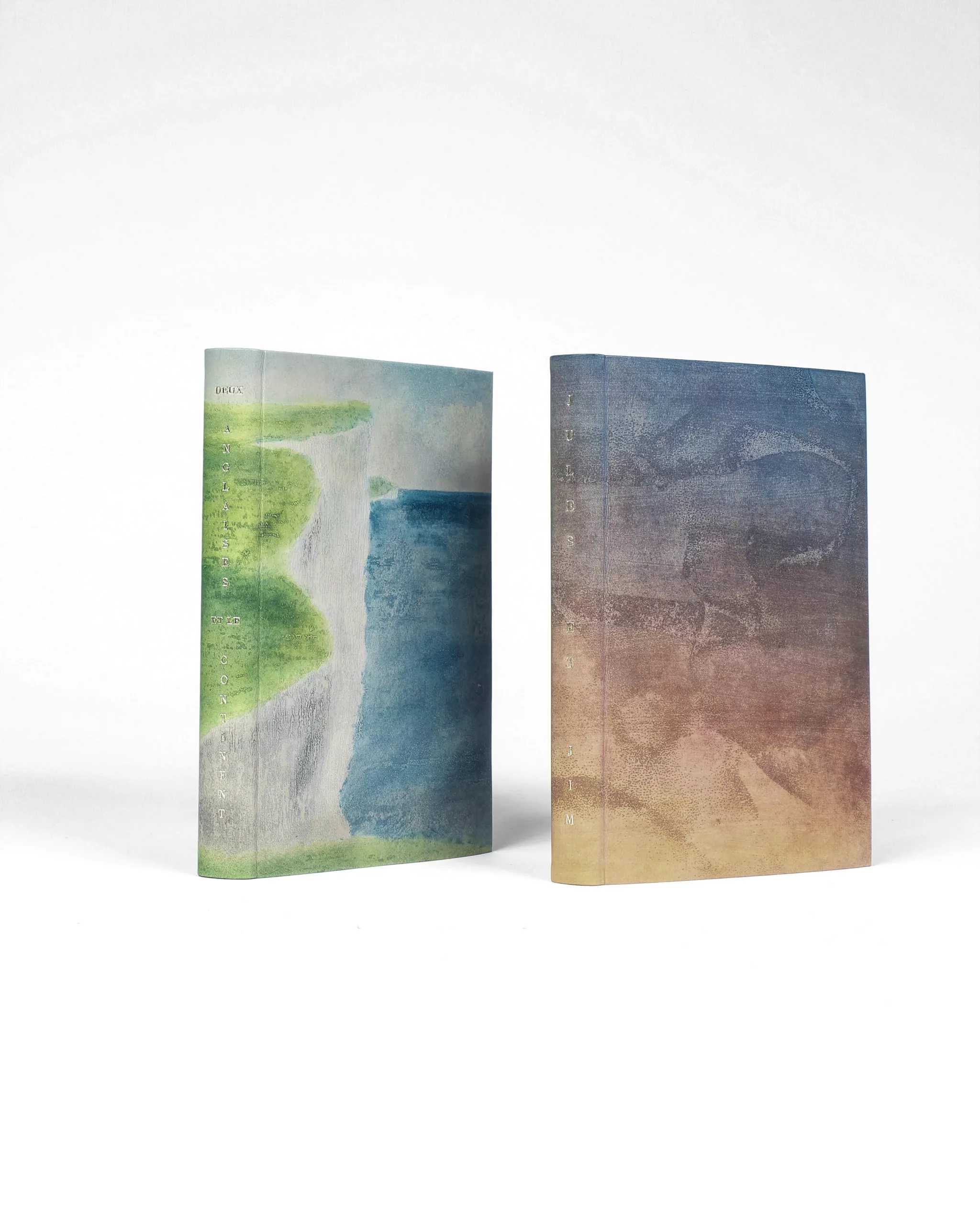
Jules et Jim Deux Anglaises et le continent
One of 55 and 25 copies on pur fil paper, this set nos. 50 and 10.
A remarkable diptych by Louise Bescond: two designs inspired by the two works. This ensemble was exhibited as no. 32 in the exhibition Louise Bescond, Reliures 2017–2020, at the Librairie Métamorphoses (Paris, May 2020, preface by Fabienne le Bars).
Jules et Jim is the celebrated story of a love triangle: Jules, a German-Jewish poet living in Paris before the First World War, meets Jim, a French poet who becomes his inseparable friend. Together they pursue various romantic conquests, until Jules marries Kathe, also German, visiting France on a cultural trip. A founding text of polyamory, the novel is largely autobiographical: Jim is essentially Roché himself, while Jules and Kathe are directly inspired by the Austrian writer Franz Hessel and Helen Grund — the parents of Stéphane Hessel.
The story’s roots run deeper still. Henri-Pierre Roché was a heartbreaker, painter, writer and art dealer who met Marcel Duchamp in 1916. In Paris, Roché had patronized and courted women artists, frequented the Bateau-Lavoir circle in Montmartre, and was later sent to the United States by the French High Commission to encourage American entry into the war. There he met Duchamp, then the darling of New York’s elite. Duchamp had just met Beatrice Wood, on 27 September 1916, for whom he immediately felt a strong attraction and who became his mistress — which did not stop him from introducing her to Roché, who also became her lover. Roché likely drew on this strange Franco-American trio, as well as other episodes from his youth, when writing his novel. During his studies in Paris between 1898 and 1900, “Hachepé,” as Duchamp called him, led “a double life in which he systematically indulged in matrimonial advertisements and various emotional manipulations that would remain a constant throughout his life. The experience was destabilizing enough that in March his mother sent him for several weeks to take the waters at the Sonnenberg institute in Carspach, Alsace.”
Both novels are intimately linked to François Truffaut, who adapted them both for the screen: “The first novel of a seventy-four-year-old man, [Jules et Jim] determined my vocation as a filmmaker. I fell in love with this book at first sight,” Truffaut admitted, when he cast Oskar Werner, Henri Serre and Jeanne Moreau. He later discovered Les Deux Anglaises et le Continent, adapted in 1971, which he considered his cinematic masterpiece.