


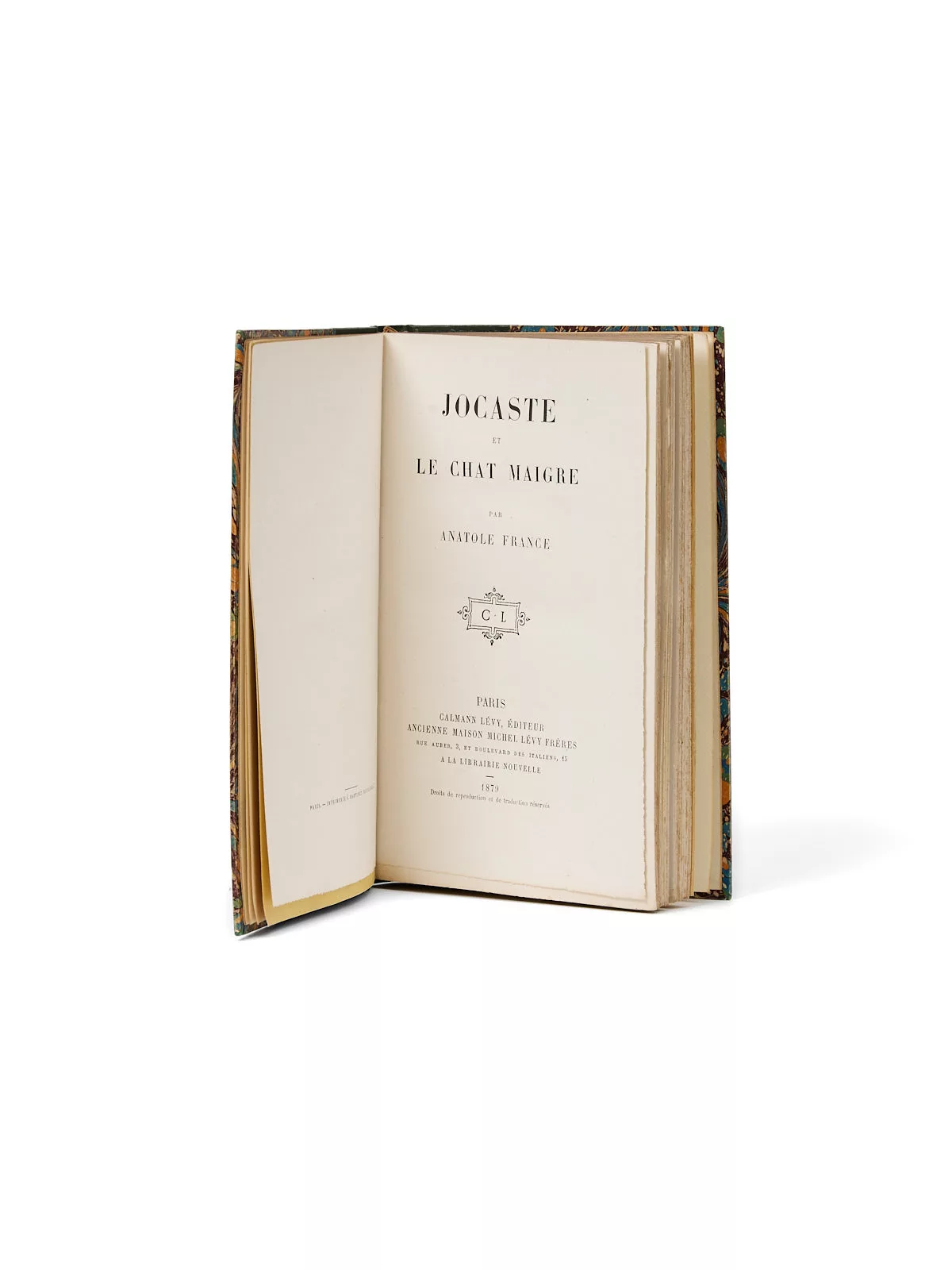
Jocaste et Le Chat maigre
This first book by France published by Calmann Lévy is a curious pairing of two texts, either of which would have made too slight a volume on its own. By joining the tale of Le Chat maigre to Jocaste under an unusual title, France surprised the public; critics judged Le Chat maigre superior to Jocaste, which the author himself described as “a short chronicle in which everyone is mad.”
The volume met with little success, but it was the origin of a serious and lasting falling-out between France and his first employer, who had become his publisher and friend, Alphonse Lemerre. At the 1911 trial that would publicly pit the two men against each other, Jocaste was cited by the defense counsel, Raymond Poincaré, as the starting point of the conflict. He summarized rather well the situation in which France had over time become entangled with Lemerre, and how, when publishing his first prose book, he had tried to free himself from it: “The men of letters who knew Anatole France and who, like him, frequented the Lemerre house had warned him against the inconceivable exploitation of which he had for some years been the too-resigned victim, and one of them […] had strongly advised him to approach another publisher.” France refused. So, “in order to spare him a step which embarrassed him, this friend had himself approached Monsieur Calmann Lévy, who had eagerly agreed to publish Jocaste.” (R. Poincaré, Plaidoirie dans le procès Lemerre.) He had indeed been directed to another publisher, one who moreover welcomed him with open arms, but France handled the matter poorly, signing with Calmann Lévy a contract that bound him exclusively, even though he was already, if only verbally, committed to Alphonse Lemerre for this first book. In the letter he sent Lemerre to explain his choice, he cited “commitments made without my knowledge” and “necessity”: “Besides,” he wrote, “I long believed I would please you by relieving you of the burden of my little novel. […] Consider, finally, that if I can give my prose a little value, your house will benefit from it, for I fully intend that we shall produce fine and successful publications together.” (8 November 1878.) France signed his letter “Believe me your friend,” a closing that cannot have convinced Lemerre. Lemerre tried to win his author back, and although he was reluctant to draw up written contracts, preferring verbal agreements, he proposed for the first time to put their affairs in order by contract. On 16 November 1878, three weeks after the one signed with Calmann Lévy, France accordingly signed a contract with Lemerre — unwittingly setting in motion thirty years of “quarrels.”