


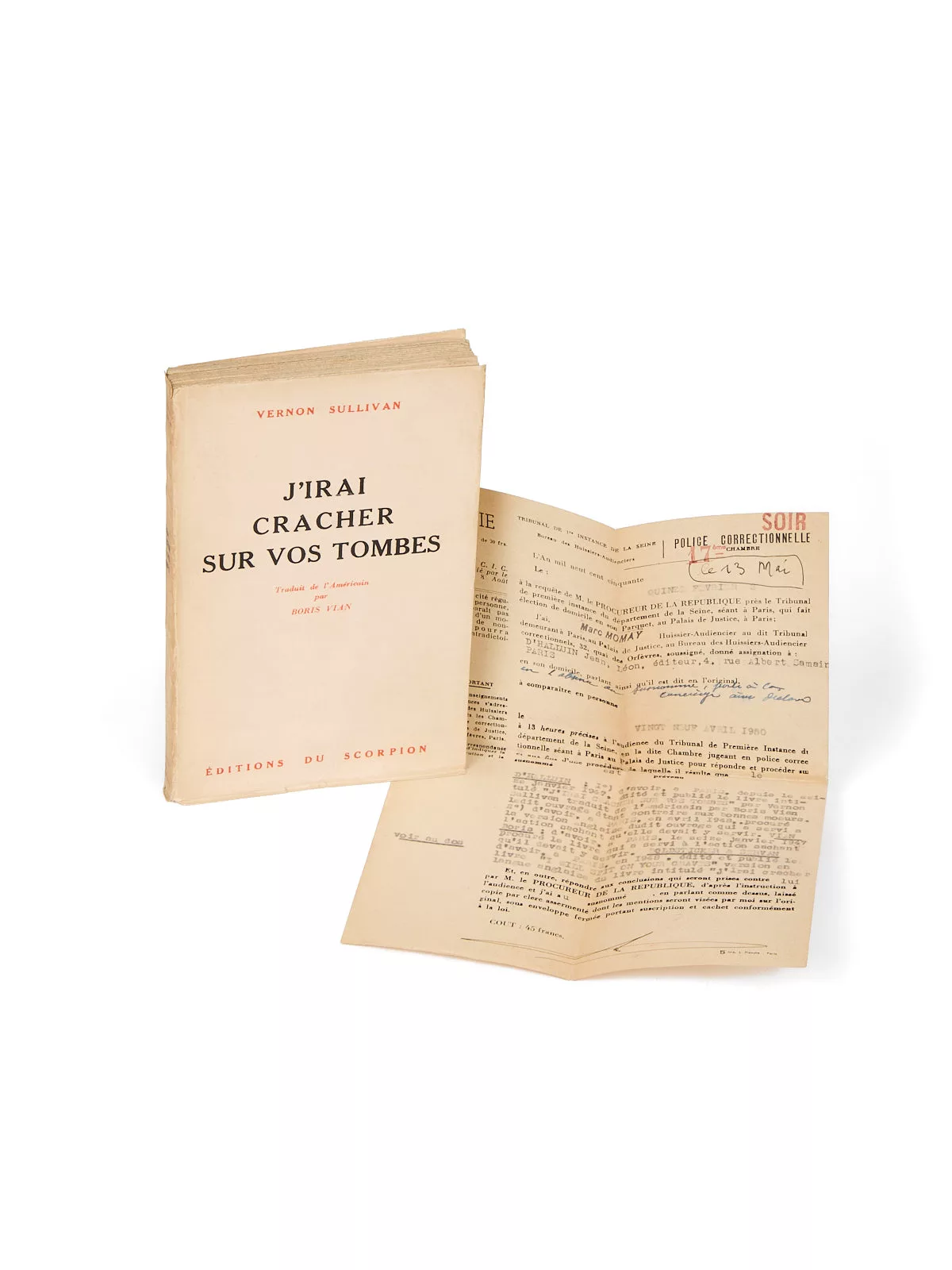
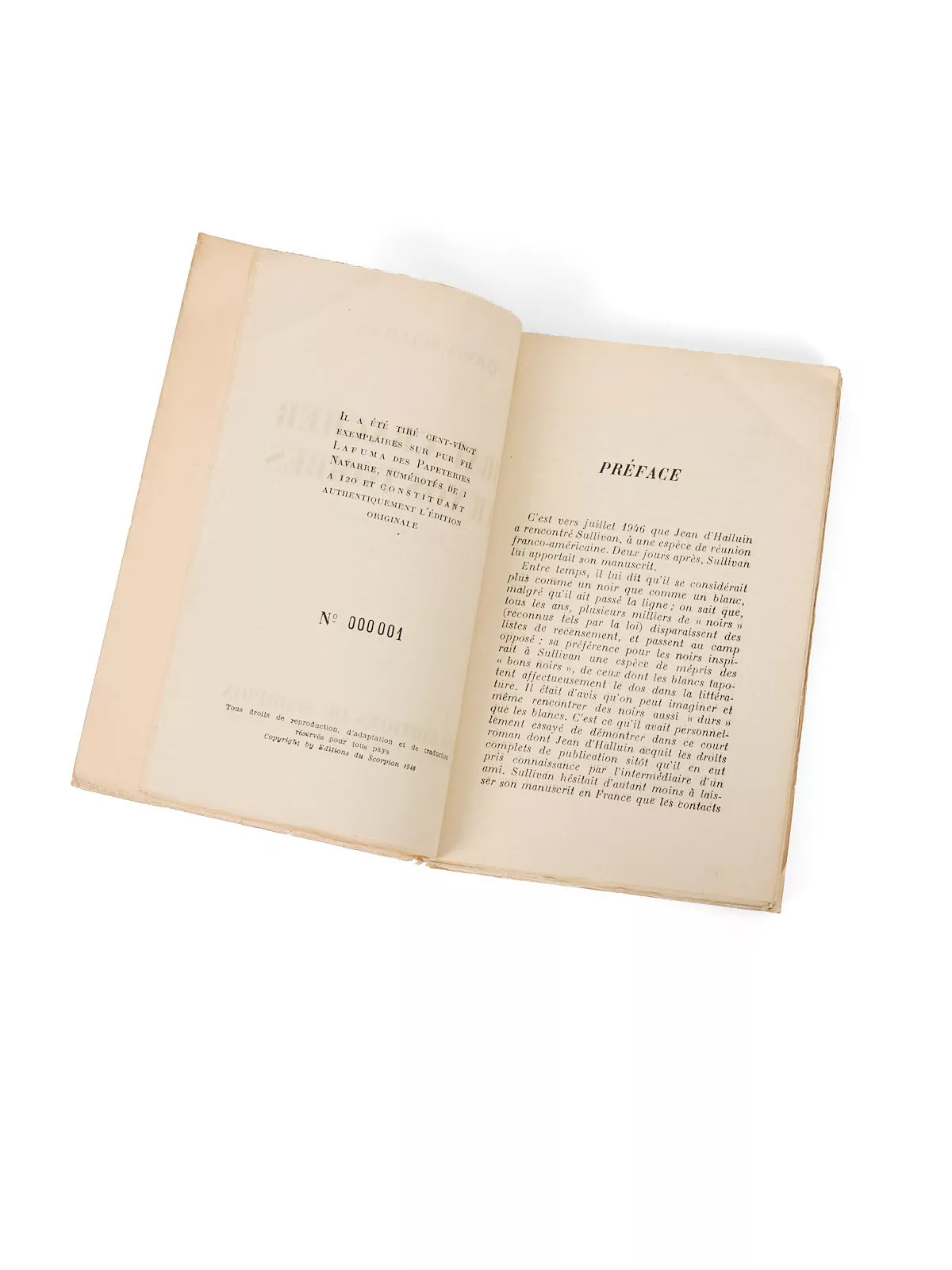
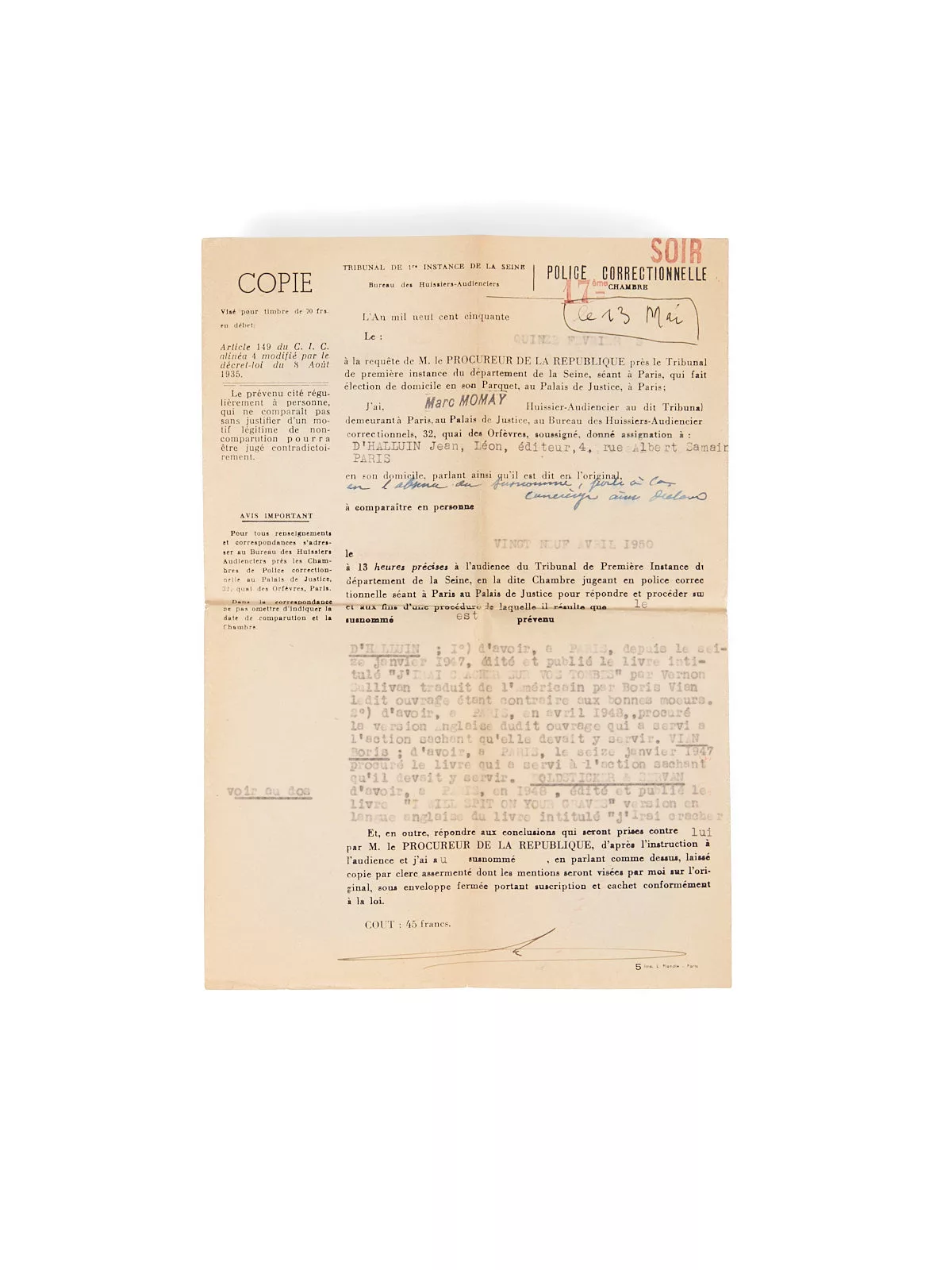
Exceptional copy belonging to the publisher Jean d'Halluin, numbered no. 1 on pur fil paper (the sole deluxe paper), accompanied by the original summons to appear before the Tribunal de première instance de la Seine for the hearing of 15 February 1950, relating to the trial brought against the book and its publisher.
The first book published by Boris Vian, J’irai cracher sur vos tombes (I Shall Spit on Your Graves) left a lasting mark on the history of French publishing: a scandalous novel that became a literary myth, banned in 1949 and later rehabilitated, it stands at the center of one of the most notorious legal affairs of the postwar period.
In 1946, Jean d’Halluin, a twenty-one-year-old publisher who had just founded Éditions du Scorpion, met Boris Vian through his musician brother. Inspired by the rising success of the Série Noire, he asked Vian for an “American-style” novel: Vian wrote J’irai cracher sur vos tombes in a fortnight, between 5 and 20 August 1946. The original title, J’irai danser sur vos tombes, was changed on the suggestion of Michelle Léglise, Vian’s first wife.
The book appeared on 8 November 1946, signed Vernon Sullivan, with Vian presenting himself merely as the translator. The preface stressed the supposed impossibility of publishing such a text in puritanical America, invoking Henry Miller, James Cain and James Hadley Chase as models.
The press immediately seized on the scandal, accusing the novel of pornography and sadism. Its success was considerable — nearly 500,000 copies sold within fourteen months — but the scandal grew when a crime of passion committed in Montparnasse the following year was directly linked by the newspapers to a reading of the novel. On 7 February 1949, the public prosecutor opened proceedings against the author, the publisher and the translator for “outrage to public morals,” following a complaint by the Cartel d’action sociale et morale. The book was banned by decree of the Ministry of the Interior in July 1949.
Summoned to appear, Vian and d’Halluin faced severe penalties. The hearing, initially set for 15 February, was postponed and finally held on 13 May 1950. At the conclusion of the trial, both men were fined 100,000 francs each, a sentence reduced on appeal in October 1953 to fifteen days’ imprisonment, amnestied under the law of 6 August 1953, and 20,000 francs in costs.
The summons accompanying this copy is an unpublished document, summoning Jean d’Halluin for having edited and published the novel “contrary to public morals,” alongside Boris Vian and his co-defendants.