

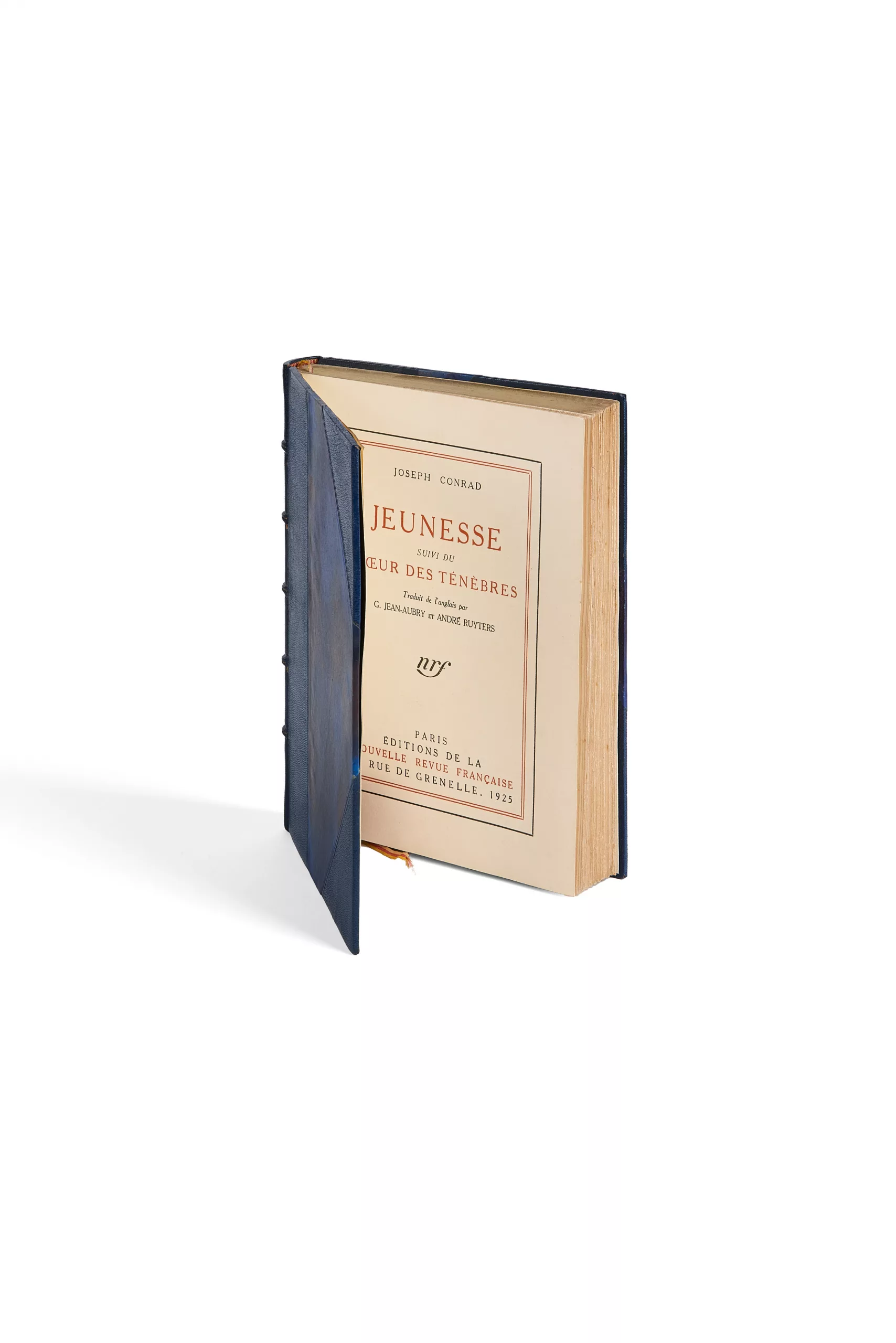
Jeunesse. Coeur des ténèbres
One of 109 copies from the first, réimposé issue on Lafuma-Navarre laid paper (no. XCVI).
“There is nothing to boast of in having it, since your strength is just an accident arising from the weakness of others.” In other words, for there to be the strong, there must first be the weak. The strong man here is Kurtz, an exceptionally gifted adventurer, the fitting product of the West, who has ventured into the depths of the Congolese jungle and subdued a tribe by the sheer power of his splendid and malevolent eloquence. The journey of Charles Marlow, a young officer of the British merchant marine, into the wild territories of Africa to retrieve this Kurtz — “in charge of a trading post and a most efficient collector of ivory” — becomes a descent into the unconscious, submerged in jungle, sweat, noise, heat, long marches and madness; and it is within this darkness that men struggle in vain against forces beyond them, forces that ultimately lead them into solitude or death.
Heart of Darkness had first appeared in serial form in Blackwood’s Magazine in 1899, then within a collection of three stories published by Conrad in 1902: Youth: A Narrative, and Two Other Stories.
These two remarkable narratives, born of Conrad’s own experience in the Belgian Congo from June to December 1890, inspired Francis Ford Coppola’s Apocalypse Now, though without preserving the disquieting ambiguity of Marlow’s encounter with Kurtz. Mention should also be made of Aguirre, the Wrath of God, by the German director Werner Herzog, released in 1972 with Klaus Kinski in the title role: its plot, transposed to the Latin America of the conquistadors, likewise draws on another of Conrad’s books, Almayer’s Folly.