

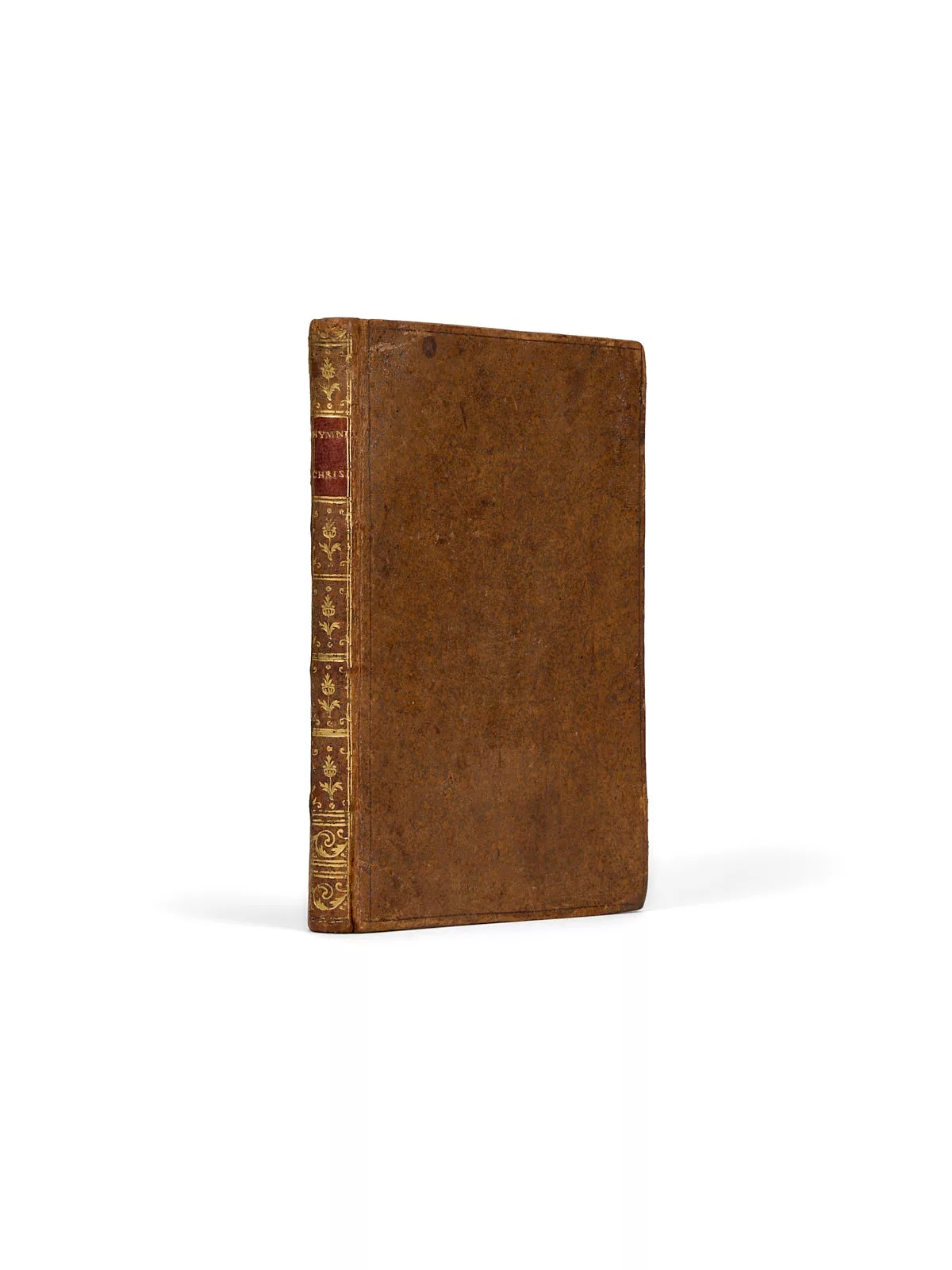
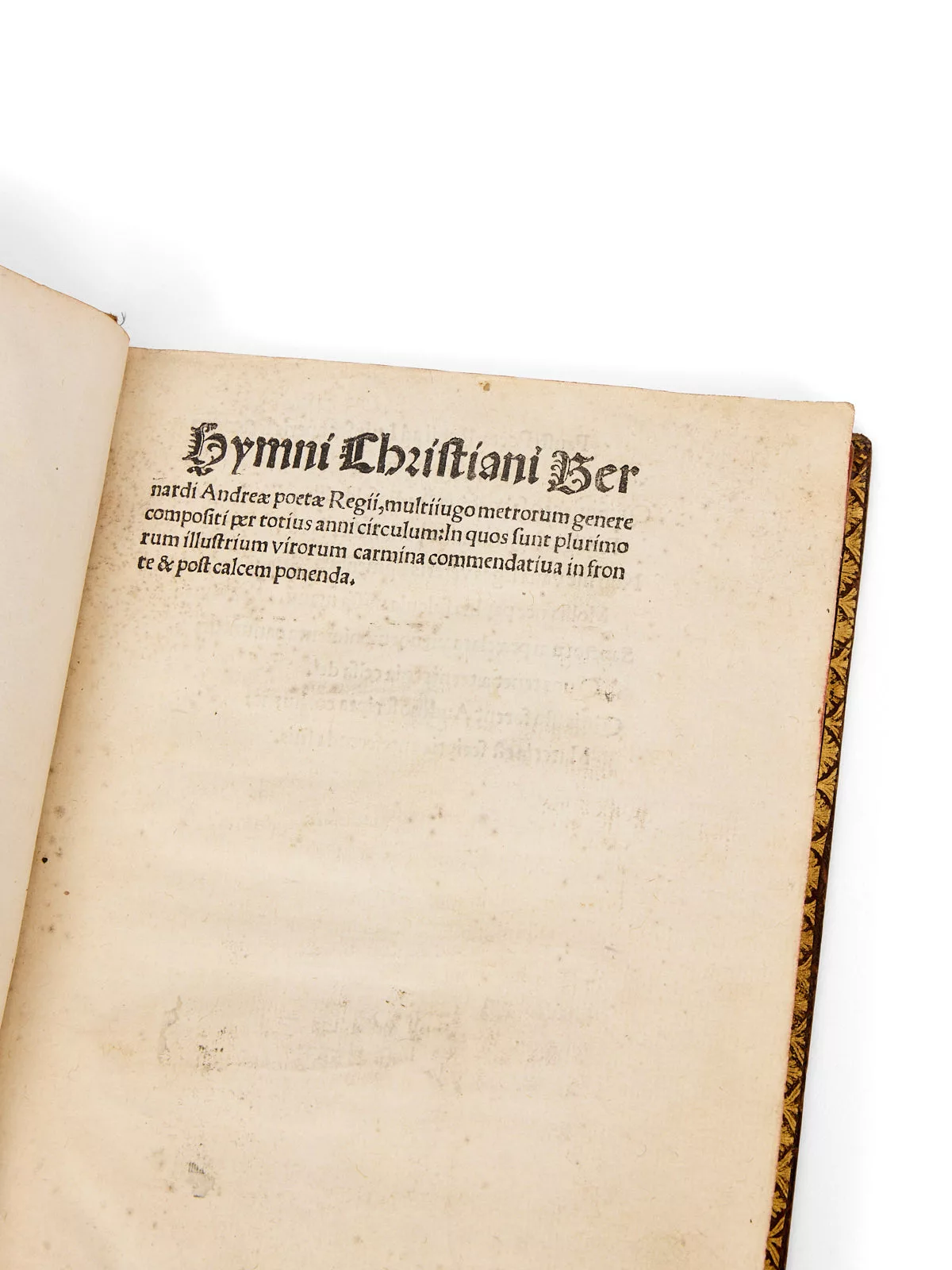
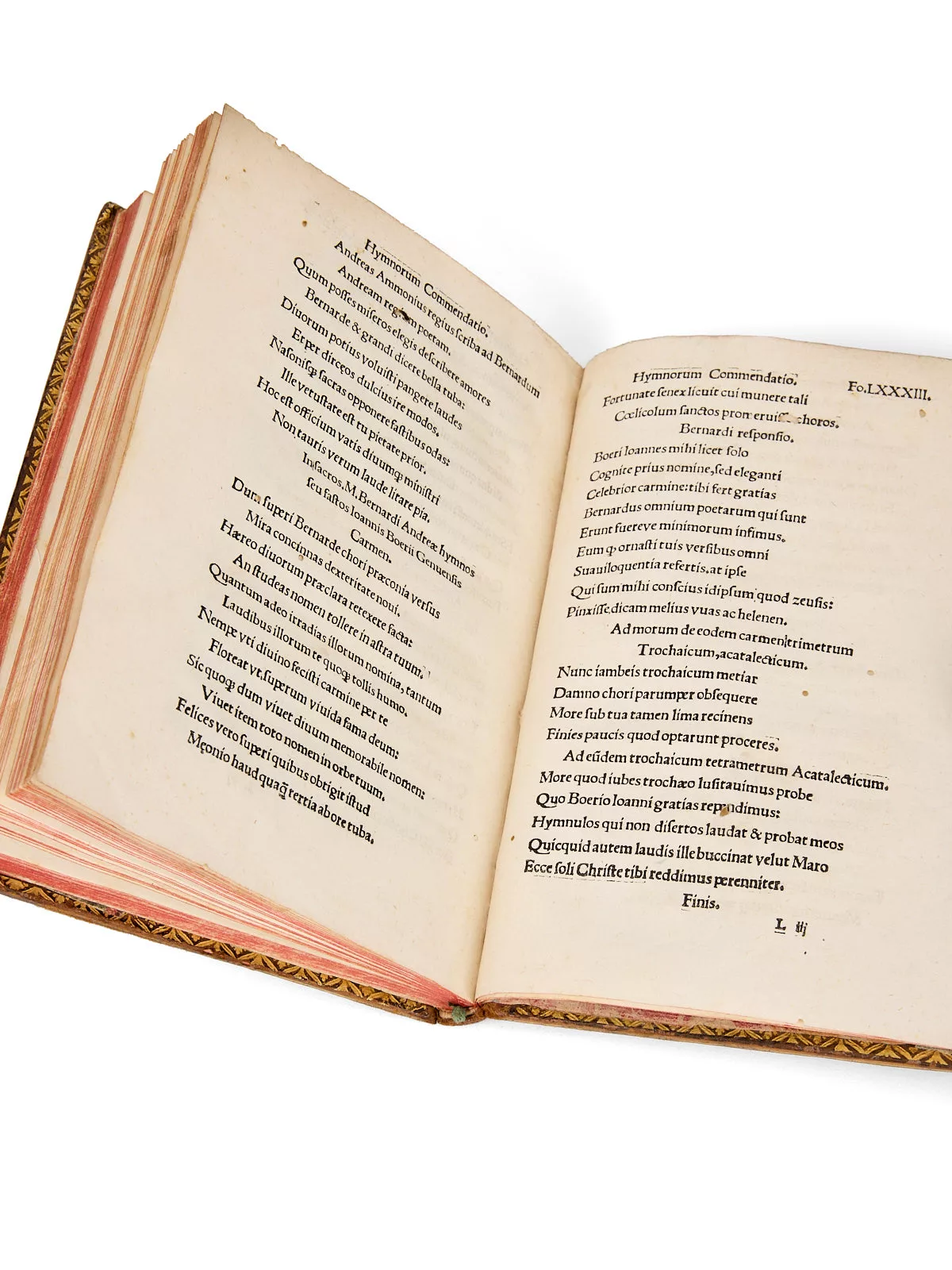
Hymni christiani bernardi andrae poetae regii
Born around 1450 in Toulouse, André Bernard was brought to England by Richard Fox, Bishop of Winchester, who enjoyed great influence with Henry VII of England and employed him in all his negotiations, serving as the king’s privy councilor, keeper of the seals, and later principal secretary of state. Through Fox, André Bernard entered the English court and was appointed chronicler and Royal Chaplain, later becoming tutor to the King’s two sons, Arthur and Henry, the latter crowned King Henry VIII in 1509.
The Hymni were begun on this occasion and completed in 1512. Publication had to wait until 1517, by Josse Bade, in Paris.
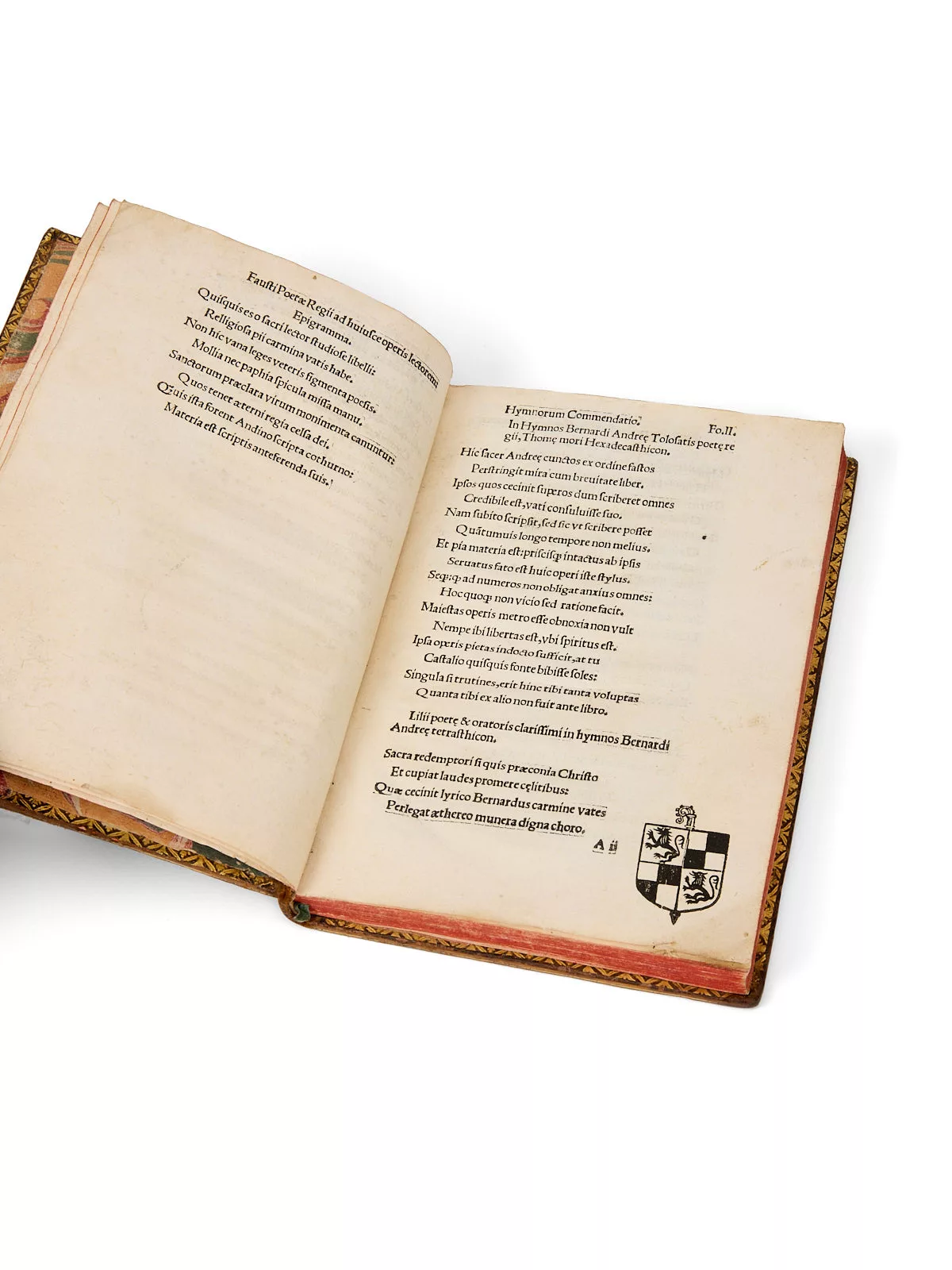
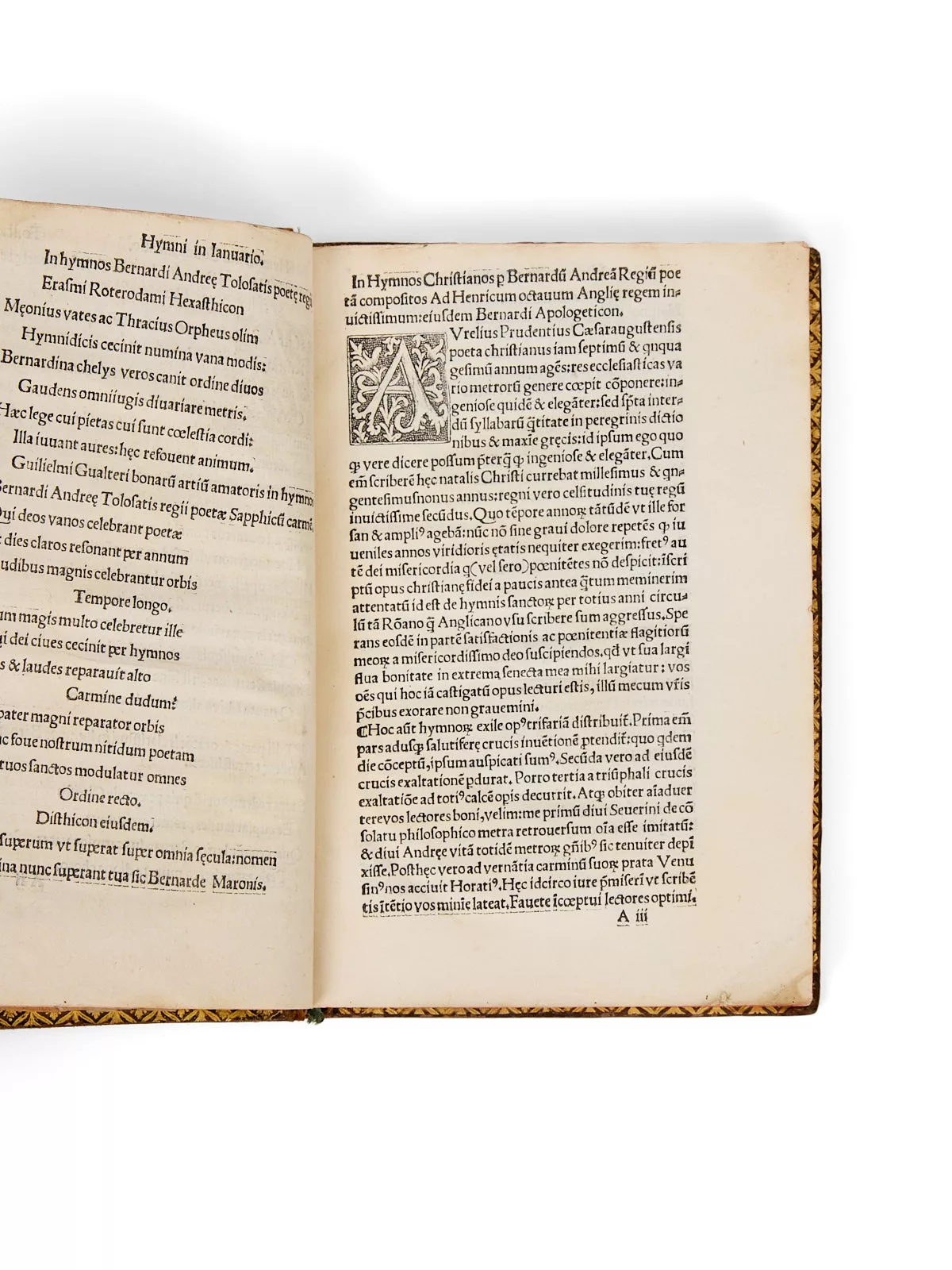
This would be the poet’s only published collection. In the meantime he had become Poet Laureate, the King’s official poet, expected to compose verse for festivals and celebrations. The Hymni are dedicated to Henry VIII, with an epitaph at the head; two epigrams are the work of Thomas More and Erasmus, both of whom he met in England — Thomas More was then Master of Requests at the court of Henry VIII and one of the King’s privy councilors; there are also contributions by William Lily and William Walter.
André Bernard was the fourth Poet Laureate, a little more than a century after an illustrious storyteller, Geoffrey Chaucer. John Skelton succeeded him under Henry VIII. Among the great names of English poetry to have held this office are Ben Jonson, William Wordsworth and Lord Alfred Tennyson. Sir Walter Scott declined the office in 1850.
André Bernard was the only non-British poet ever to hold the post; his manuscripts are preserved at the British Library.
Many of Bernard’s other works are considered lost, and the Hymni form the only edition ever published. Several unpublished manuscripts are preserved at the British Library, in the Humanistica Lovaniensia department, and only two copies of the Hymni are recorded — both in the United Kingdom — in public collections: one at the British Library, the other at the Bodleian Library, University of Oxford.
Renouard mentions a copy at the University of Amsterdam, which we have been unable to locate and which does not appear in WorldCat.
No other copy appears to exist.
Renouard, Imprimeurs et libraires parisiens du XVIe siècle, 342; Carlson, King Arthur and Court Poems for the Birth of Arthur Tudor in 1486, Humanistica Lovaniensia, XXXVI, 147–183 and 419; Carlson, The Writings of Bernard André, Renaissance Studies, XII, 1998, 229–250, no. 28.