

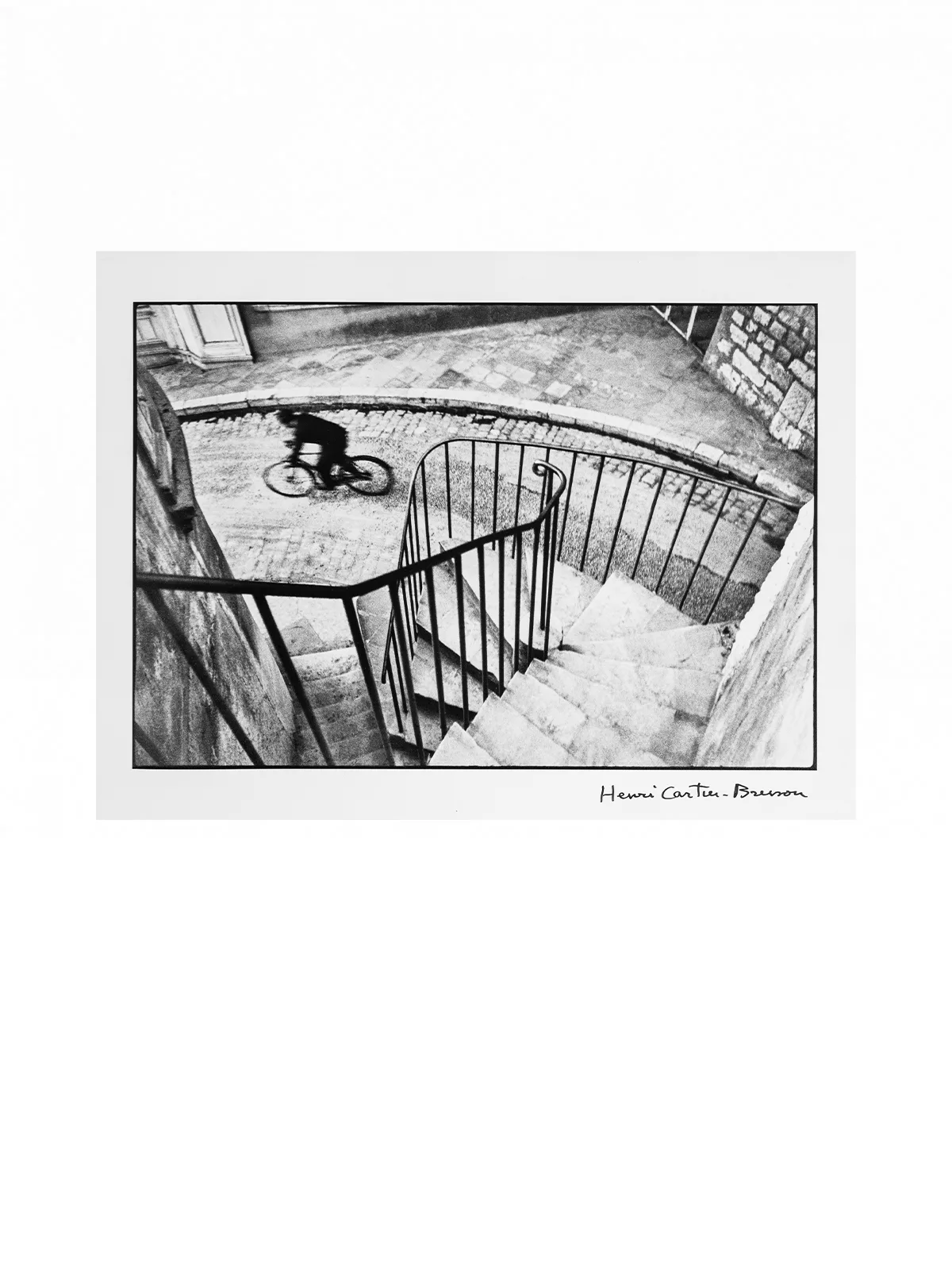
Hyères
One of his earliest photographs, taken in 1932.
“Around 1931,” Cartier-Bresson recalled, “I saw a photograph by Martin Munkácsi […], three Black children running into the waves. I have to say that this photograph lit the fuse. There is such intensity in that image, such spontaneity, such joy of life.” He abandoned his early training in painting and literature and devoted himself to photography.
Hyères was taken at the very beginning of Cartier-Bresson’s photographic career, shortly after his return from a trip to Africa in 1931. Standing at the top of a stairway on the rue Edith-Wharton, he released the shutter of his Leica 50 mm, bought a few days earlier in Marseille, at the fleeting passage of a cyclist. The black, curved railing has since been replaced by a white, angular one, and the cobblestones of the street have been covered with asphalt.
In early 1932, Cartier-Bresson passed through Hyères. His choice of framing is far from incidental and reveals the aesthetic he was pursuing in this urban landscape. A spiral forms between the staircase and its metal railing, echoing the curve of the pavement below — an almost mathematical composition, one that recalls Cartier-Bresson’s known fascination with Matila Ghyka’s book on the golden ratio, published that same year. Everything here contributes to the dynamism of the photograph, a perfect illustration of his conviction that to “signify” the world, one must feel implicated in what one frames through the viewfinder.
“By pressing the shutter release of his Leica, Cartier-Bresson arrested motion, but at the same time he was able to produce images that, through their framing, composition and rhythm, preserved the dynamism of the action. Following the principle of dialectical synthesis, they are therefore at once in motion and at rest: fixed and explosive.” (Chéroux, 2014, p. 86.)
A major work from Henri Cartier-Bresson’s early career.
Henri Cartier-Bresson, The Decisive Moment, Paris and New York, 1952; Peter Galassi, Henri Cartier-Bresson, The Modern Century, exhibition catalogue, Museum of Modern Art, New York, 2010, reproduced p. 89; Clément Chéroux, Henri Cartier-Bresson: Here and Now, London and New York, 2014; MET New York, Gilman Collection, 2005, 100-460; Robert Delpire, Henri Cartier-Bresson: Photographer (Boston, 1979), pl. 13; Peter Galassi, Henri Cartier-Bresson: The Early Work (New York, The Museum of Modern Art, 1987), p. 100; Peter Galassi, Henri Cartier-Bresson: The Modern Century (New York, The Museum of Modern Art, 2010), p. 89; Clément Chéroux, Henri Cartier-Bresson, Paris, Centre Pompidou, 2014, p. 88; Matthieu Humery, Henri Cartier-Bresson: le Grand Jeu (Paris, Bibliothèque nationale de France and Fondation Henri Cartier-Bresson, 2020), pp. 82 and 248.