

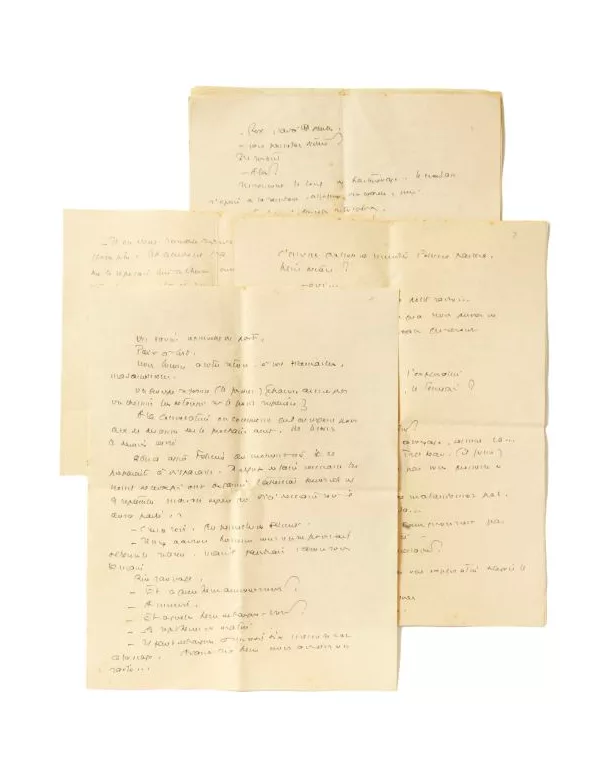
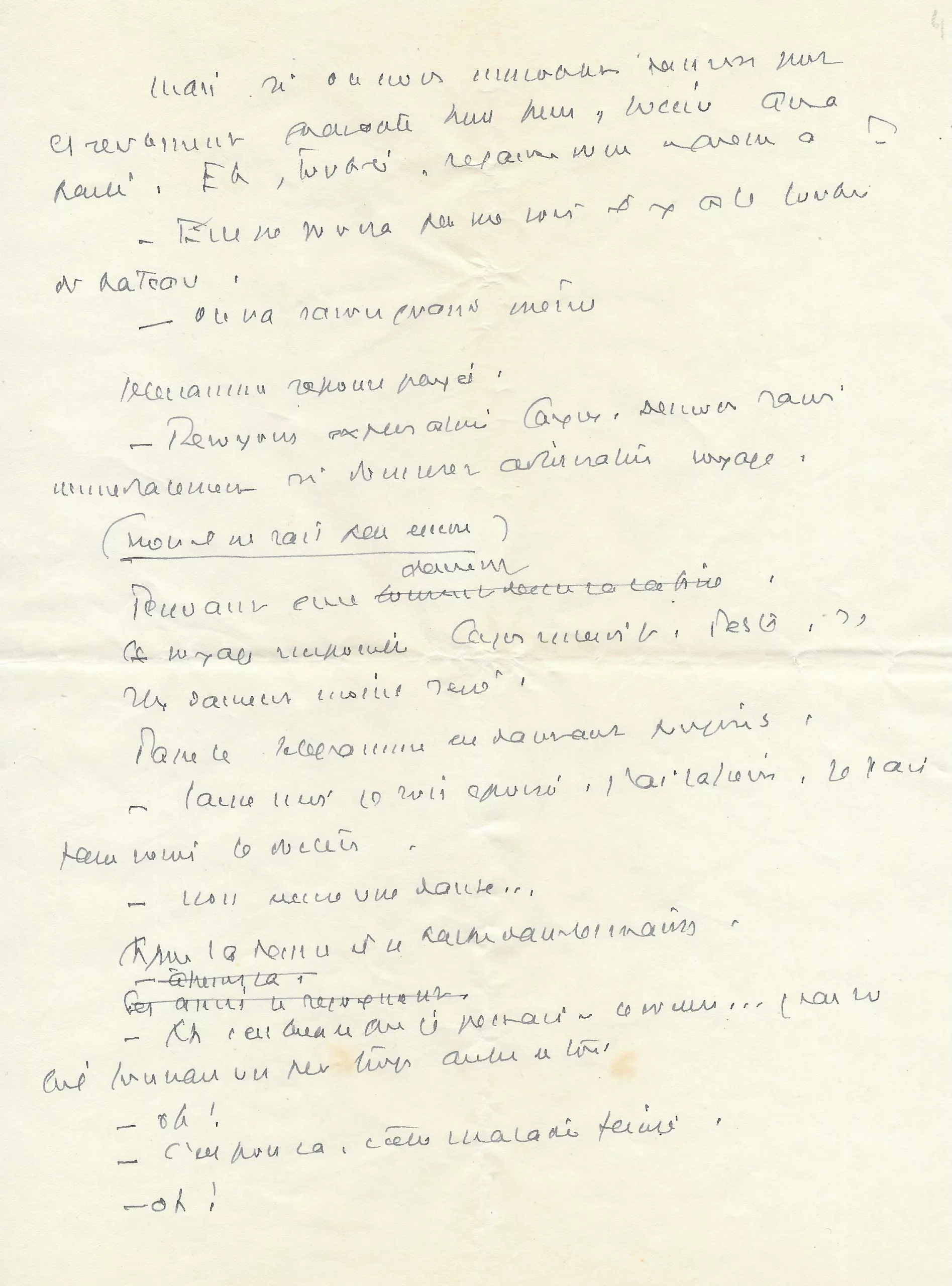
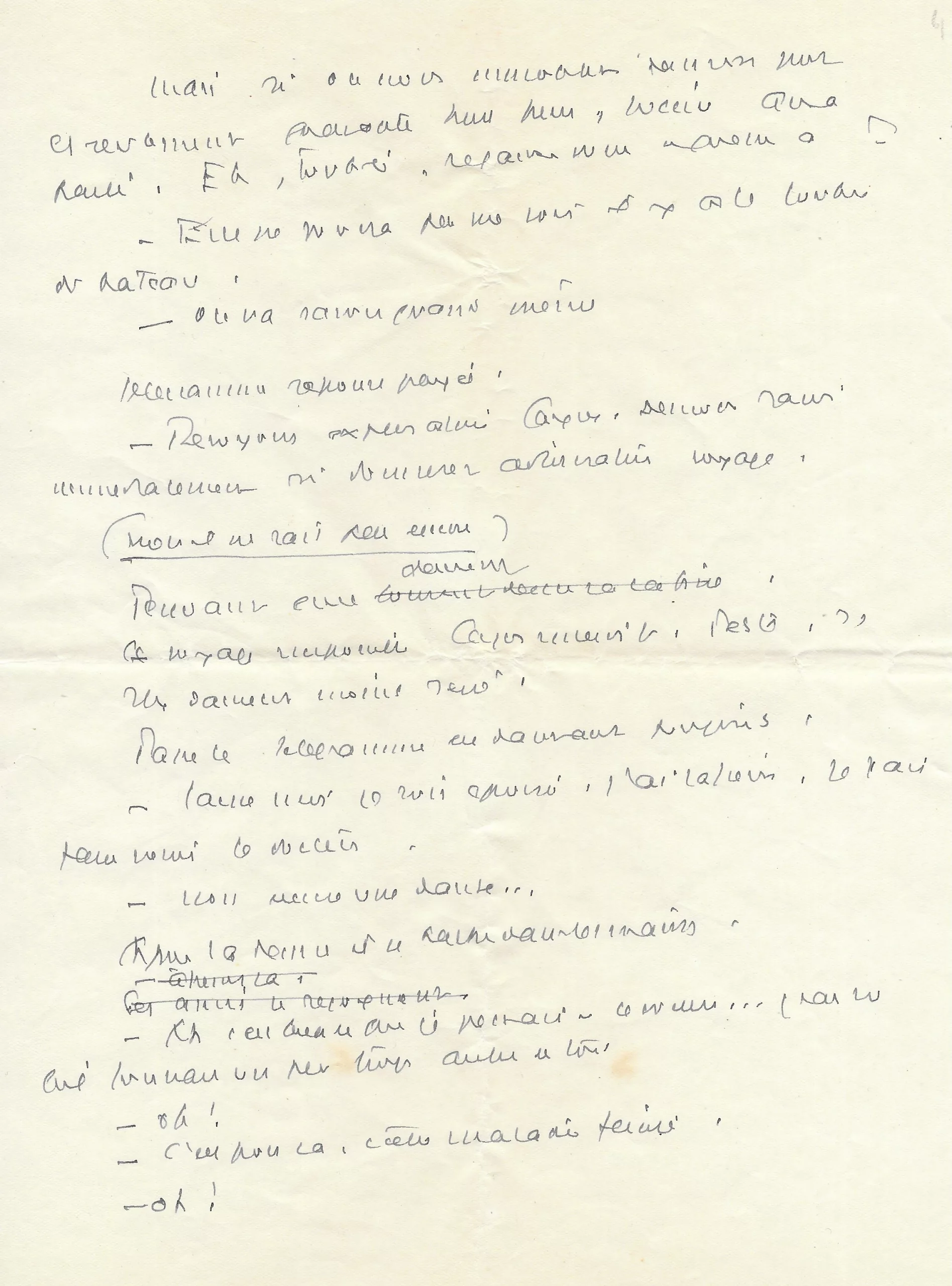
« Huit heures à vivre »
A regular filmgoer, Saint-Exupéry, like all young people of his generation, was an enthusiastic lover of the cinema. His ambitions as a screenwriter surfaced between 1931 and 1936, a period during which he wrote seven film projects and took part in the adaptation of some of his books for the screen.
This scenario can be linked to a passage in his Lettre à un otage: the collection opens precisely with an account of his crossing to the United States from Portugal in December 1940, in which he describes the roulette and baccara players, mostly refugees about to depart. Lauren Bacall and Humphrey Bogart could almost have been cast!
Huit heures à vivre tells a story far removed from the fictional universe of Le Petit Prince: a dark world peopled with crooks, swindlers and prostitutes, beginning in the slums of Rio and continuing in the holds of an ocean liner struck by a plague epidemic. The ship eventually reaches Lisbon carrying 1,500 emigrants, many of them sick. Five terrorists on board take advantage of the captain’s panic and confusion to commit their worst crimes.
This scenario is inspired by that of Igor, a script entrusted to Pierre Billon in the summer of 1940, in Nice, just before the writer’s departure for the United States: “This is for you. It is a film subject. If I come back we will work on it together, otherwise you will make it on your own.” He added with a smile: “Don’t lose it. It’s the only copy… and I typed it myself!” Shown at the exhibition Antoine de Saint-Exupéry at the Archives nationales in November 1984 (no. 450), this typescript consists of twenty leaves with a few manuscript corrections. Christian Janicot, in his preface to the Anthologie du cinéma invisible, emphasizes how far the world of Igor is from Saint-Exupéry’s usual register, as Pierre Billon summarized: “The essence of this story is not the revolution. It is, above all, the drama that unfolds aboard an old steamship which, setting out from South America, returns to a country in Europe. During the crossing, two men sacrifice their lives so that a third may arrive and carry out his mission, which is to lead the uprising that will free his country from a regime of oppression.” No manuscript of Igor is known to exist.
Huit heures à vivre, a reworked and more literary version of it, was probably composed in the United States in the second half of 1940. Aboard the liner are a lovesick, suicidal explorer stricken with the plague, her lover, also ill, and terrorists responsible for an attack, including one Felicio, arrested by the police, who refuses to betray his fleeing accomplices, all blending into the crowd of other travelers. The explorer, afraid of losing her lover, tells him she has the plague… and takes her own life. A long passage follows on the question of suicide as duty: “—Isn’t that so, doctor? Suicide is cowardice. A woman’s suicide is even a violent act. Is he responsible for this death? No, of course not! He is responsible for nothing. Suicide can only be understood… if, for instance, it saves companions. Then, yes. If it defends a cause. Then it is not only excusable, I would even say it is a duty.”
Saint-Exupéry produced a rewriting of it, in the form of an untitled manuscript reprising the plot but this time set in Africa; it was offered for sale in 2011 at Artcurial (May 9, 2011, Saint-Exupéry section, no. 269). The writer also produced one further scenario — a film about the Resistance — in 1941.
In 1935 he had written the screenplay for Anne-Marie, the story of a young woman engineer who dreams of learning to fly and moves within a group of pilot friends, all of them in love with her. Raymond Bernard directed the film that same year, with Annabella in the title role as the archetype of the modern, seductive woman, aviator and adventuress. It is the only original screenplay of his to be brought to the screen. Vol de nuit (Night Flight), released a year earlier but in which Saint-Exupéry had no involvement, was a great success that persuaded him to adapt Courrier Sud (Southern Mail), which he had been considering since 1931. His screenplay was ready in 1936, for which a very young beginner, Françoise Giroud, assisted him; it was passed on to the director Pierre Billon. Two producers were found: André Aron and his associate, the aviator Édouard Corniglion-Molinier, a friend and companion in adventure of Malraux. Filming took place at the end of 1936 in Mogador (present-day Essaouira), in Morocco. The film was released in 1937. For Anne-Marie and the adaptation of Courrier Sud, only corrected typescripts are known, with no manuscripts or even autograph drafts.
Mention should also be made of an unfinished film project inspired by the failed Paris–Saigon raid of December 31, 1935, which ended, after a forced landing in the middle of the desert, in a rescue by a tribe of nomads. The project was drafted as a fifteen-leaf typescript, shown at the exhibition Antoine de Saint-Exupéry at the Archives nationales in November 1984 (no. 448), as was Sonia, a synopsis on a nine-page typescript, given to Raymond Bernard, the director of Anne-Marie. This synopsis contains an element that would later be reused, transformed, in Huit heures à vivre: it features the character of a plague-stricken Spanish dancer, who contaminates the ship as it begins its Atlantic crossing.
Sale Antoine de Saint-Exupéry (Artcurial, 2012, no. 146); Histoire postale, héros de l’aviation (Artcurial, 2018, no. 96); Paule Bounin, “L’œuvre cinématographique de Saint-Exupéry,” Études littéraires, 2001, pp. 113–124; Christian Janicot, Anthologie du cinéma invisible, 1995.