

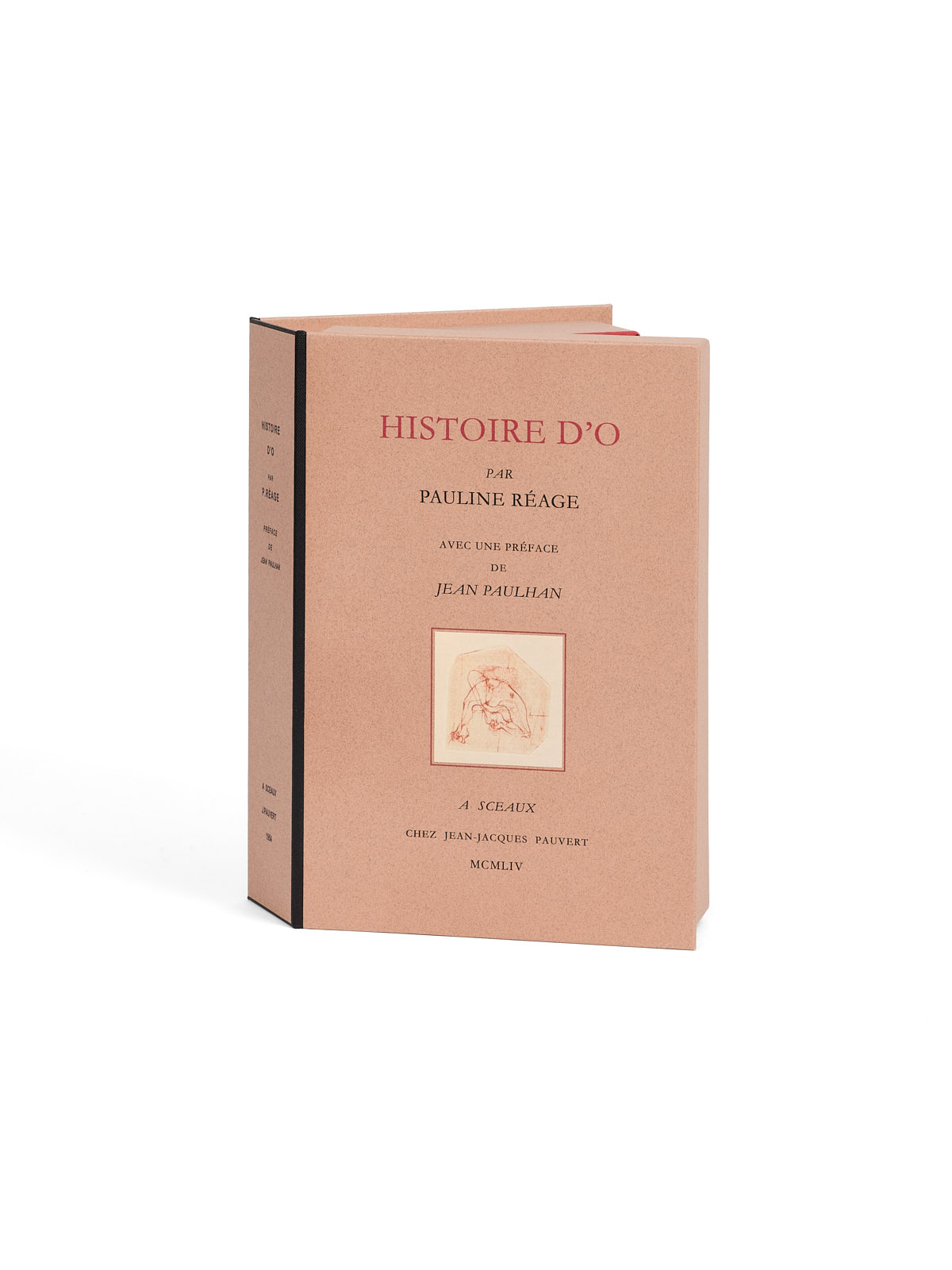

Histoire d’O
We owe to Jean-Jacques Pauvert’s memoirs much of what is known about the literary and editorial genesis of this now-classic work of erotic literature. Dominique Aury, alias Pauline Réage, described it in Une fille amoureuse, written for the publisher fifteen years after the novel appeared: “A girl in love once said to the man she loved (Jean Paulhan, in this case): I too could write those stories you like… You think so, he replied. […] One evening, after that ‘You think so?’, instead of picking up a book before falling asleep, lying curled on her left side with a very black pencil in her right hand, this girl began to write the story she had promised […]. Then, ten pages at a time, five pages, chapters or fragments of chapters, she sent them by post to a poste restante address.” Aury submitted her text to Gallimard’s editorial committee, which rejected it; Paulhan then offered it to Jean-Jacques Pauvert, asking him to write a preface, which Paulhan delivered under the title “Le Bonheur dans l’esclavage.”
A precious copy belonging to Régine Deforges, who was the mistress of Jean-Jacques Pauvert, the man who introduced her to publishing and to his world. Their first meeting took place at the Café de Flore in Paris. “They talked at once about Sade, one of Pauvert’s favorite authors, whom she had also read, and about Bataille, Boris Vian… She was fascinated by Pauvert, and they saw each other often. She recalled taking pleasure in the time spent with him, in those long lunches, without realizing that he was ‘courting her, for he was a married man’ — was she still naïve? They became lovers; he never left his wife. And one day, as she recounts in L’Enfant du 15 août, she abruptly fell out of love. But together they had a daughter, Camille […]. It was also Jean-Jacques Pauvert who, some years later, enabled Régine Deforges to meet Dominique Aury” (in “Régine Deforges l’insolente,” Josyane Savigneau, Le Temps, April 4, 2014).
Régine Deforges had read the book in 1954 and had been fascinated by its audacity; the two women remained close friends thereafter, until Dominique Aury’s death in 1998. In 2004, Deforges explained the full impact the book had had on her, fifty years earlier: “I read Histoire d’O shortly after it appeared, and it was a shock to the young woman I was then. Afterward, I reread the novel almost every year for ten years, then two or three more times since, discovering on each new reading things that had escaped me. I remember that at the time, I understood nothing about O; her submission to her lover’s desires was unbearable to me: I had to fall in love myself, in turn, to understand how far one could go for the love of a man. So when Jean-Jacques Pauvert suggested I meet this legendary author, I accepted with joy and a certain apprehension. From our very first meeting, I was won over by Dominique Aury, by her kindness and simplicity. I was surprised that she was so far removed from the idea I had formed of a writer who had written such a disturbing book […]. Over the years, our friendship developed, and she agreed to answer my questions about the origin of Histoire d’O and why she had written it; this gave rise to O m’a dit, a book dear to my heart. For long hours, she answered my questions, hiding nothing of her fantasies nor those of the lover for whom she had written this book, knowing it would trouble him and, perhaps, frighten him. ‘I wanted him to love me despite that,’ she told me, with that pride in submission which made her resemble her heroine […] Histoire d’O had, for my generation and those that followed, an importance we only came to realize much later: a woman dared to speak her most secret desires and freed us from the shame attached to fulfilling them.”
It was Pauvert who encouraged her to found a publishing house in 1967, L’Or du temps, in homage to André Breton’s phrase: “Je cherche l’or du temps.”
Régine Deforges also owned the regular issue of Histoire d’O — one of the copies on vergé paper — inscribed by Pauline Réage in the late 1970s, when the two women met (Collection Régine Deforges, Pierre Bergé & Associés, Paris, February 2015, no. 194). The deluxe copy, meanwhile, remained in the Deforges estate.
A very fine copy, preserved in a box by Julie Nadot, remarkable for its delicacy and precision.
From the library of Régine Deforges (bookplate).