

Hartung
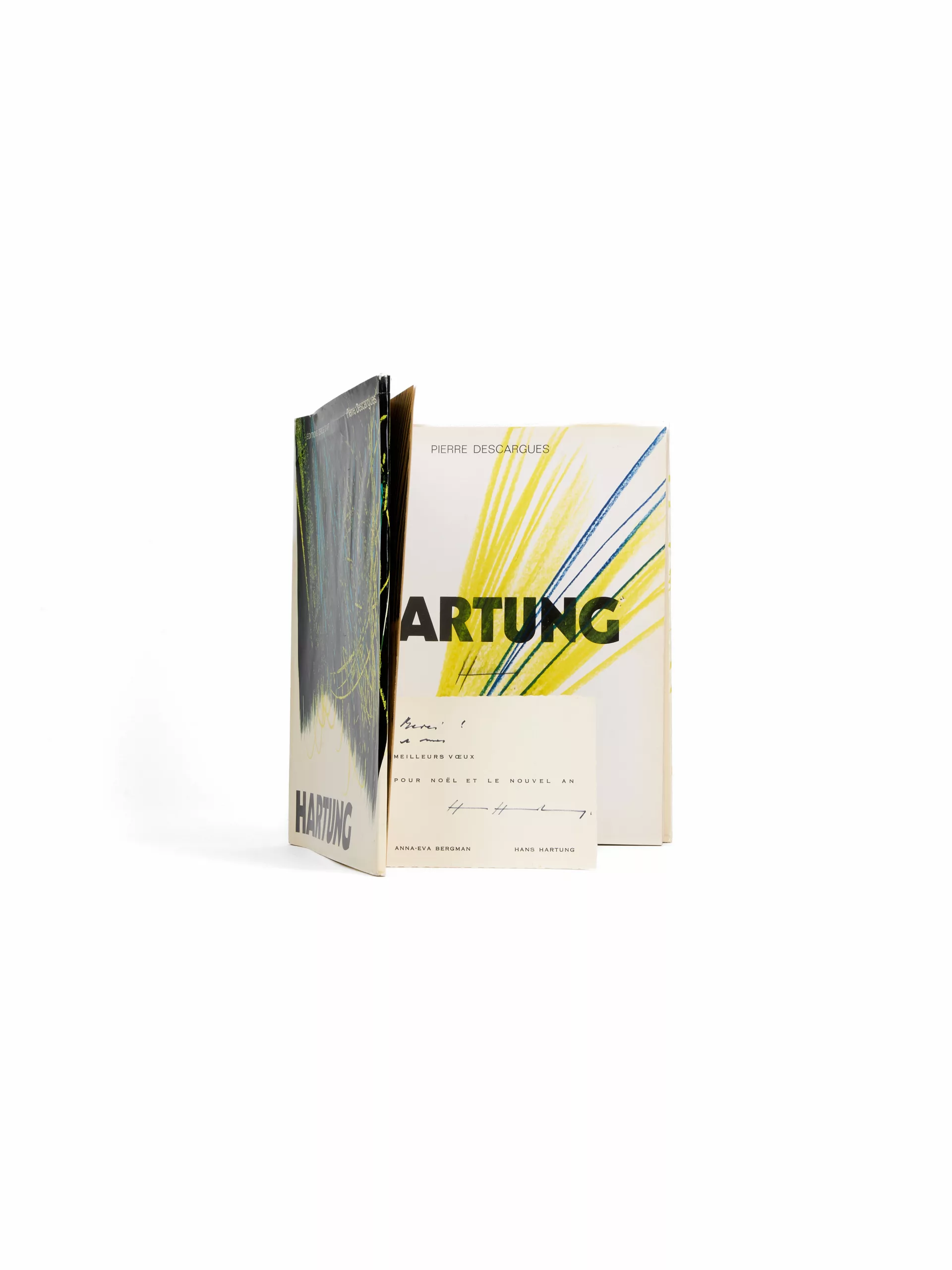
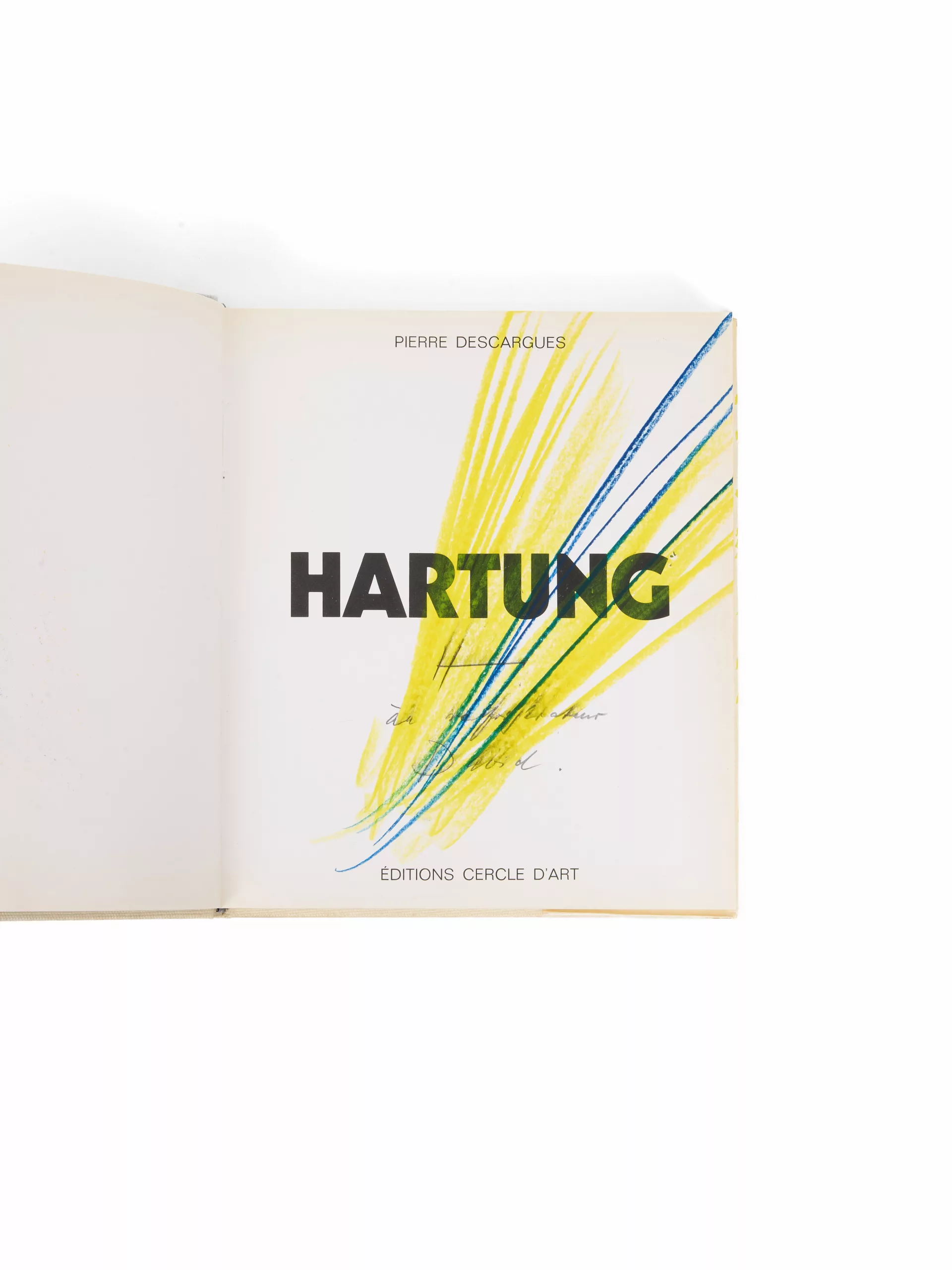
An exceptional copy, enriched with a large original drawing: a pastel intervention (flashes of yellow streaked with blue and green lines) covering the half-title page, signed with a large “H” at the center of the composition, together with an autograph presentation inscription.
Accompanied by: an autograph greeting card, signed: “Merci ! Avec mes meilleurs vœux pour le Nouvel-An. Anna-Eva Bergman et Hartung.”
Born in Leipzig in 1904, Hans Hartung developed an early and distinctive graphic vocabulary — the childhood “books of lightning” — that would nourish his gestural grammar. Trained in Leipzig, Dresden and then Paris (visits to the Louvre, spells with Lhote and Léger), he turned to abstraction as early as 1922, experimenting with watercolor and charcoal before developing his method: calculated spontaneity, transferred to canvas by way of a squared grid, a practice he maintained until 1960. Exiled to Paris under Nazism, close to Hélion, Domela, Miró, Calder and Julio González (whose studio left a lasting impression on him), he served in the Foreign Legion; wounded in 1944 and amputated, he resumed after the war a body of work built on vivid signs in ink and pastel, soon transposed onto large canvases.
After several major retrospectives (Documenta, in 1955, 1959 and 1964) and the Grand Prize for Painting at the Venice Biennale in 1960, he adopted vinyl paints and scraping techniques that freed his gesture on a larger scale. Settled in Antibes with Anna-Eva Bergman, he built a house and studios while continuing to expand a systematic catalogue of his work. Their house-studio has housed the Fondation Hartung-Bergman since 1994.
His election to the Académie des Beaux-Arts in 1977 coincided with the publication of this important monograph, issued by Éditions Cercle d’Art. This copy was presented to David Beccaria, an art collector and well-known figure in Nice, whose shop — located at 2, cours Saleya — welcomed guests and artists, notably those of the École de Nice: it was not an art gallery, but… an ice-cream parlor!