

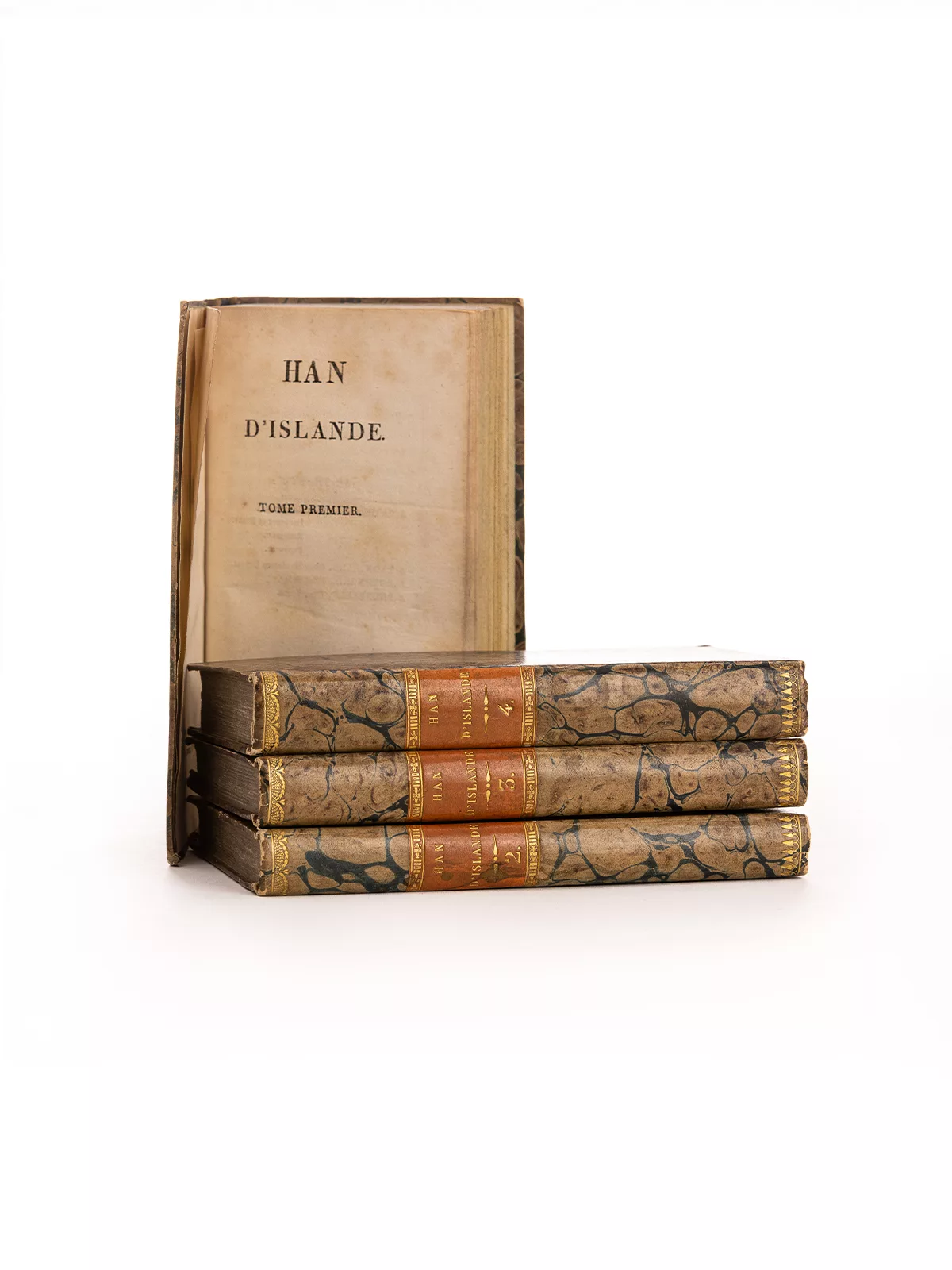
Han d’Islande
Victor Hugo’s first published novel, Han d’Islande appeared on 8 February 1823, anonymously, in four duodecimo volumes, published by Persan, an improvised bookseller and ruined marquis to whom the young writer had sold his manuscript for a thousand francs. The book belongs to a decisive moment in Hugo’s life: after a long engagement to Adèle Foucher, his marriage was celebrated on 12 October 1822, made possible by the pension granted him by Louis XVIII. It was in this context of financial anxiety, literary ambition and newly won happiness that Hugo reworked this text, begun as early as 1820. The autobiographical element should not be sought in incident, but in a certain emotional intensity: this novel of extreme passions, violence, fidelity and obstacles clearly bears the mark of this youthful episode.
The book attracted attention early on. Le Réveil, as early as 23 January 1823, announced the imminent appearance of a novel of Nordic inspiration, comparing it to Walter Scott; then Le Constitutionnel, on 15 February, half-revealed its authorship by attributing the book to Victor Hugo, already known for his Odes. The edition is recorded in the Bibliographie de France of 8 February 1823. Hugo himself was dissatisfied with it: the printing was faulty and full of misprints, so much so that he wished to issue a corrected version ten years later, with Renduel, in May 1833. Charles Nodier devoted a favorable article to the book in La Quotidienne, a famous piece that marked the beginning of his relationship with Hugo and of a friendship that would prove significant. A youthful melodrama, willingly excessive, Han d’Islande nonetheless remained dear to its author, who returned to it in memory and imagination; several of its scenes and effects already anticipate, from a distance, the world of Notre-Dame de Paris.
An attractive copy in contemporary boards: fine copies of this first edition in contemporary binding are extremely rare.
From the library of Frédéric de Pourtalès (bookplate).
Vicaire, IV, 236; Carteret, I, 390, “A very rare and highly esteemed work.”