

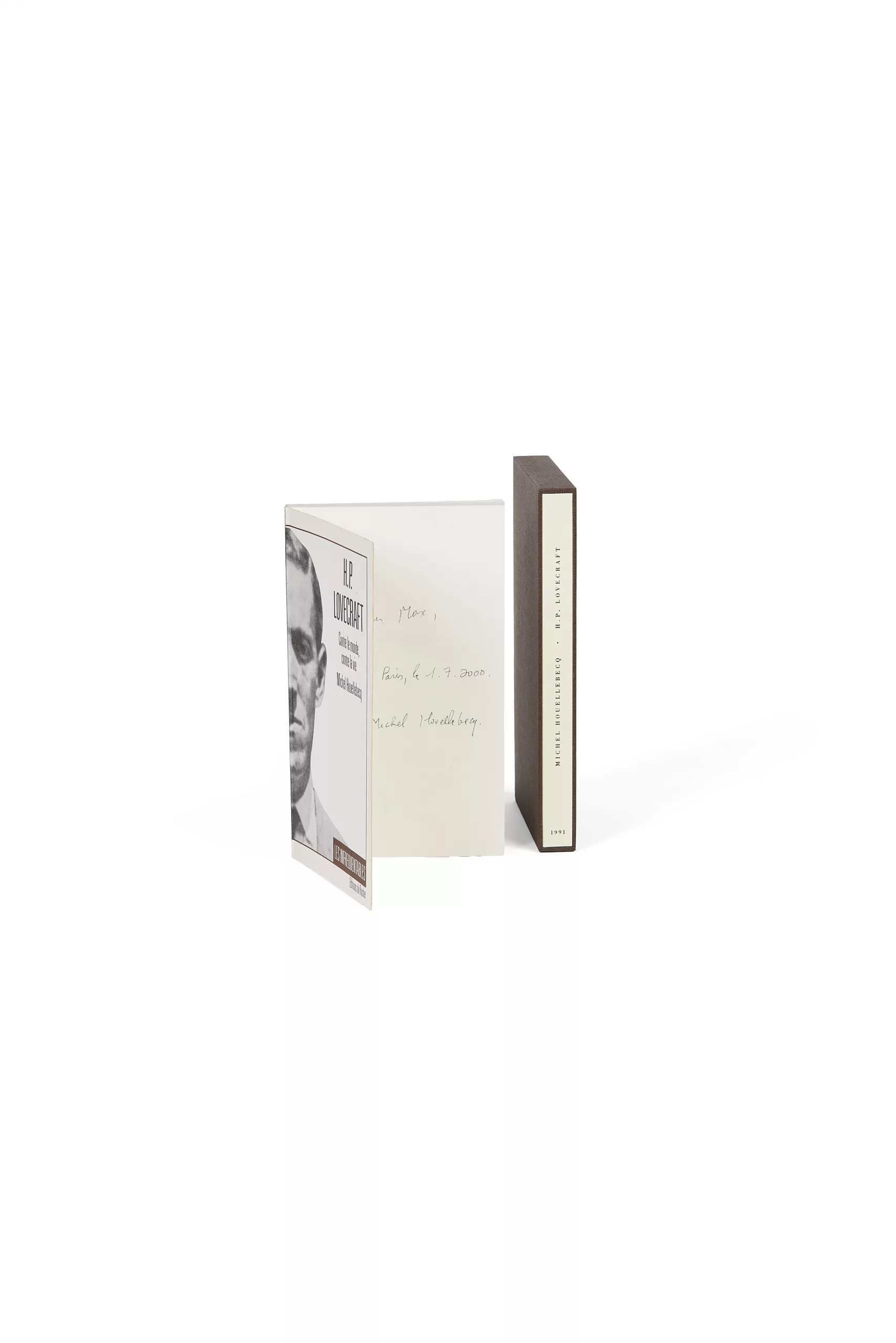
H.P. Lovecraft. Contre le monde, contre la vie
Inscribed and signed: “Pour Max, à Paris, le 1.7.2000. Michel Houellebecq.”
In 1991, Houellebecq joined the National Assembly as an administrative secretary in the computer department, an uninspiring position similar to the one he had previously held at the Ministry of Agriculture, but his status as a civil servant now gave him the material security he needed to write. By this time he had already published, in a rather confidential manner, a few poems in the Nouvelle Revue de Paris, edited by his friend Michel Bulteau, who offered him the chance to publish his first book in his newly launched series “Les infréquentables” at Éditions du Rocher: an essay on the American author Howard Phillips Lovecraft, the master of weird fiction.
Having read the author of The Call of Cthulhu, Dagon and At the Mountains of Madness since the age of sixteen, Houellebecq never stopped reading Lovecraft. Both a biography and a brilliant analysis of the work of the “recluse of Providence,” Lovecraft contre le monde, contre la vie already contains the seeds of the themes that would come to define Houellebecq’s own fiction: the atomization of human beings amid rising individualism, nature as a blind force, the gradual disappearance of all spirituality, the erosion of values, the futility of a purposeless existence, and the world conceived as a jungle of competition, combat, victory and crushing defeat. These preoccupations reveal a clear line of continuity between the poet he already was and the novelist he would become. A few lines drawn from the text say more than any commentary about the tone of the future author of Whatever: “it is hardly surprising that Lovecraft felt little sympathy for Freud, the great psychologist of the capitalist era. That universe of ‘transactions’ and ‘transferences,’ which makes one feel as though one has stumbled by mistake into a board meeting, held nothing to seduce him.” And in his conclusion, Houellebecq pays tribute to Lovecraft the poet: “The work of his maturity remained faithful to the physical prostration of his youth, transfiguring it. Here lies the deep secret of Lovecraft’s genius, and the pure source of his poetry: he succeeded in transforming his disgust with life into an active hostility.”
Note also the “brief bibliography” at the end of the volume, “arranged in order of preference,” accompanied by the author’s own remarkable personal remarks.
The same series would go on to publish Alain Jouffroy’s Arthur Rimbaud et la liberté libre, also in 1991; Michel Bulteau’s Baron Corvo, l’exilé de Venise in 1990; and Jean-Pierre Deloux’s Dashiell Hammett, Underworld USA in 1994. Houellebecq’s Lovecraft was reissued in 2005 by the same publisher with an introduction by Stephen King, translated from his preface to the American edition.