

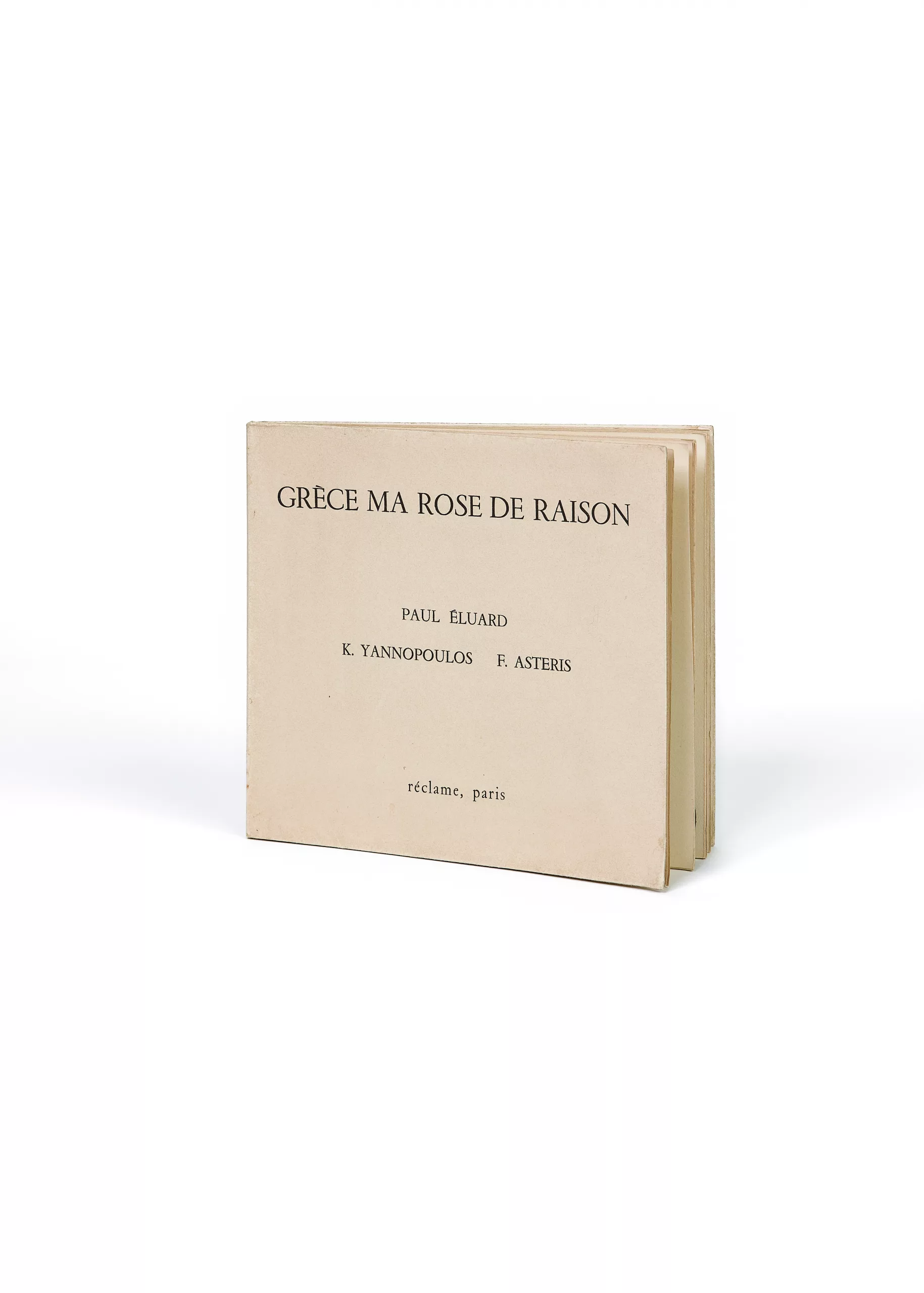
Grèce ma rose de raison
One of 115 first copies on Crèvecoeur paper (no. 69), preceding a commercial printing of 10,000 copies.
Translation by Melpo Axioti and Paul Éluard.
Poems by Éluard, K. Yannopoulos and F. Asteris, composed during the Greek Civil War — the latter two being Greek poets and revolutionaries, the first executed in 1948 and the second sentenced to death.
In the spring of 1949, Paul Éluard traveled to Greece accompanied by two Resistance journalists from the socialist left, Jean-Maurice Hermann and Yves Farge, then a commissioner of the Republic. There they joined the Greek revolutionaries led by General Markos. Éluard came away dazzled by his journey: “I am having a wonderful trip through free Greece,” he wrote to his daughter Cécile. “I am really living, here, a whole period of my life. The fighters, men and women, are prodigious in hope, courage and beauty. […] Last night, four thousand peasants and soldiers carried us in triumph. My poem Athéna had been read aloud. It was a rally for world peace, and everyone sang and danced…” (quoted in the Bibliothèque de la Pléiade, II, p. 1114).
On his return, Éluard wrote several poems in homage to the Greek resistance fighters, first published in Les Lettres françaises with an introduction by Claude Roy, then in an edition illustrated with 6 color woodcuts by “Z. Srnitch,” printed in 50 copies. It is now known, thanks to copy no. 1 (Kahn collection, Mille nuits de rêves, I, 2019, no. 253), who was hiding behind this name: a Franco-Yugoslav mosaicist and engraver born in Budapest in 1924, Zizi Makris, wife of the sculptor Agamemnon (known as Memos) Makris. She came to Paris in 1946, where she studied engraving and printmaking at the École des Beaux-Arts under Galanis, who probably introduced her to Éluard. The Makrises were expelled from France in 1951 because of their political activities and returned to Yugoslavia, then illegally to Greece in 1960, where she was arrested and imprisoned for a year. Grèce ma rose de raison was her first book.
This first edition brings together six poems: “Le soir recule”; “Le Mont Grammos”; “Prière des veuves et des mères”; “Dans la montagne vierge”; “Des yeux qui ont vraiment trop souffert de voir”; and “Vieille jeunesse.” For the Réclame edition that followed shortly afterward, Éluard added four further poems: “Pour ne plus être seuls”; “Athéna”; “La Grèce en tête”; and “Si la Grèce était délivrée.”