

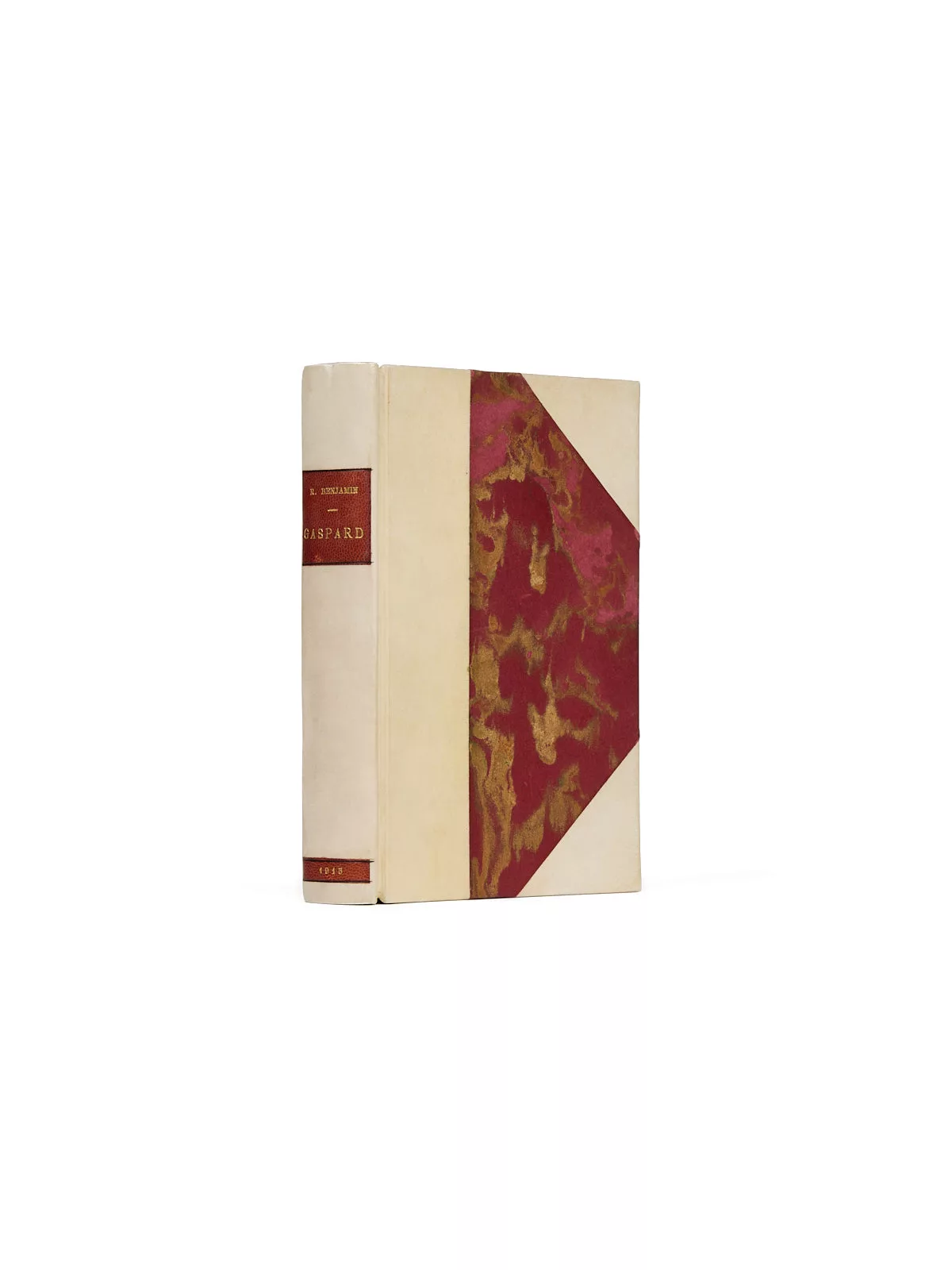
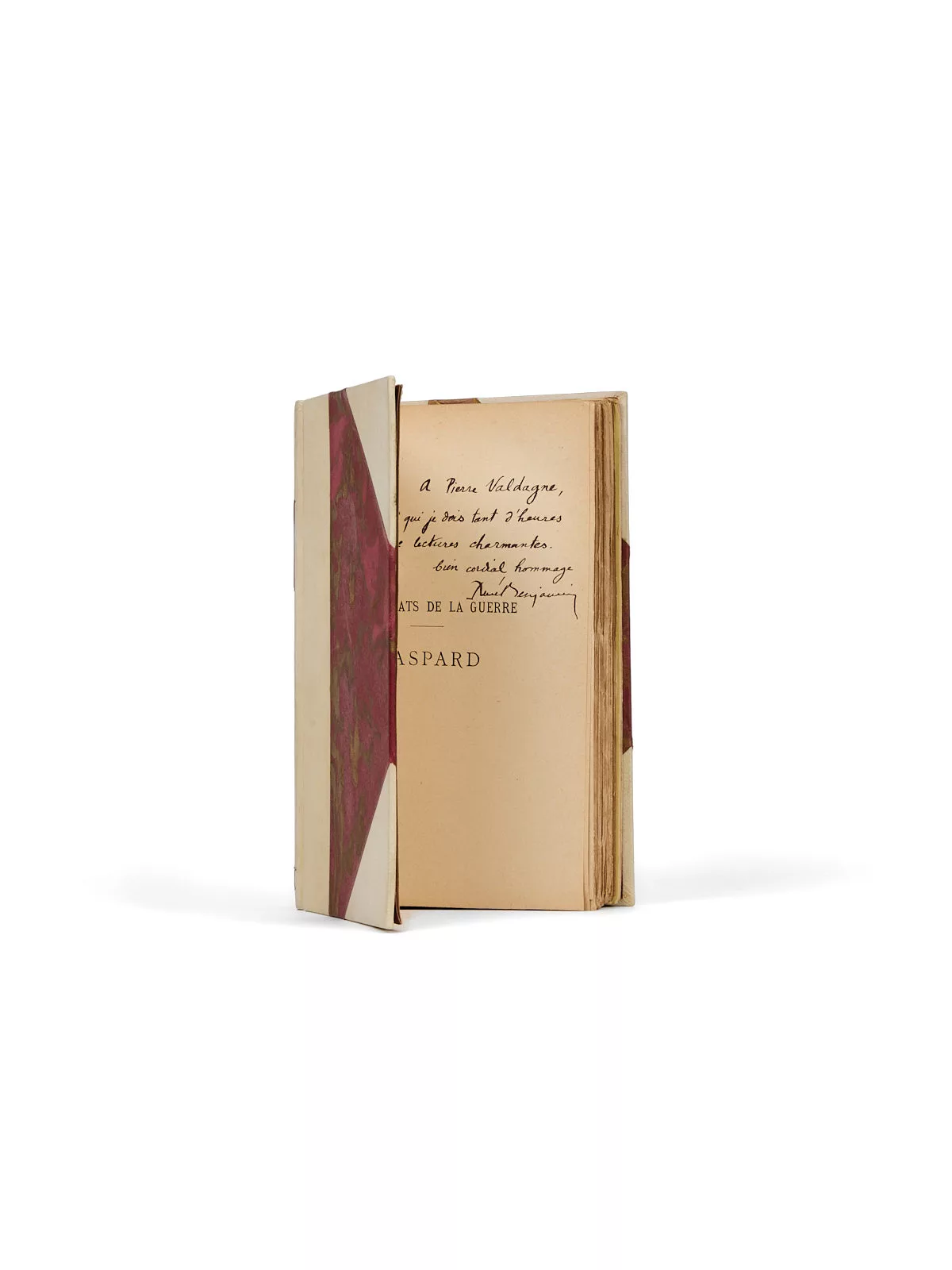
Presentation copy inscribed by René Benjamin to Pierre Valdagne: “À Pierre Valdagne, à qui je dois tant d'heures de lectures charmantes. Bien cordial hommage, René Benjamin.”
René Benjamin and Pierre Valdagne collaborated after the war on the literary review Les Œuvres libres.
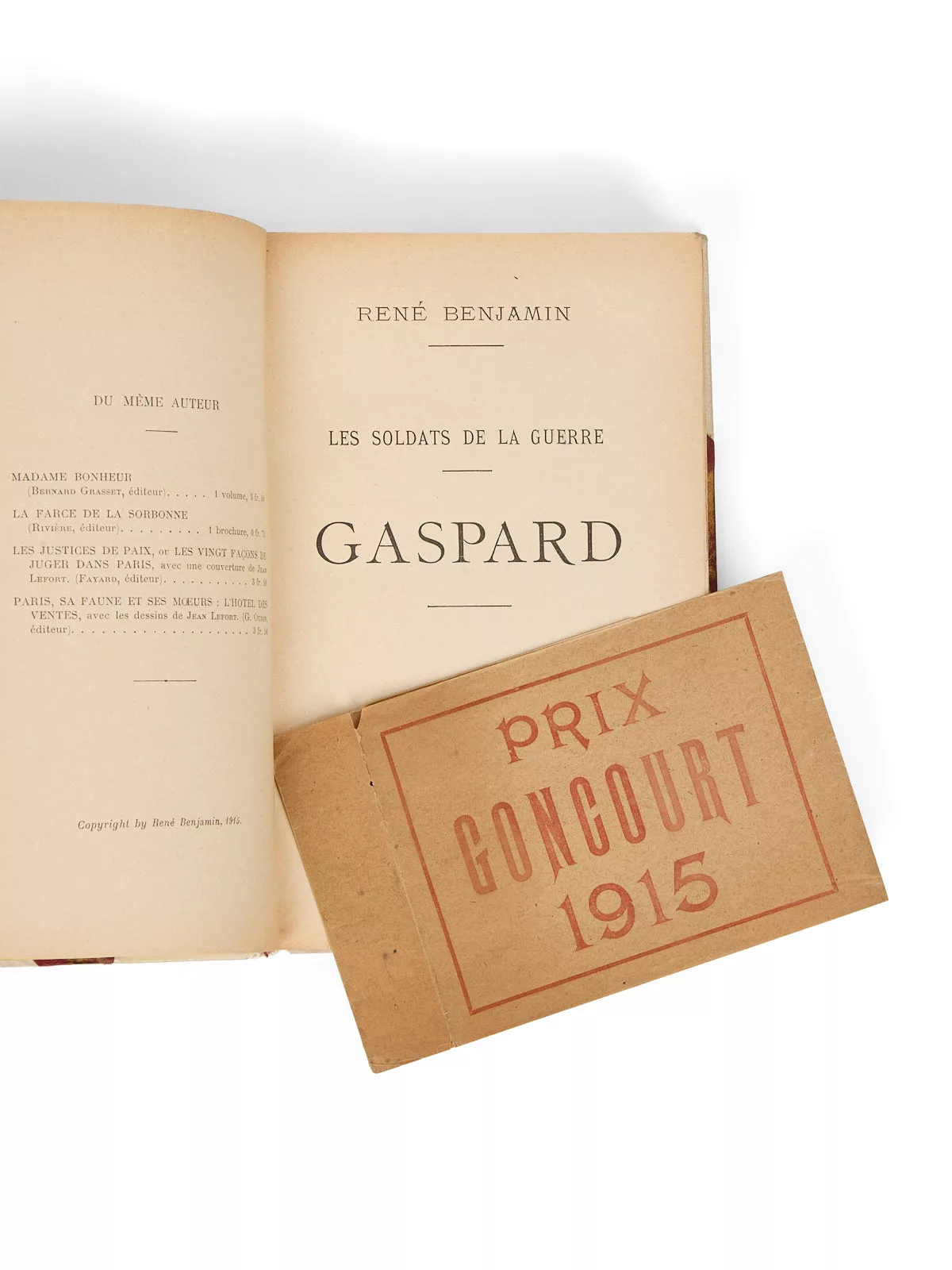
Winner of the 1915 Prix Goncourt, Gaspard is one of the earliest literary accounts of the First World War.
On 31 October 1914, the members of the Académie Goncourt met for the first time at the restaurant Drouant, place Gaillon. With the outcome of the war still highly uncertain, the academicians decided not to award their prize that year, planning instead to give two the following year. The double award would not in fact take place until 1916, and so, in December 1915, “in order to allow young authors whose novels were in press or under consideration at the outbreak of the war to take part in the competition,” a single prize was awarded.
For the first time since the Goncourt’s creation in 1903, it was awarded unanimously, to Gaspard by René Benjamin. Mobilized at the outset of the conflict at the age of twenty-nine, Benjamin offers a chronicle of barracks and front-line life through the character of Gaspard, a boastful, quick-witted Parisian meant to embody the French poilu. Unlike other, darker publications, Gaspard is distinguished by its cheerful, satirical tone, exposing the absurdities of military hierarchy.
Among the dozens of books published from 1915 onward on the theme of the emerging conflict, Gaspard was above all the first and only true novel: it enjoyed great success on publication and, bolstered by the Prix Goncourt, quickly reached its hundredth printing. According to Norton Cru, Gaspard was the favorite book “of a public kept ignorant of the military situation by the strict, uncompromising censorship of the early war years. Published a year later, its success would have been doubtful; two years later, it would have gone unnoticed. On one point Gaspard is truer than Le Feu: only the Parisian hero speaks slang, a legitimate slang, taken from life […]. This praise I give the author proves his talent for observing people’s speech.”
This episode opened a particular period for the Goncourt: in 1915, 1916, 1917 and 1918, all five prizes were awarded to combatants and their more or less fictionalized accounts of the front. This reflects both the powerful appeal of war narratives and the willingness of publishers — even when driven by commercial motives — to document these years of conflict through literature.
In 1938, René Benjamin became the first Prix Goncourt laureate to join the jury.
Jean Norton Cru, Témoins, 567; Talvart, I, 355.