

Galanis
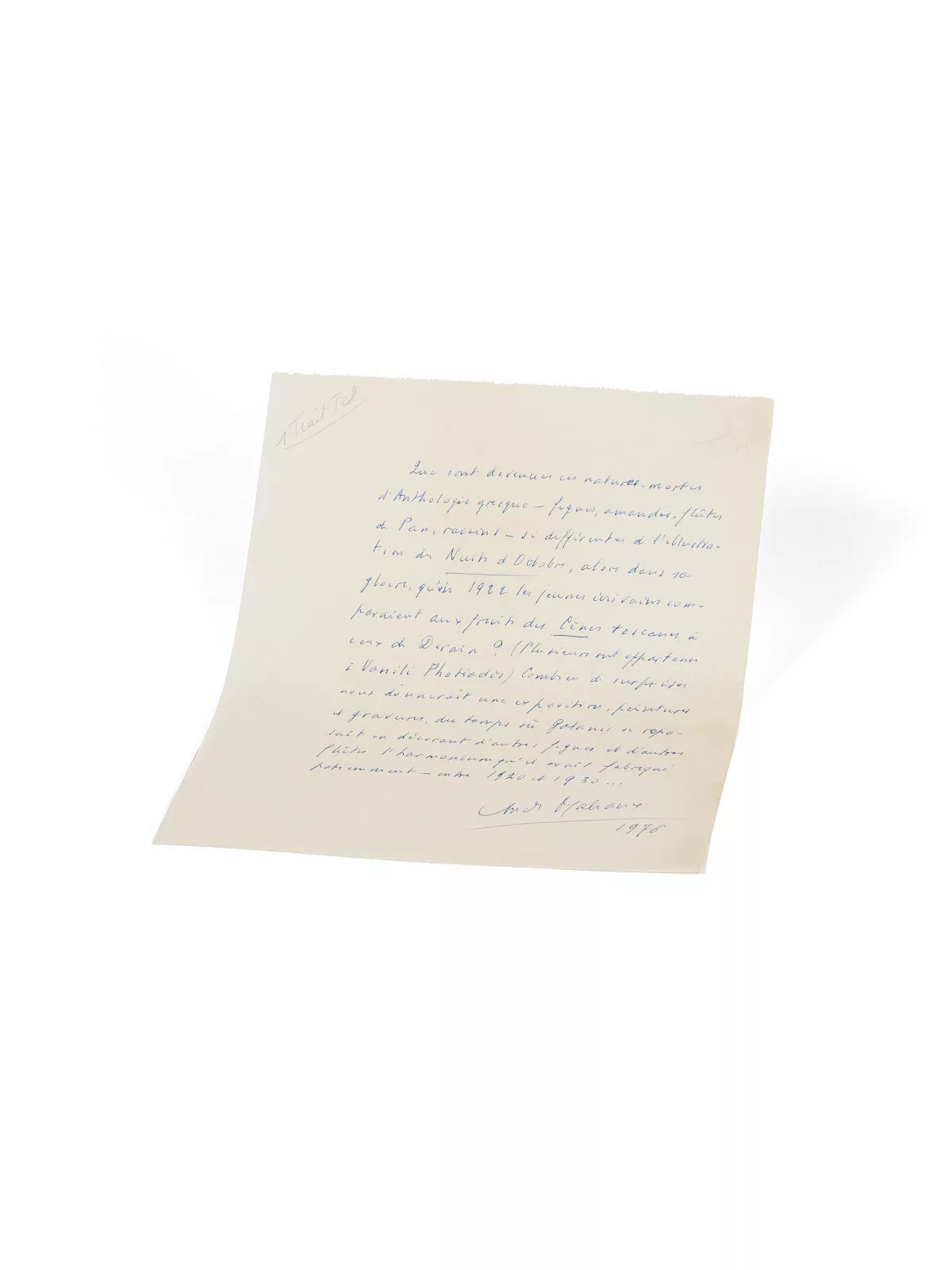
One of Malraux's last texts, recalling his friend Galanis: fifty years of friendship.
Malraux’s friendship with Galanis began early, in 1919. The young Malraux had visited the painter’s studio in Montmartre, and his very first text as an art critic, published in 1922, concerned the Greek painter, whose exhibition catalogue Malraux prefaced. It was a foundational friendship that would lead to a fruitful collaboration: throughout his editorial ventures, both on behalf of Simon Kra and for his own imprint (founded with his childhood friend Louis Chevasson under the name “À la Sphère,” later “Les Aldes”), Malraux repeatedly called on Galanis to illustrate books, notably those of Georges Gabory, Paul Morand and Albert Samain.
For Gallimard’s foreign-authors series “Du Monde Entier,” Malraux entrusted Galanis with designing the cover vignette, the series being intended to “bring together some of the best foreign novels, presented by well-known French writers whose authority would guarantee the reader, among the considerable number of translations from every language, a certain literary quality.” The motif Galanis created was used, for every title without exception, as the central cover ornament until 1961, when it was replaced by a photographic design by Georges Guimbertaud, adapted by Massin.
Their friendship culminated in the exhibition organized at the Bibliothèque nationale in 1963, on the initiative of the Minister of Culture, three years before the artist’s death in 1966. Malraux also played a full part in transforming the “ruche de Montmartre” — the studio where Galanis worked in the 1920s — into what is now the Musée de Montmartre.
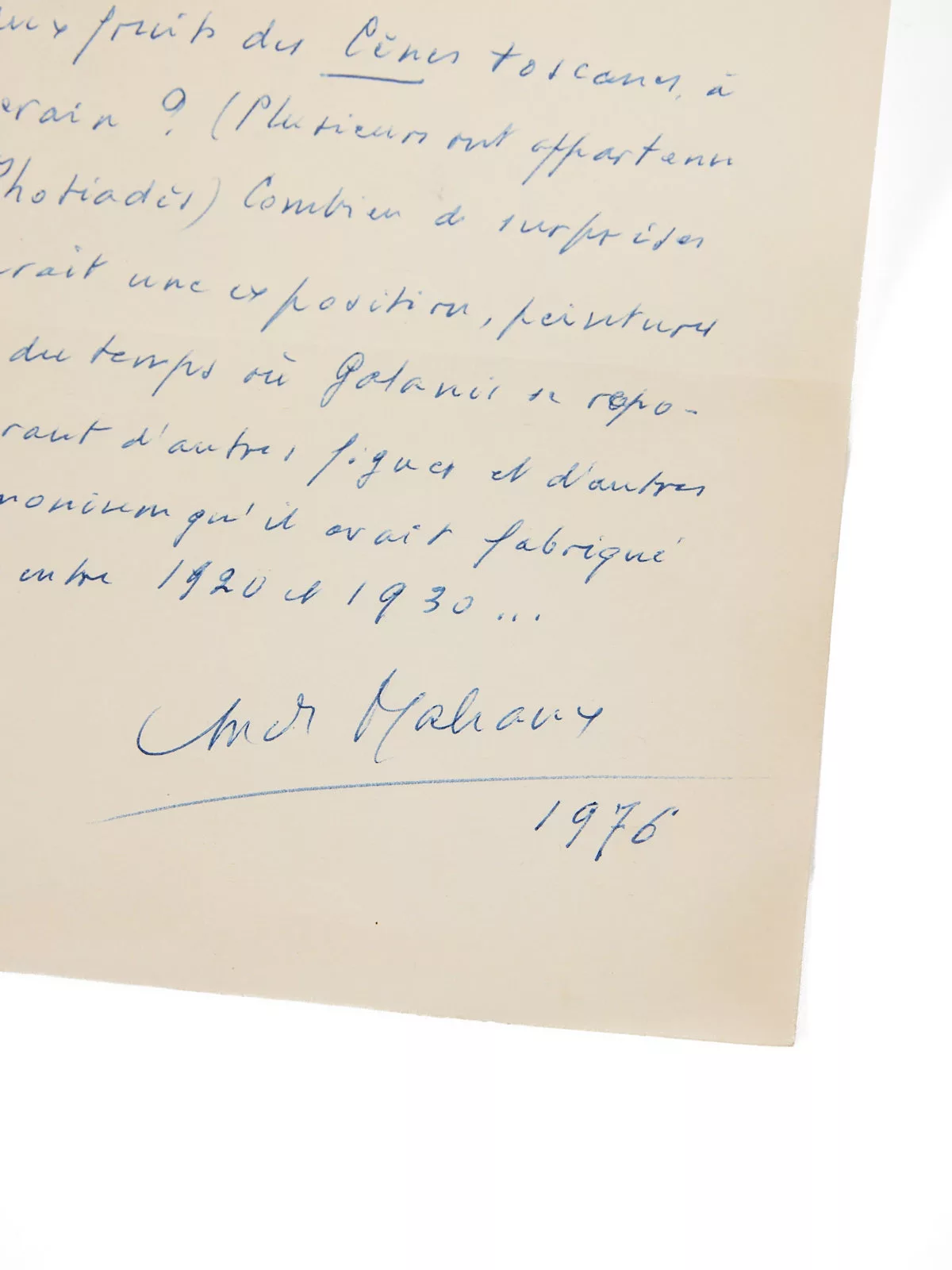
Malraux wrote this text, one of his last publications, a few months before his death on 23 November, in honor of his friend. A melancholy and respectful piece, it was reproduced in facsimile at the head of the catalogue for the exhibition Hommage à Demetrius Galanis, held from 1 June to 18 September 1976 by the Centre culturel hellénique de Paris, fittingly at the Musée de Montmartre.
Too weak to attend, Malraux wrote: “What has become of those still lifes from the Anthologie grecque — figs, almonds, panpipes, grapes — so different from the illustrations for Les Nuits d’octobre, then in their glory, which in 1922 young writers compared to the fruit of Tuscan Last Suppers, to those of Derain? (Several once belonged to Vanili Photiadès.) What surprises an exhibition would hold — paintings and engravings — from the time when Galanis relaxed by decorating other figs and other pipes, on the harmonium he had patiently built between 1920 and 1930…”
Provenance: Paul-Louis Weiller (Paris, sale IV, 2011, no. 641).