

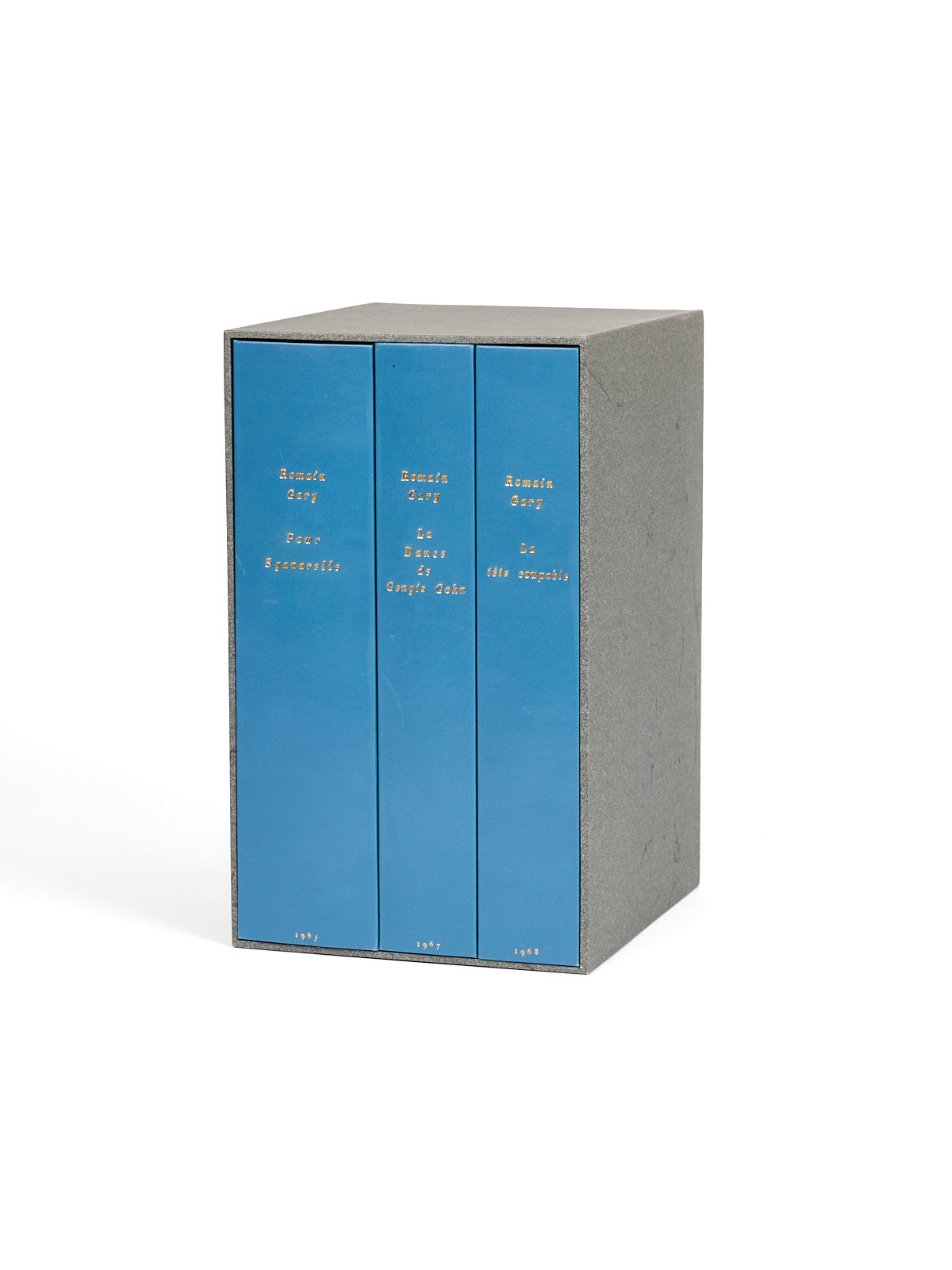
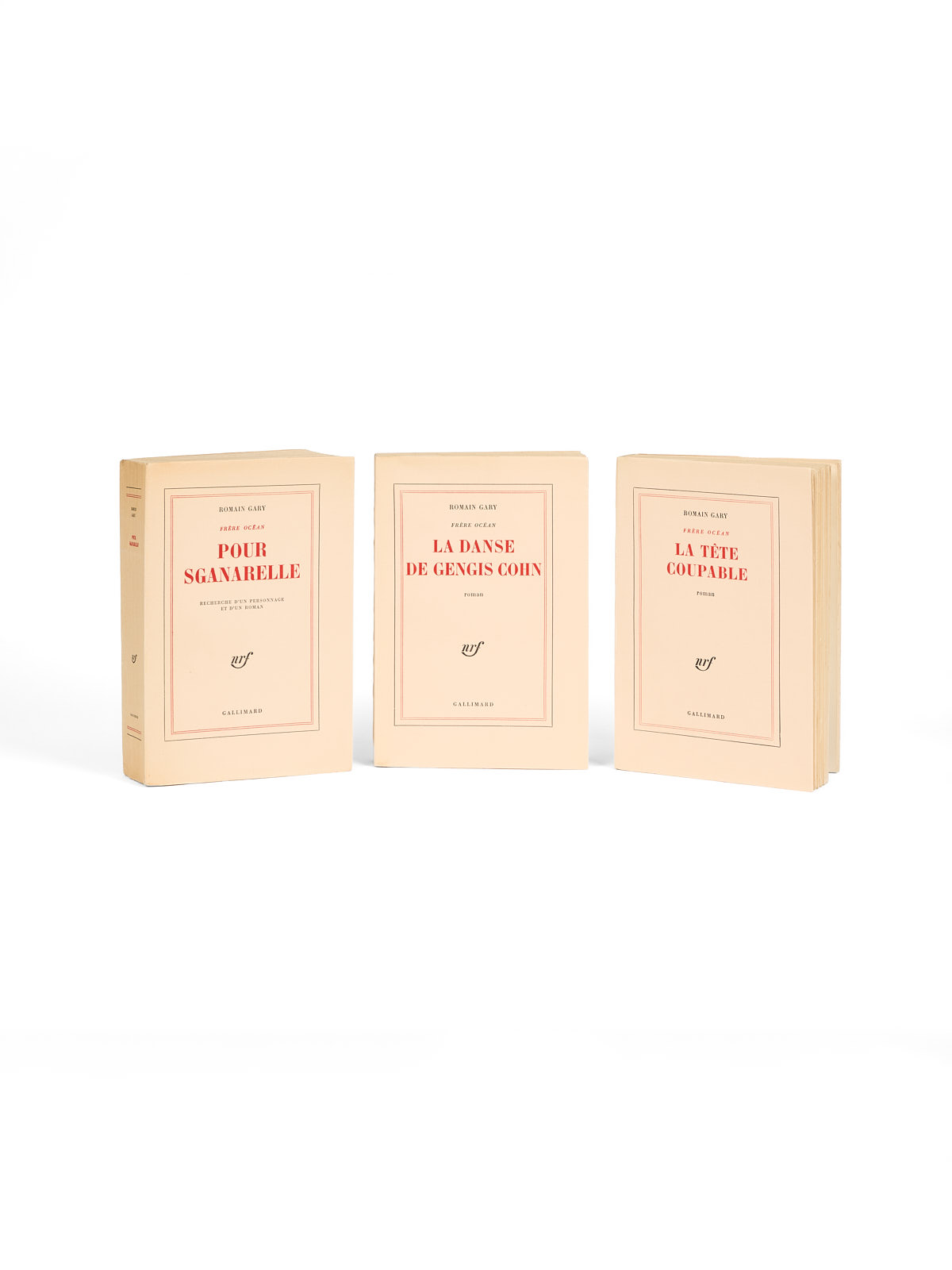
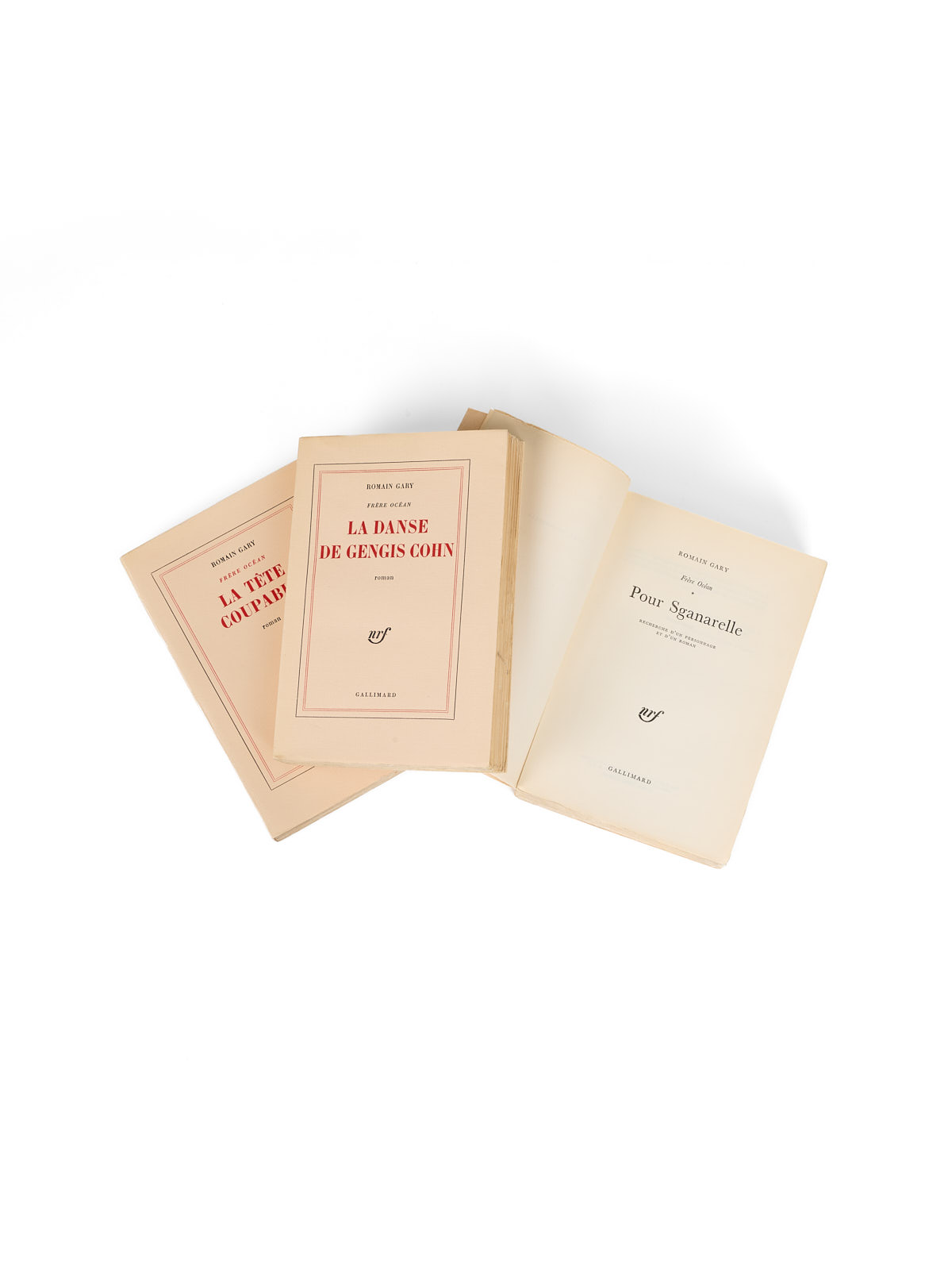
Frère Océan [Trilogie]
One of 27 and one of 23 deluxe copies on vélin de Hollande, respectively nos. 22 and 13.
This is a rare gathering of deluxe copies of the Frère Océan trilogy, whose generic title occurred to Gary while writing the first volume, Pour Sganarelle: “Perhaps I have a title there. Les Couleurs du jour, Les Racines du ciel, La Promesse de l’aube, Le Mangeur d’étoiles… Frère Océan. It fits the pattern. And yet I never had to search for these titles — there was never any choice, any alternative: they simply spoke my name, what I am […] Frère Océan. Perhaps I have my trigger there. I must find the novel, the only thing that matters. Everything else is literature.”
The first volume is a polemical essay attacking the Nouveau Roman, which Gary rebaptized the “totalitarian individualist novel,” claiming to answer only to “what inspires me and binds me so deeply to life: a love story. A servant of the novel, I am a Sganarelle in the pay of the masterpiece, wages I will probably never collect.” To what he considered a “preface to a novel in the making, Frère Océan,” he would add La Danse de Gengis Cohn and La Tête coupable. Gary addresses the Shoah for the first time here: “Humor has been my faithful companion all along the way: I owe it my only true moments of triumph over adversity.” Behind the comedy lies a painful experience that left him feeling he would “never be the same again”: “During a trip to Warsaw, I visited the museum of the uprising. I knew everything about the murder of six million Jews […]. But although I often spoke of my Jewish origins, deep down I did not feel Jewish, despite my attachment to my mother’s memory. Yet, standing before the section of the museum devoted to the Ghetto uprising, I suddenly collapsed and remained unconscious for twenty minutes. Perhaps I had not realized the weight, for me, in this city where I had been raised, of this immense, massive absence: that of the Jews. At that moment, I felt more than Jewish.” (interview with Jelenski, Livres de France, March 1967).
The critics were harsh. Undeterred, Gary remained unshaken: “Criticism in France, I’ll tell you, never judges a book, only a personality. And mine has long irritated them. I’ve always been given the cold shoulder in Paris.”
Perfect copies.