

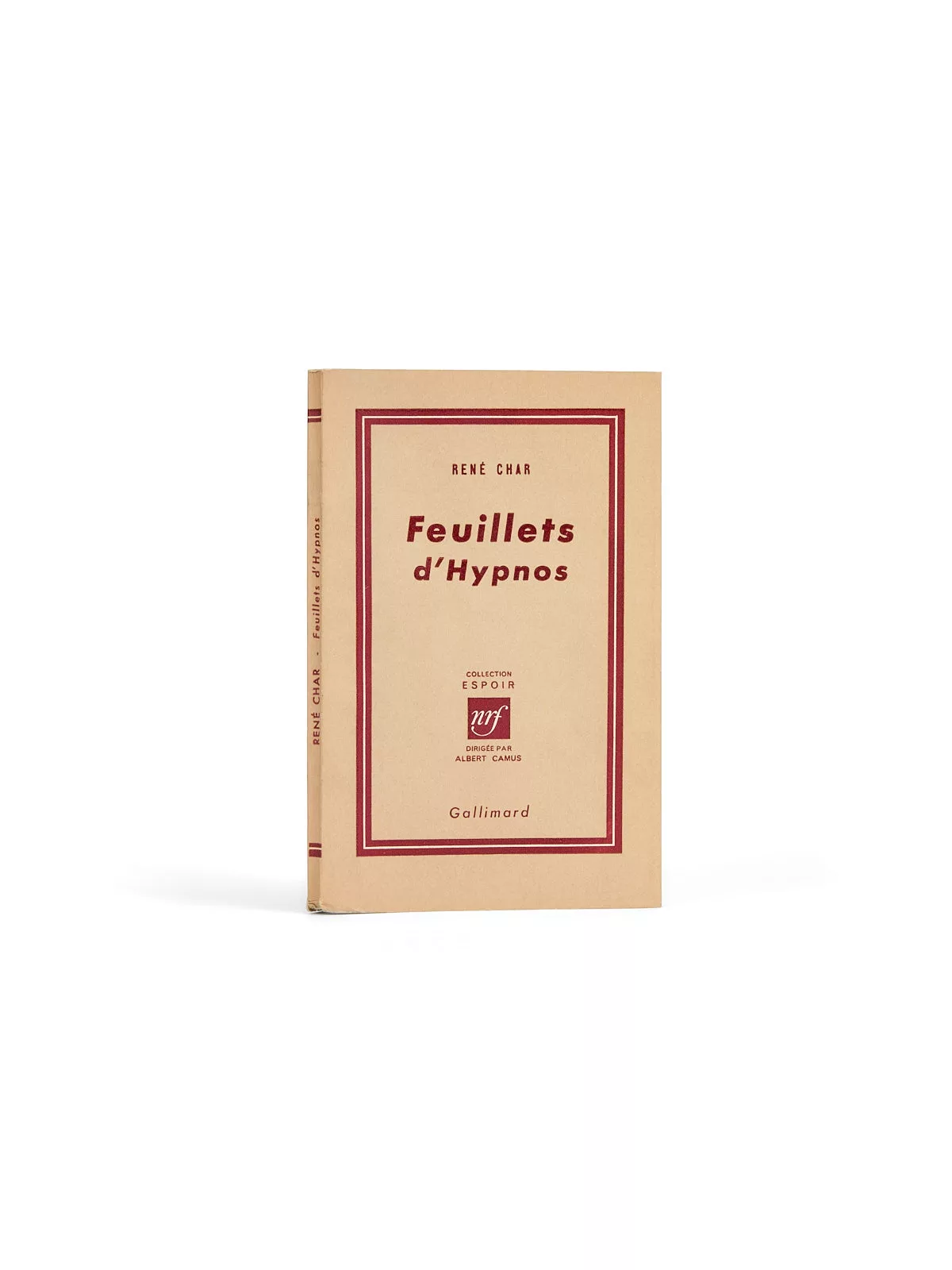
Feuillets d’Hypnos
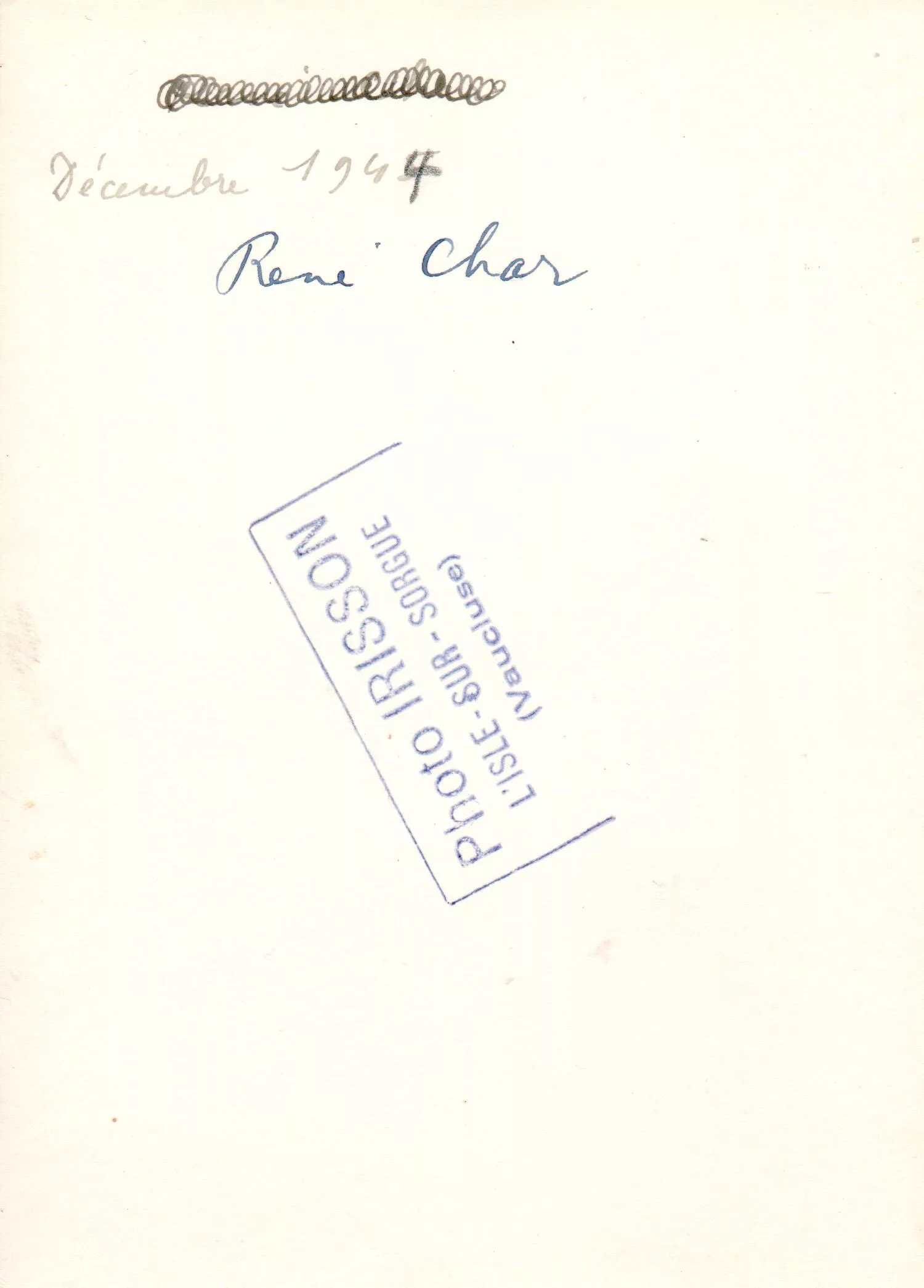
A portrait of René Char, contemporary with the book, is included with the volume: a black-and-white print stamped “photo – ciné Irisson L'Isle-sur-Sorgue (Vaucluse),” with an autograph note on the verso in pencil and ink: “décembre 1944. René Char.” It shows the poet in the dress of “capitaine Alexandre,” smoking a cigarette.
The Feuillets d’Hypnos were written between 1943 and 1944 in Céreste, while Char, known as “Capitaine Alexandre,” commanded the Landings and Parachute Drops Section of the Basses-Alpes. He called himself “Hypnos,” the man who watches over his people at night: his fragmentary writing was dictated by the demands of his engagement in the Resistance. “I write briefly. I can hardly be away for long,” Char notes at fragment 312, having ceased in the summer of 1943 to work on Seuls demeurent in order to record only brief notations in a notebook.
A first typescript of 72 fragments was made at the Liberation, which he revised the following year: “I have thrown myself violently into the work,” he wrote to Gilbert Lely on 17 July 1945. “It is called Carnet d’Hypnos (Hypnos is a man’s name), 1943-1944. I was fortunate enough to recently find the journal I kept at Céreste, buried in a wall before my departure for Algiers. It is this journal that I am going to publish […]. I am putting it in order, shortening or expanding as the case requires.” He notably added fragments 204 and 221, written in Algiers in the summer of 1944. This work resulted in August 1945 in a second typescript, intended for the printer, now held at the Bibliothèque littéraire Jacques Doucet, with this note: “There is no other manuscript of the Feuillets d’Hypnos. I destroyed, for reasons easy to understand, the notebook of originals […] except for one leaf kept as a witness.”
Dedicated to Albert Camus, the Feuillets d’Hypnos marked the beginning of the friendship between the two men, the collection being moreover not unrelated to ideas later developed in L’Homme révolté. It was, incidentally, the first title in the “Espoir” series, directed by Camus, which embodied his aspirations: “We are in nihilism. Can we escape nihilism? That is the question forced upon us. But we shall not escape it by pretending to ignore the sickness of our time or by deciding to deny it. The only hope is, on the contrary, to name it and take stock of it in order to find the cure at the end of the illness. This series is precisely such an inventory.”
Coron (ed.), René Char. Catalogue de l’exposition de la Bibliothèque nationale de France, 4 mai – 29 juillet 2007, Paris, Bibliothèque nationale de France / Gallimard, 2007, p. 79, no. 106.