

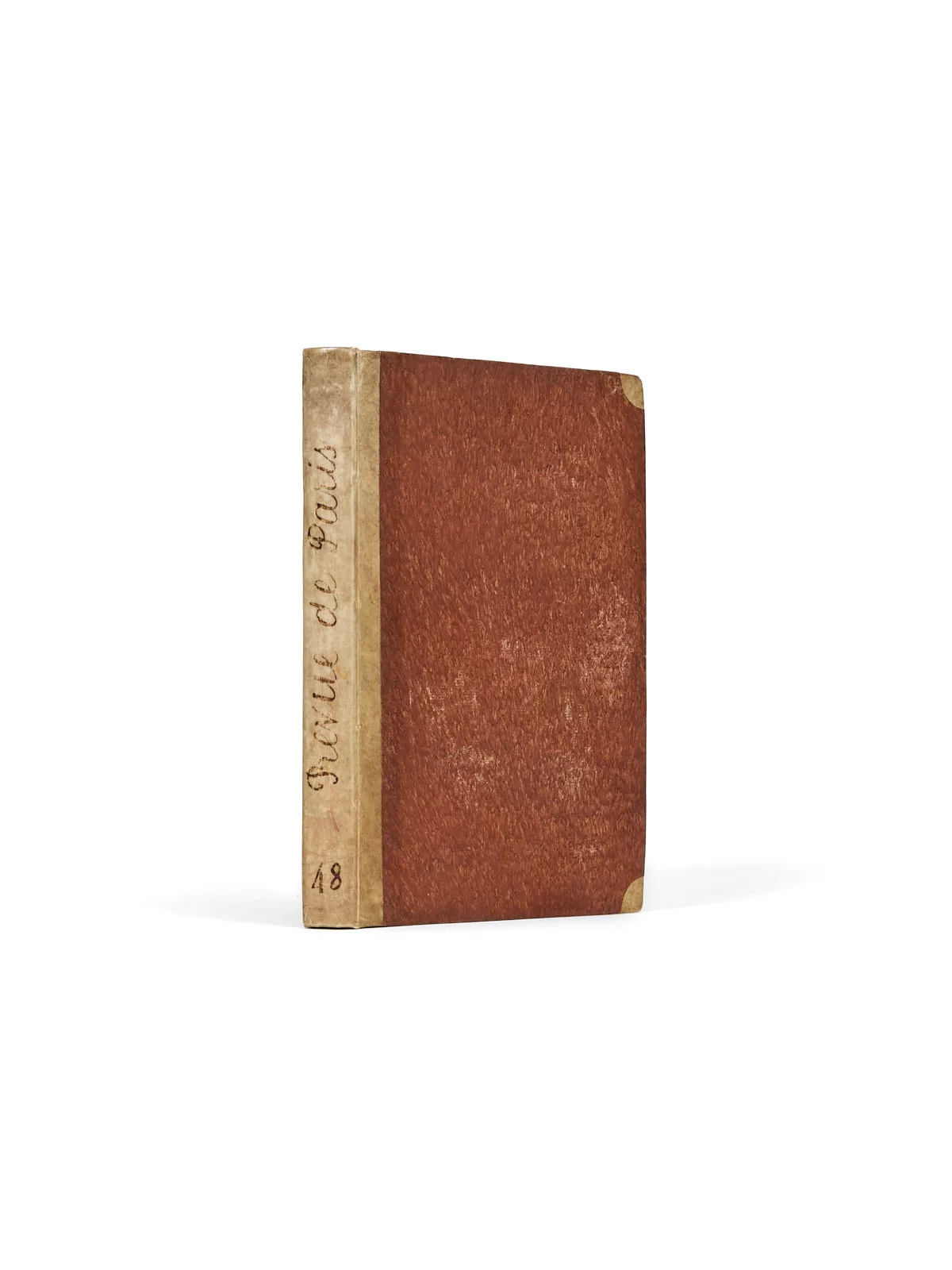
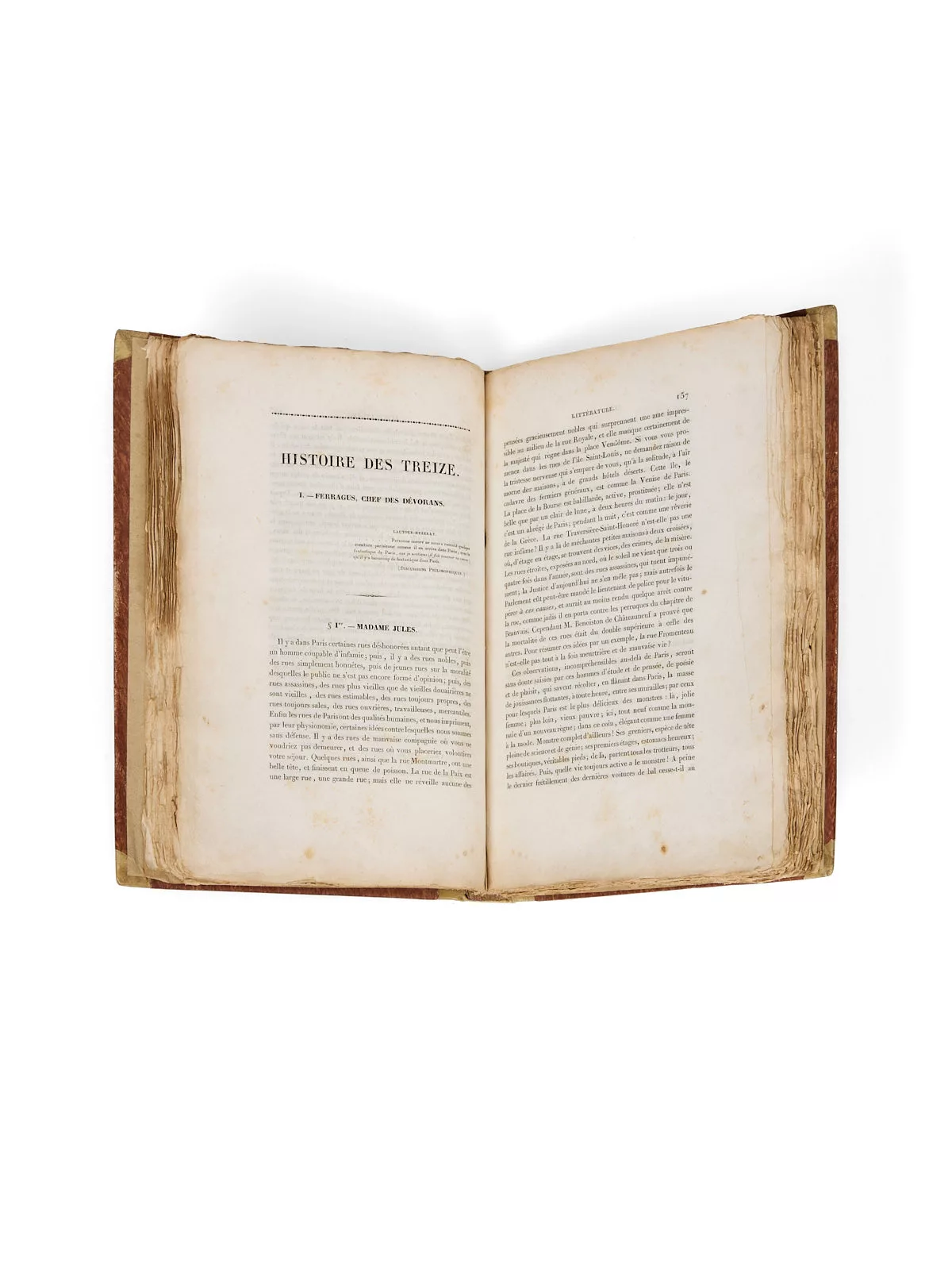
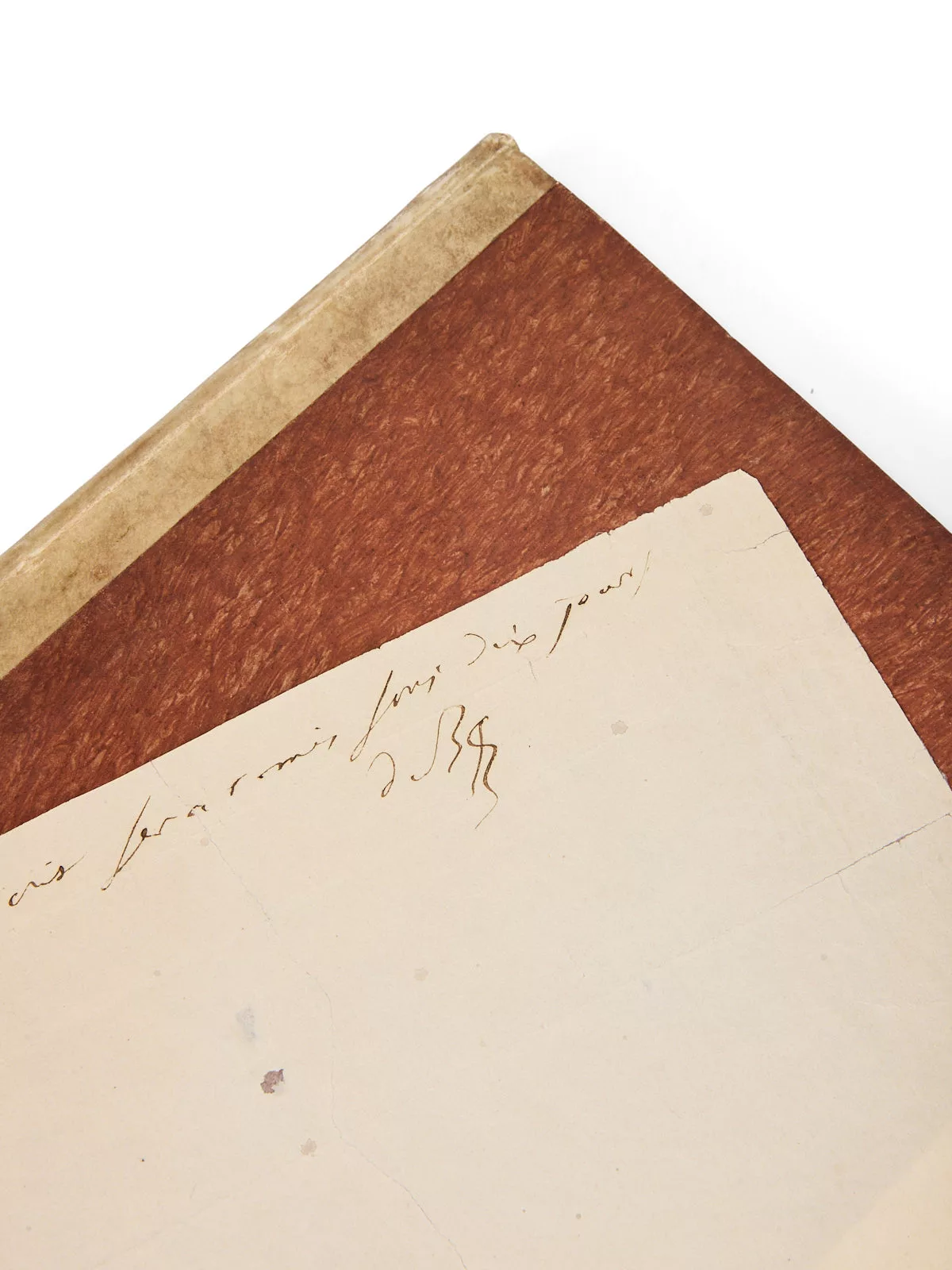
Copy bound and assembled at the time, most likely for Amédée Pichot, editor of the journal in which the story appeared — the Revue de Paris — with an accompanying autograph note: “Le manuscrit sera remis sous dix jours. H.B.”
This manuscript, completed by Balzac in February 1833, comprises 104 leaves, now preserved in the Fonds Lovenjoul at the Bibliothèque de l’Institut.
Written at the same time as La Théorie de la démarche, Ferragus, chef des Dévorants was published in the Revue de Paris beginning 10 March 1833, in four installments, the last of which was announced for April. This did not happen, however, owing to an editorial rupture between Balzac and Pichot. This rare final part therefore appeared only as an offprint attached to the last March issue, added at the last minute and specially paginated from 1 to 34, for a small number of copies. The present copy, assembled at the time, does contain it.
The first edition in book form, published by Mme Charles-Béchet under the title Les Treize, differs from the text published here, since Balzac removed the names of “real” writers and artists that appear in the Revue de Paris text.
According to Balzac’s preface, Les Treize are “thirteen men equally struck by the same feeling, all endowed with sufficient energy to remain faithful to the same idea, sufficiently honest never to betray one another, even when their interests were opposed, sufficiently deeply political to conceal the sacred bonds uniting them, sufficiently strong to place themselves above all laws, sufficiently bold to undertake anything, and sufficiently fortunate to have almost always succeeded in their designs”: in fact a secret society that tips La Comédie humaine into a fantastical universe, the famous “fantastique social” as defined by Charles Nodier, a genre in which Eugène Sue would later excel with Les Mystères de Paris.
The text is dedicated to Hector Berlioz and enjoyed great success. Balzac himself commented, in a letter to Madame Hanska of 29 May 1833, on its “extraordinary success in this so carefree and so busy Paris,” considering Ferragus one of his finest productions: “(…) Le Père Goriot has become, under my pen, a book as considerable as Eugénie Grandet or Ferragus.” (22 October 1834, Corr., II, 560).
The Bulletin de Censure even granted it a certificate of morality: “The inner sufferings of Madame Jules, the Christian heroism that makes her resigned, are expressed with a feeling and an eloquence that bring tears to the eyes. It is one of the most gripping and most moral works of M. de Balzac.” (René Guise, “Balzac et le Bulletin de Censure,” A.B. 1983).
A rare and little-known Balzac text, here in the most desirable condition.