

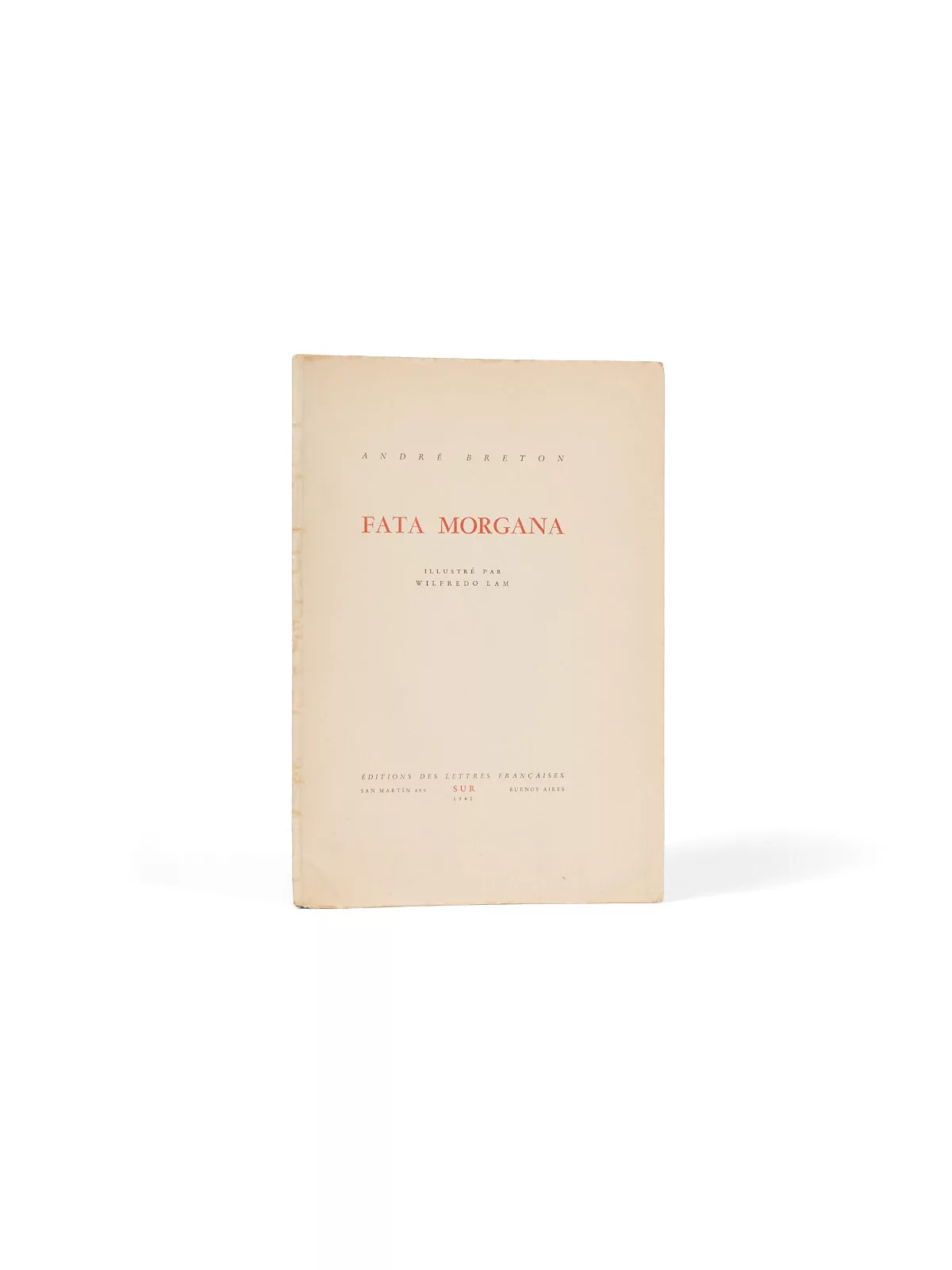
One of 500 copies of the first printing (only the 20 deluxe copies on Ledger paper are numbered).
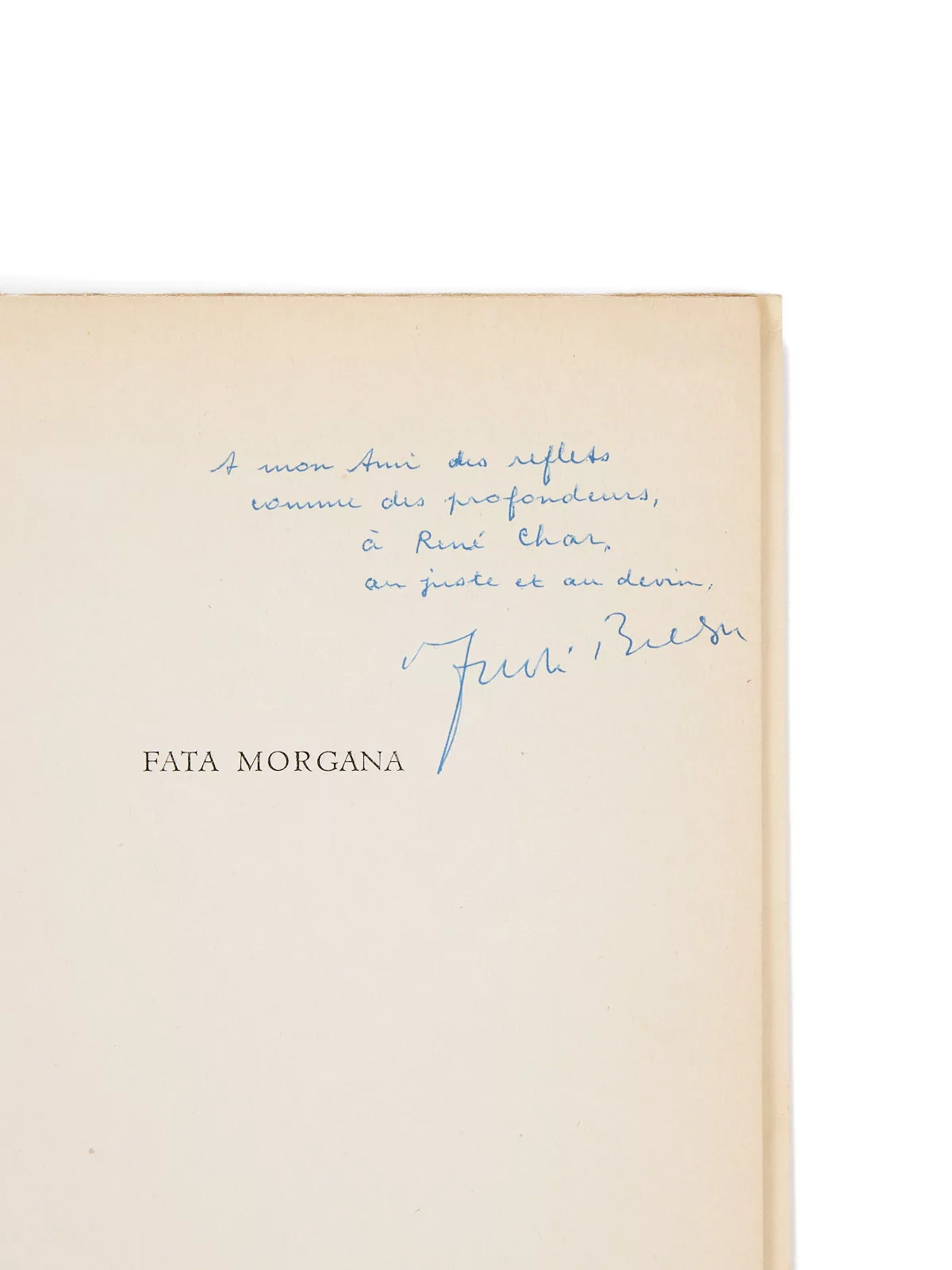
Signed presentation inscription: “À mon Ami des reflets comme des profondeurs, à René Char, au juste et au devin, André Breton.”
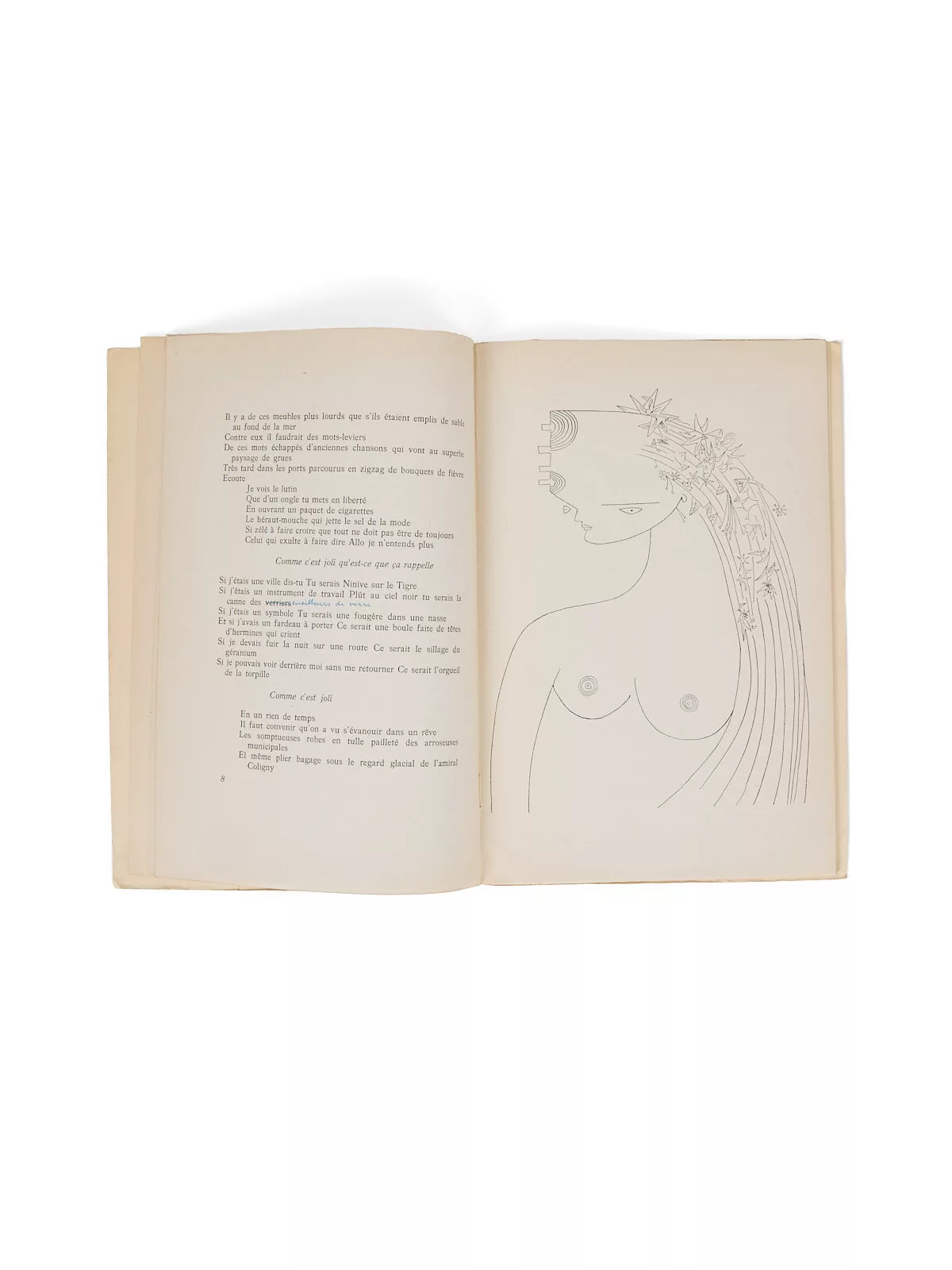
The copy is exceptionally enriched with an autograph variant in André Breton's hand on page 8: “verrier” [crossed out and replaced by] “cueilleurs de verre.”
Marseille, October 1940: the largest city in the Free Zone and, above all, the only port still active outside German control, Marseille and its surroundings were the last remaining gateways out of France, still open toward Algiers, London and America. French citizens and foreigners threatened by Hitler, Mussolini and Franco, or watched by the Vichy regime, lived clandestinely by the hundreds while awaiting the visa that would save them. Political activists, intellectuals and artists — many of them Jewish — formed a remarkable concentration of the European avant-garde.
The Emergency Rescue Committee of New York sent its representative to Marseille: Varian Fry. Thanks to the generosity of Mary Jayne Gold, Fry was able to rent a large villa in the Pomme district, with the task of helping the intellectuals and artists gathered there while awaiting a visa. He began with a list of 200 people to save, for a mission meant to last three weeks. It lasted thirteen months, until his expulsion by Vichy, and allowed more than 2,500 people to escape.
The Villa Bel-Air soon sheltered the core of the Surrealist group in exile: André Breton, his companion Jacqueline Lamba, their daughter Aube, Jean Arp, Victor Brauner, Óscar Domínguez, Marcel Duchamp, Wifredo Lam, Max Ernst, Sylvain Itkine, Benjamin Péret, Jean Malaquais, André Masson and Victor Serge. Connections formed between the villa — nicknamed “Château Espère-Visa” by its residents — and other refugee gathering places such as the châteaux de la Reynarde, de Montgrand or Pastré. On Sundays, Surrealist gatherings were even organized there, with exquisite corpses and improvised auctions, the offered works hung from the ancient trees. René Char, who had several friends among the group, visited twice during the winter of 1940, before permanently joining the maquis in the Basses-Alpes.
André Breton, for his part, wished to leave France, and sought for the moment to briefly reconstitute the phalanstery of his dreams. It was during this precarious freedom that he composed a new poem of unusual length (more than 400 lines): Fata Morgana. It would be the last text he wrote on French soil before his departure for the United States, dedicated to his wife Jacqueline. He wished to see it published illustrated with drawings by Wifredo Lam, “a young painter, born of a Chinese father and a Cuban (Black) mother, who, of all the artists I know, seems to me at present to have the most to say.” Lam, who had left his native Cuba for Spain in 1923, had been living in Paris since 1937 and had met Breton in 1939.
Photographic plates and proofs were quickly prepared for the publication of this poem of “rare gentleness,” as noted by Léon-Pierre Quint, its first reader and head of the Éditions du Sagittaire, which was to publish it in an edition of 215 copies. But on 6 March 1941, everything collapsed: the Vichy government censored the text and banned its publication, “postponed until the definitive conclusion of peace.” Only five proof copies were saved (lettered A, B, C, D and E: those of Breton, Jacqueline Breton, Wifredo Lam, Peggy Guggenheim and Gilbert Lély). For Breton, time was short: Fry was threatened with expulsion, and it was essential to cross the Atlantic as soon as possible. Events accelerated, and on 25 March 1941, thanks to Peggy Guggenheim, who financed this final crossing, Breton, his wife and their daughter Aube managed to embark on the Capitaine Paul-Lemerle bound for the New World via Martinique, for what would become “the crossing of the proscribed.”
As soon as he arrived in New York, Breton contacted James Laughlin and Peggy Guggenheim about a publication in the review New Directions, which appeared in November 1941. But he was determined above all to see a French edition, since this poem “fixes my position of resistance, more uncompromising than ever, to the masochistic enterprises that tend, in France, to restrict poetic freedom or to sacrifice it on the same altar as other freedoms.” He turned to Roger Caillois, who directed the Institut français in Buenos Aires and, since July 1941, edited the review Lettres françaises. Caillois, who had left the Surrealist movement in 1935 after a falling-out with Breton, agreed to publish Fata Morgana, a text Breton, in the first letter he had sent him in years, called one he “preferred to everything I have written in verse until now.”
Breton sent the text from New York, while Benjamin Péret, from Mexico City, was entrusted with sending Lam’s plates. On 7 May 1942, Caillois acknowledged receipt of the text, followed by the Mexican plates at the start of the summer. Despite a disastrous financial situation, Caillois began printing in July: “I will publish it immediately and put an end to my unfortunate publishing venture, for these little books have met with the most disheartening indifference; no one has bought them, no one has spoken of them, and the till is empty; there is barely enough left for the review.” On 10 July 1942, 520 copies were printed, which struggled greatly to reach New York. A first, substantial shipment, including the deluxe copies, was lost. On the spot, Caillois admitted to Breton that “sales are nil, but not interest, at least from Chile (Gómez Correa, Huidobro, Jorge Cáceres — are you in contact with them?).” A second shipment was mentioned: “the climate is perhaps, or so it seems to me, better in New York.” But there too the booklets failed to reach the author, who complained to Caillois in February 1943 that he had still not received a single copy of the poem: “I had hoped to be able to acknowledge receipt of Fata Morgana, but once again only the issue of Lettres Françaises has reached me. I hope your first shipment was returned to you, amid the postal confusion caused by my change of address.”
Copies of Fata Morgana have remained rare, and among the handful Breton managed to obtain, only two inscribed copies are known: that of Patrick Waldberg (Christie’s, Collection Paul Destribats I, 2019, no. 568) and that of Robert Valançay (Pierre Bergé & associés, Mille nuits de rêves, Kahn III, 2021, no. 100).
The René Char copy now joins these two known inscribed copies and is the only one with a literary provenance of comparable importance.
Wifredo Lam would go on to collaborate with several writers and poets — Antonin Artaud, André Breton, Aimé Césaire, Max-Pol Fouchet, Édouard Glissant, Michel Leiris and, of course, René Char, with two major volumes: Le Rempart de brindilles (1954) and Contre une maison sèche (1976). This volume, almost certainly given to Char in the immediate postwar period, marks the first aesthetic encounter between the poet and the painter, followed by another in 1947 in Paris, at Pierre Loeb’s gallery on the rue de Seine. A striking account describes the sense of presence that seized Char in May 1947 before two canvases by the Cuban artist, his sense of smell drawn “in the back room, by two knotted canvases, aggressively risen from the earth, giving off their violent and haunting aroma of forests reconciled with imminent figures.” He would recapture that same powerful sensation only “two days later, walking at night across the plateau des Claparèdes in the Luberon,” thanks to a “chorus of shrilling crickets” (M. Creac’h, Dictionnaire René Char, Garnier, 2015, p. 334).
Étienne-Alain Hubert in André Breton, Œuvres complètes II, Pléiade, pp. 1786–1787; “Lam filled several sketchbooks with fantastical drawings while in Marseille. Breton later selected seven of these to illustrate his poem Fata Morgana (1942), the first of Lam’s many collaborations with poets. These drawings also provided Lam with the point of departure for many of his large-scale works in Cuba.” (MoMA, Lam exhibition, 2026).