


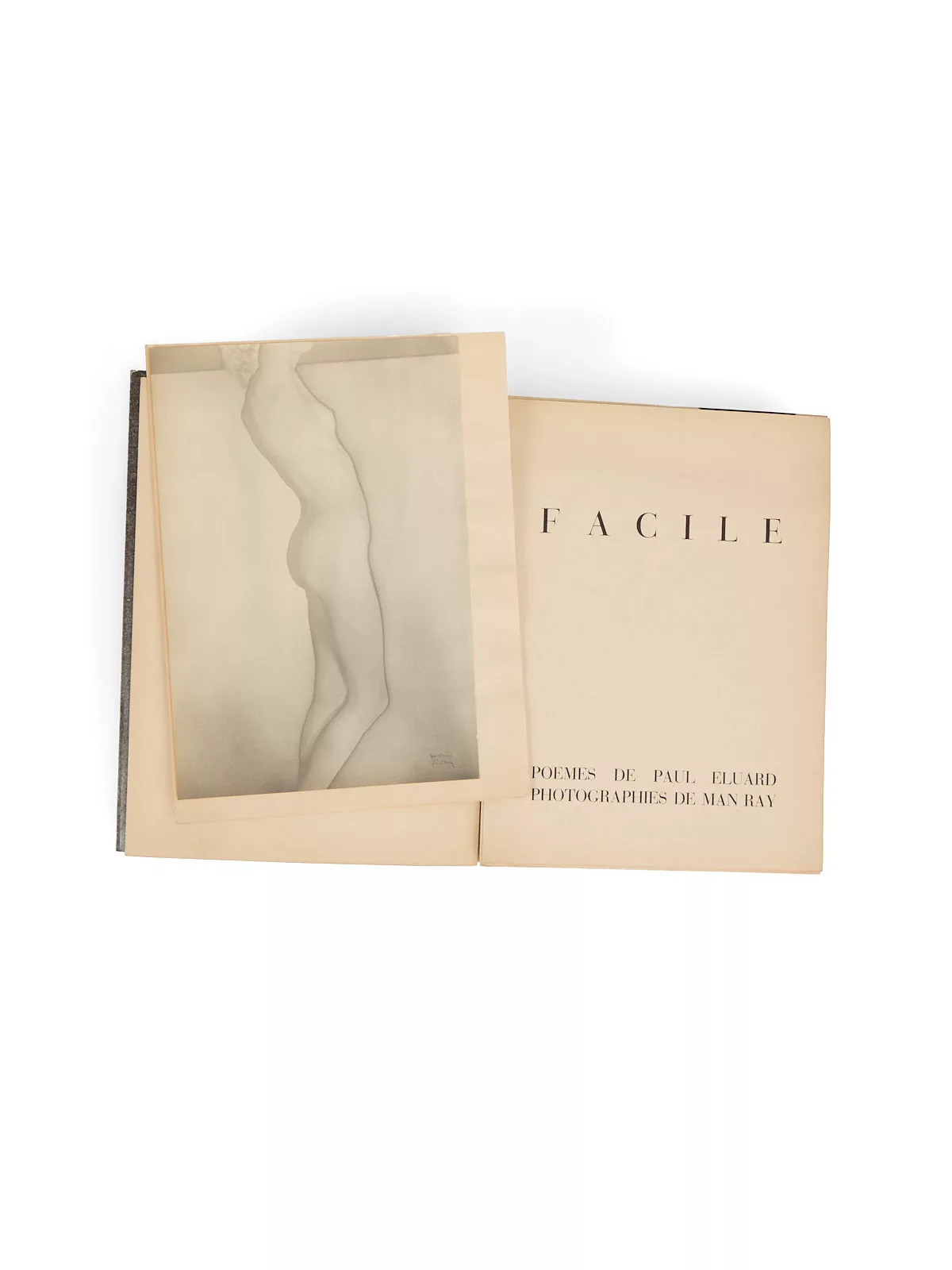
12 photogravures by Man Ray in the text.
One of the 25 deluxe copies on Japanese paper (no. 17), with the solarized photograph illustrating the poem “L'Entente,” reserved solely for the deluxe copies.
A cult work of the Surrealists, Facile forms, according to Parr and Badger, a perfect ménage à trois of poetry, photography and typography, the whole celebrating love and the body of Nusch. It is unanimously regarded as one of the most successful and emblematic illustrated books of the twentieth century.
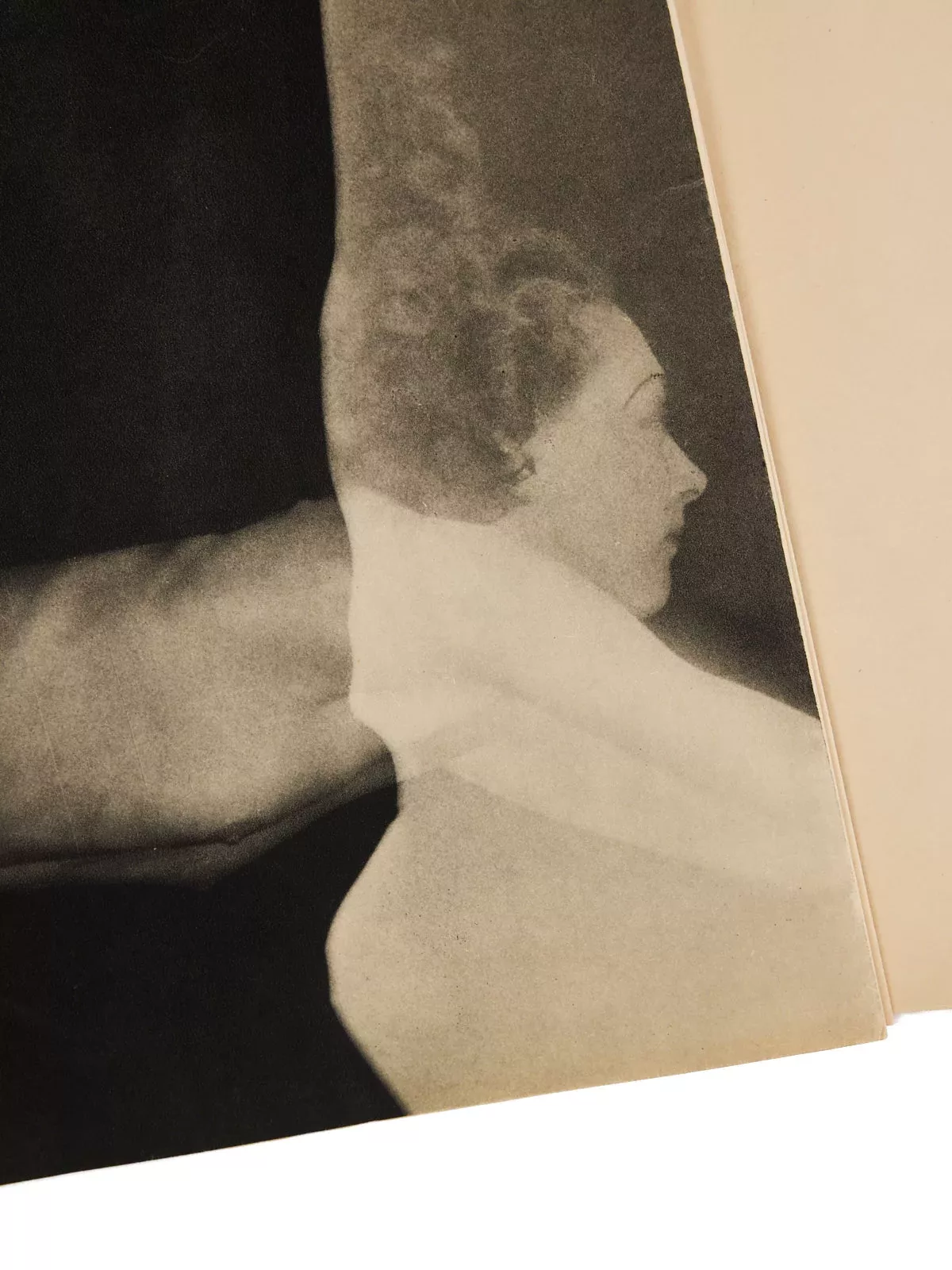
Built around five poems and twelve photographs, Paul Éluard, Man Ray and Guy Lévis Mano created a landmark of publishing that signaled the resurgence of eroticism in 1930s art. “It is because of the integration of images with text that this book became fundamental to modernism and a source of inspiration for generations of graphic designers” (Parr & Badger).
“Supple and elegant, Nusch’s nude body decorates the pages in an innovative presentation: solarizations, negative prints, double exposures; this nude body seems to float on each page like a drawing in an indeterminate space. The only other subject photographed in the book is a pair of gloves,” a pair that Éluard would later entrust to Paul Bonet to incorporate into the copy he bound for him in 1944.
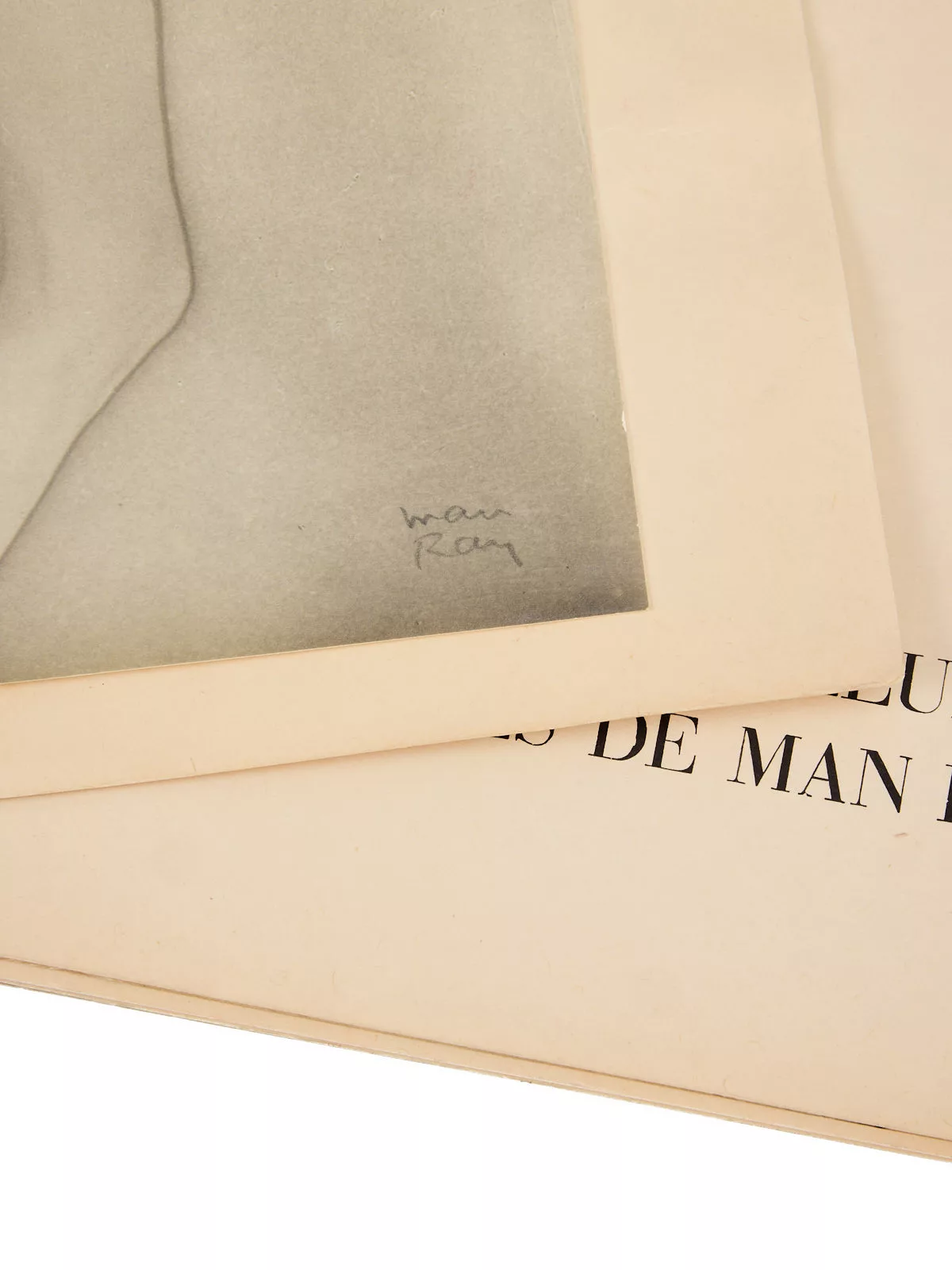
For the deluxe copies on Japanese paper, Éluard and Man Ray decided to add an original print, made using the innovative process Man Ray had invented in the early 1930s: solarization. “The process (…), which remained secret until 1933, created an impression of disembodiment through the action of light during development. Solarization intensified Man Ray’s fascination with artificial light and with isolating objects to increase their mystery (…). Solarization produced faces and hands that seem suspended in a void, heads that resemble masks, torsos to which an unhealthy luminescence lends the lightness of ether — all in magnificent prints” (in The Art of Man Ray, National Museum of Art, Smithsonian Institution, ed. Gallimard, 1989, p. 175 et sq.). To illustrate this definition, the photograph chosen was the one from Facile (p. 209): a solarized cropping of Nusch’s body, illustrating the poem “L’Entente.” All the original prints from 1935 were signed by Man Ray, in pencil, in the lower right corner of the photograph.
The print run for Facile consisted of 1,225 copies: 25 copies on Japanese paper (numbered 1 to 20 and I to V) and 1,200 copies on vélin (1,000 numbered 21 to 1020 and 200 hors commerce numbered VI to CCV). A few unnumbered hors commerce copies were also printed, including some on Japanese paper, though it is not certain whether these were accompanied by the solarized photograph.
Three copies on Japanese paper are held at the BnF (Nusch’s copy, Guy Lévis Mano’s copy, and no. 9, bound by Bonet); only one is in the United States (at the MET, recently acquired, being the Loliée copy sold in 2016, bound by Pierre-Lucien Martin in 1968); the Getty and MoMA each hold a print of the solarized photograph alone, without a copy of the book. No Japanese-paper copy is found in the other major American institutions: Beinecke Library (Yale), Morgan Library (New York), Houghton (Harvard), Huntington (Los Angeles), Smithsonian (Washington), Harry Ransom Center (Austin) or McFarlin (Tulsa).
A magnificent deluxe copy, in spectacular near-new condition, making it highly desirable. The glossy paper cover by Man Ray retains a freshness rarely seen, as does the solarized photograph, perfectly preserved. As in other copies examined, it has been mounted along the right margin on straw-colored paper; an old tissue guard accompanies the copy, probably also original. The copy also contains its rare subscription form, present in only a minority of copies.
We offer here a brief list of the 18 copies we have been able to trace:
Numbered copies [1-20] with the photograph
no. 1, in sheets, inscribed by Éluard and Man Ray to Guy Lévis Mano (Bibliothèque Nationale de France, Fonds GLM);
no. 6, in sheets (Sotheby’s, Bibliothèque Régine & Bernard Loliée, 2016, lot 277); private collection;
no. 9, binding by Bonet (Carnets, 799; commissioned by and for the Bibliothèque Nationale de France);
no. 11, in sheets (Christie’s, Avant-garde, 2011, lot 201); private collection;
no. 12, binding by Martin, private collection;
no. 13, binding by Leroux (Christie’s, Destribats I, 2019, lot 409);
no. 17, in sheets; this copy;
no. 19, binding by Bonet (Carnets, 802); private collection;
no. [?], in sheets (New York Antiquarian Book Fair, 2024, Librairie Benoît Forgeot, [sold]).
MoMA (New York) and the Getty Research Institute (Los Angeles) hold the solarized photograph alone.
Hors commerce copies on Japanese paper:
Paul Éluard’s copy; inscribed by Man Ray, binding by Paul Bonet (Carnets, 656; Christie’s, Avant-garde, 2017, lot 23), with the photograph;
Man Ray’s copy (no. II), inscribed by Éluard and Nusch (Christie’s, Daniel Filipacchi, 2004, lot 101), with the photograph;
Nusch Éluard’s copy; inscribed by Éluard and Man Ray (Bibliothèque Nationale de France, Fonds Trutat 2016), with the photograph;
Lise Deharme’s copy, inscribed by Éluard and Man Ray, with the photograph; private collection;
Evrard de Rouvre’s copy, inscribed by Éluard, without the photograph; Librairie Walden;
unnumbered hors commerce copy, binding by Martin (Sotheby’s, Bibliothèque Régine et Bernard Loliée, 2016, no. 277; Bluff Collection, then MET New York), with the photograph;
unnumbered hors commerce copy; binding by Leroux (Loudmer, D’une bibliothèque l’autre, 1995, no. 280), without the photograph [but with a later, unsigned print laid in];
unnumbered hors commerce copy, private collection, with the photograph;
unnumbered hors commerce copy, in sheets, without the photograph; private collection;
Copies on vélin with inscriptions
copy no. 161 on vélin, Sylvia Beach’s copy, inscribed by Éluard and Man Ray;
copy no. 450 on vélin, Marcel Adéma’s copy, inscribed;
copy no. 478 on vélin, Georges Sadoul’s copy, inscribed;
copy no. 510 on vélin, Louis & Peggy Kannenstine’s copy, inscribed by Man Ray;
copy no. 561 on vélin, Robert Ganzo’s copy, inscribed;
copy no. 623 on vélin, unidentified copy, inscribed;
copy no. 638 on vélin, Jean Marcenac’s copy, inscribed;
copy no. 757 on vélin, Henriette Gomès’s copy, inscribed;
copy no. 886 on vélin, Edita Hirschowa’s copy, inscribed;
copy no. (?), to Pierre-Jean Jouve, inscribed and signed by Man Ray;
hors commerce on vélin [?], José Corti’s copy, inscribed with a later print added;
hors commerce on vélin [?], Ady Fidelin’s copy, inscribed;
hors commerce on vélin [?], Suzanne and Luc Somerhausen’s copy, inscribed;
hors commerce on vélin [54], René Char’s copy, inscribed;
hors commerce on vélin [93], Jindřich Štyrský’s copy, inscribed;
hors commerce on vélin [100], Leonor Fini’s copy, inscribed;
hors commerce on vélin [119], Gaston Gallimard’s copy, inscribed;
hors commerce on vélin [137], Léon Pierre-Quint’s copy, inscribed;
hors commerce on vélin [148], Guy Crouzet’s copy, inscribed;
hors commerce on vélin [151], Louis de Gonzague-Frick’s copy, inscribed;
hors commerce on vélin [175], René Bertelé’s copy, inscribed;
hors commerce on vélin [388], Serge Béguier’s copy, inscribed;
hors commerce on vélin [no number], Pierre Seghers’s copy, inscribed;
hors commerce on vélin [no number], Sergio Tosi’s copy, inscribed by Man Ray.
Robert D. Valette, Éluard, Livre d’identité, 1967, p. 135; Roland Penrose, Man Ray, Paris, 1975, p. 125; Roth, The Book of 101 Books, Seminal Photographic Books of the Twentieth Century, pp. 86–87; Les éditions GLM [ed. Antoine Coron], Bibliothèque Nationale, 1981, no. 73; Paul Éluard et ses amis peintres, exhibition at the Centre Pompidou, 1982–1983, pp. 145–149; Sinibaldi–Couturier, Regards sur un siècle de photographie à travers le livre, 48; Leclair–Née, Dictionnaire Char, Classiques Garnier, 2015, pp. 203–205; Des livres rares depuis l’invention de l’imprimerie [ed. Antoine Coron], Bibliothèque Nationale, 1998, no. 194 (Guy Lévis Mano’s copy); Parr & Badger, The Photobook, vol. I, 2006, pp. 104–105; Bonet, Carnets, nos. 656, 799 and 802; Montier, Facile, ou le Livre photographique comme scène érotique, 2012, pp. 108–118; The Art of Man Ray, National Museum of Art, Smithsonian Institution, ed. Gallimard, 1989, p. 175 et sq.