

Exil
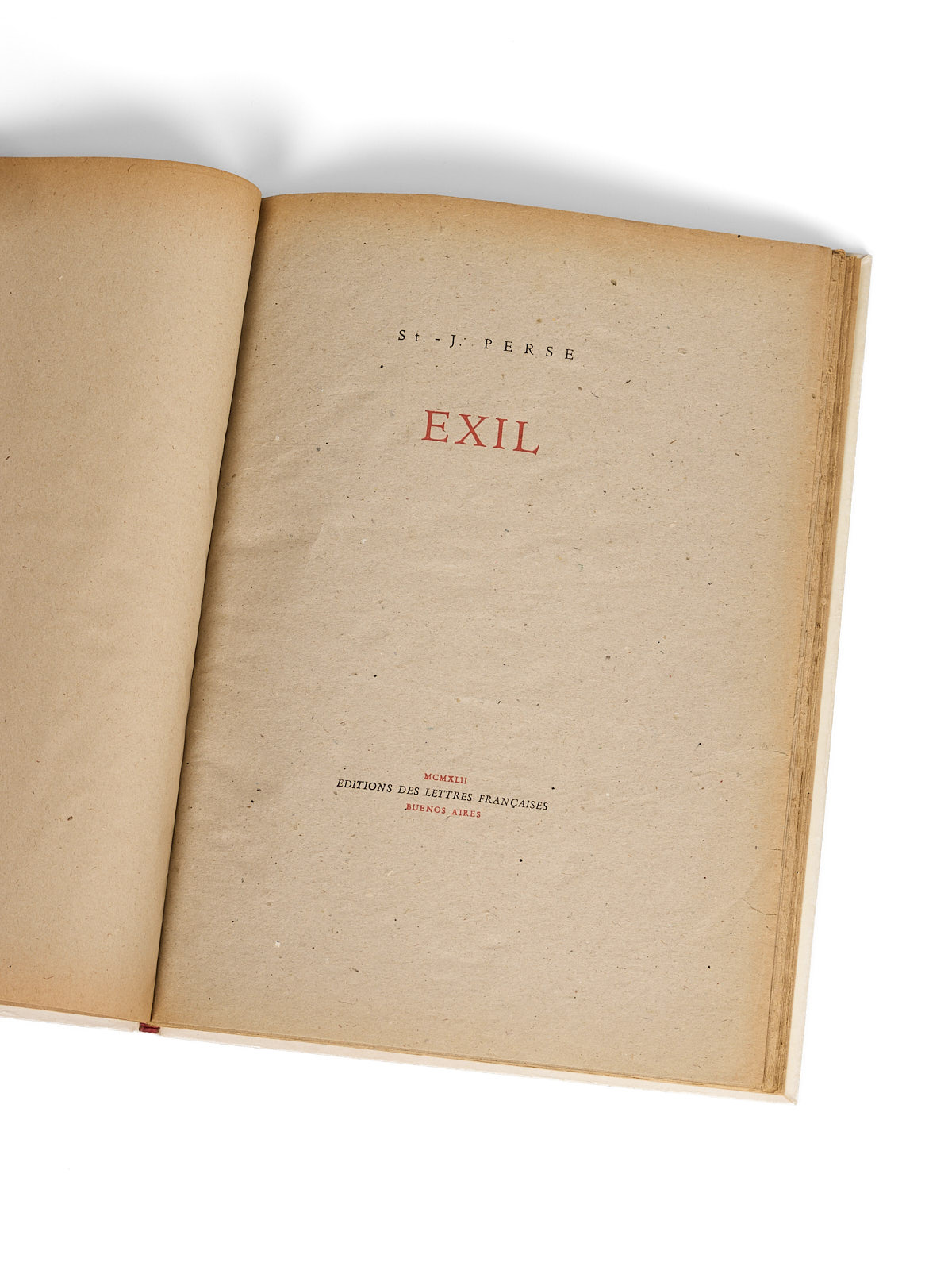
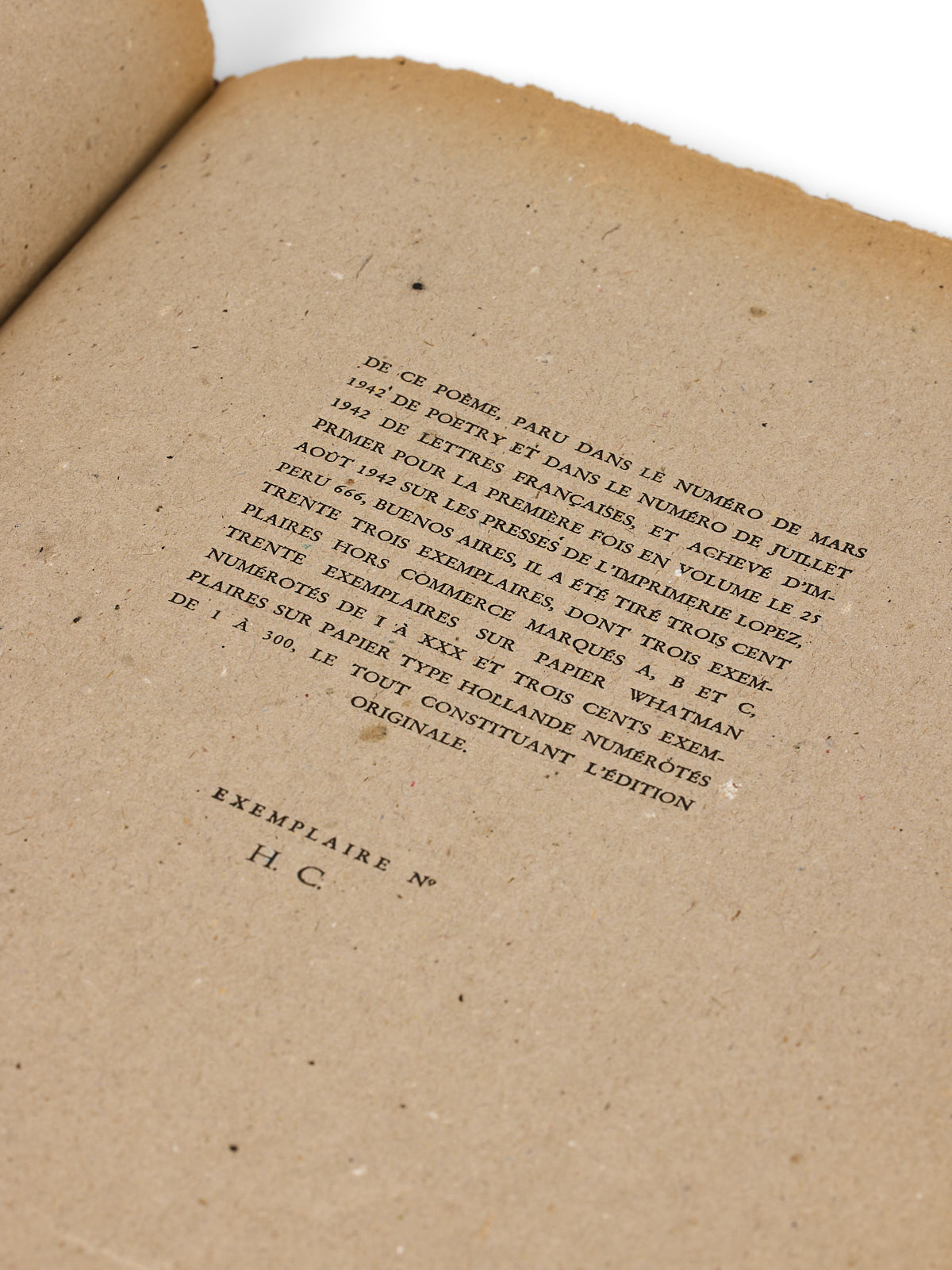
One of the rare hors commerce copies on papier pierre: only three copies (A, B and C) were announced as such. Note, however, an unauthorized publication issued three months earlier, in May 1942, arranged by Jean Ballard, in the form of an offprint of 200 copies from the Cahiers du Sud, printed in Marseille.
This copy belonged to Henri Hoppenot, to whom Alexis Léger owed a great deal.
In August 1914, Henri Hoppenot joined the Press Bureau of the Ministry of Foreign Affairs. Alexis Léger, who had passed the entrance examination the previous year, was already in place. When they joined the ministry, the diplomat-writers Giraudoux, Morand and Claudel were already there. For more than sixty years, Alexis Léger and Henri Hoppenot’s careers ran alongside one another, diverging with postings, converging again at the Quai d’Orsay, and meeting once more on the American continent. Léger’s only foreign posting was in China, before a brilliant career in the central administration: after publishing Anabase in 1924 under the pen name Saint-John Perse, he set aside his literary career to devote himself entirely to diplomacy. Appointed director of Minister Aristide Briand’s cabinet in 1925, he became one of the most senior officials at the Quai d’Orsay. He managed to remain in post after Briand’s death in 1932 and succeeded Philippe Berthelot as Secretary-General of the Ministry of Foreign Affairs from 1933 to 1940 — the highest-ranking official after the minister himself. Léger did much to advance Hoppenot’s career: “He helped me several times in my career, whenever he could” (Ina, Archives du XXe siècle, interview with Henri Hoppenot, 1971) — notably securing his appointment to China in 1933. In memory of this period, Hoppenot had a rarity printed in 1937: an account of one of Léger’s missions, printed on the Lazarist presses in Peking in ten copies, the Relation respectueuse adressée par le secrétaire Lei Hi-Ngai [Alexis Léger] à son excellence le ministre Kang Te [Alexandre Conti, French minister in Peking]. This was shortly before the two men were reunited in Paris, at the Quai d’Orsay, between 1937 and 1940.
Disgraced in 1940, Alexis Léger was dismissed from his post on 18 May 1940 by Paul Reynaud and went into exile in the United States. Hoppenot paid the price for his closeness to Léger: several accreditations in Europe were refused him, and he was sent to Uruguay. He resigned his post in 1942, when the Service du Travail Obligatoire was introduced and a new status for Jews was promulgated. Removed from his diplomatic functions on 6 March 1943, he made his way to Washington, where he rejoined Léger, and rallied to Free France. In 1945 he was appointed ambassador to Bern.
Léger, who had refused to rally to de Gaulle, was rehabilitated thanks to Hoppenot, who secured his return from exile after the war. Hoppenot became the principal advocate for Perse’s Nobel Prize in Literature, which he was awarded in 1960, after resuming poetry under his pen name in 1944.
A precious hors commerce copy of the first book Perse published in exile.
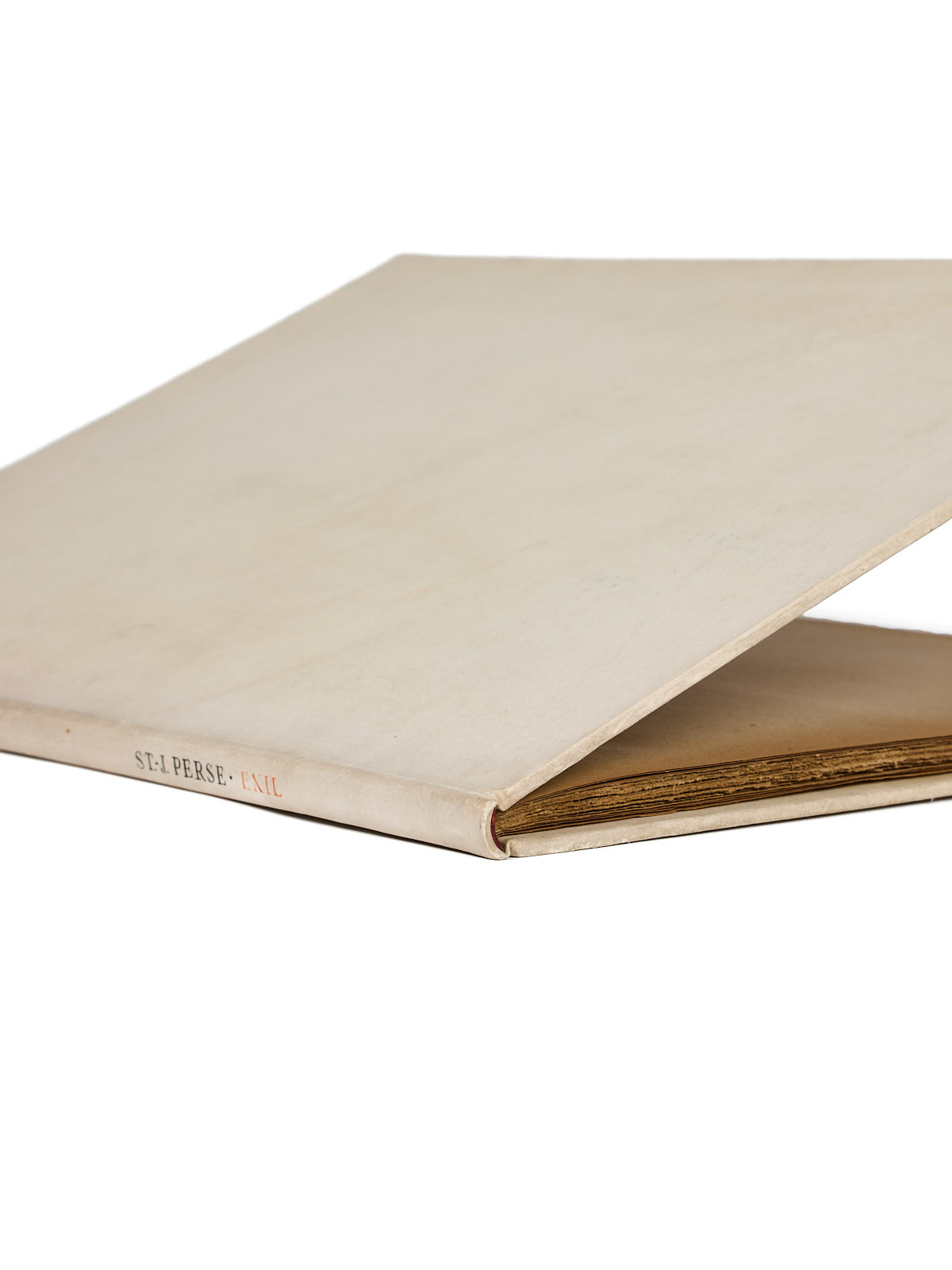
This is the only known copy on this paper. In what circumstances did Hoppenot receive it? In August 1942 he was in Buenos Aires, and may have obtained it there through a note from Perse, with whom he corresponded. The two men in any case met the following year in New York, and one might expect an inscription to have then enriched such a gift. In any case, Hoppenot returned to Europe in 1945 with the book: it was in Bern — where he took up his post as ambassador, with a young embassy secretary, Romain Gary — that he had the copy bound, along with Pluies and Vents, by a well-known bindery on the Kramgasse, one of the main commercial streets of the old town: the Schumacher firm, founded in 1840.
During the war, Perse lived in New York and then Washington, supported by American friends including Archibald MacLeish, director of the Library of Congress, who offered him a position as literary adviser at his institution as early as 1941. Financial necessity led him to take up his pen again, under the name Saint-John Perse, and write Exil, an apt title to which the poet added his own name: “J’habiterai mon nom.” The poems, composed in New Jersey, on Long Beach Island, are dedicated to Archibald MacLeish and were first published in three journals: Poetry (Chicago, March 1942), Cahiers du Sud in Marseille in June, then in Les Lettres françaises / SUR, in Buenos Aires, in July 1942.
The Buenos Aires edition is the only one recognized by the author: the Marseille offprint was published without his knowledge, from a text he had not reviewed — the layout in particular differs considerably. Exil was later expanded with Pluies, Neiges and Poème à l’étrangère.