

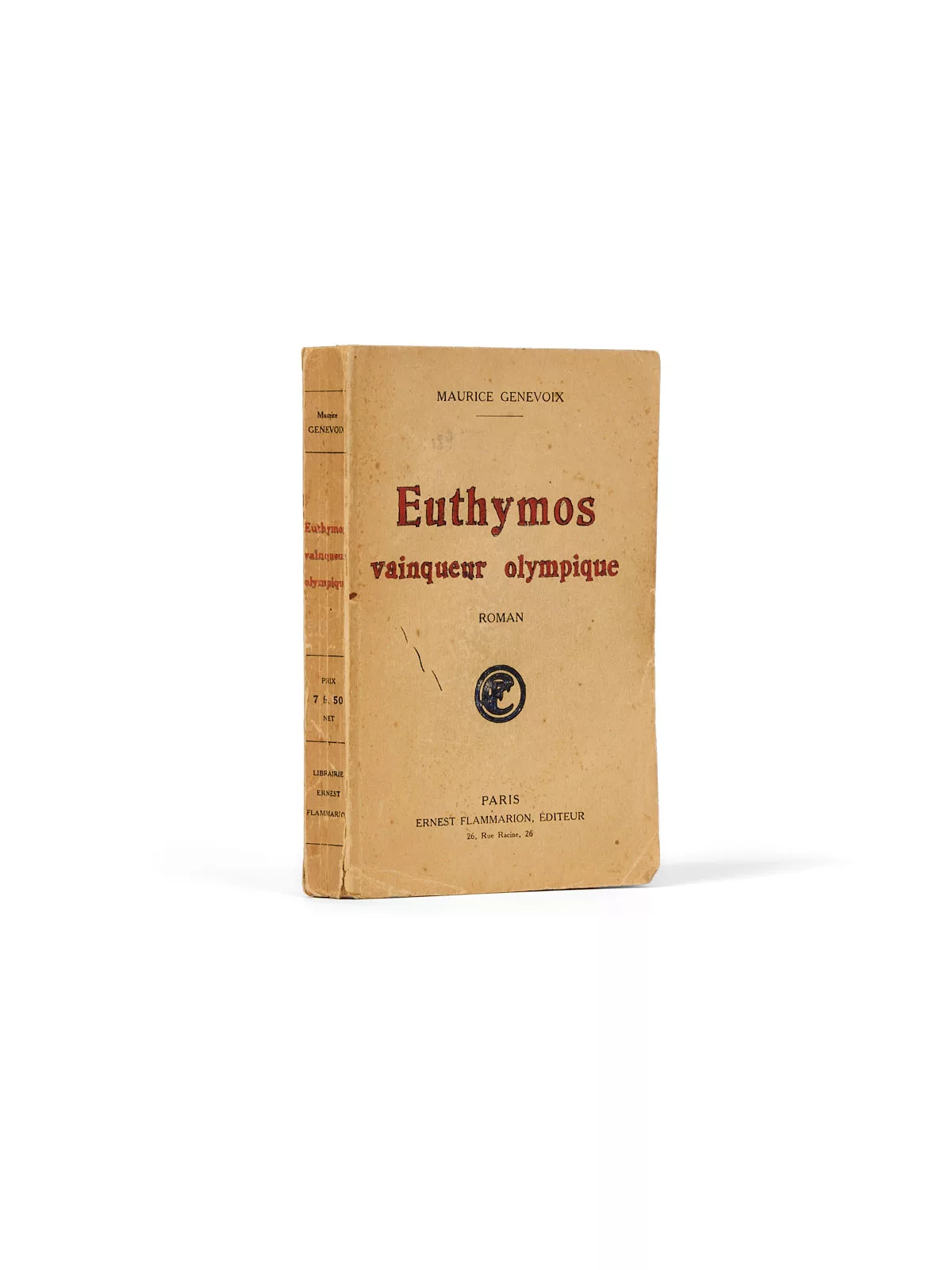
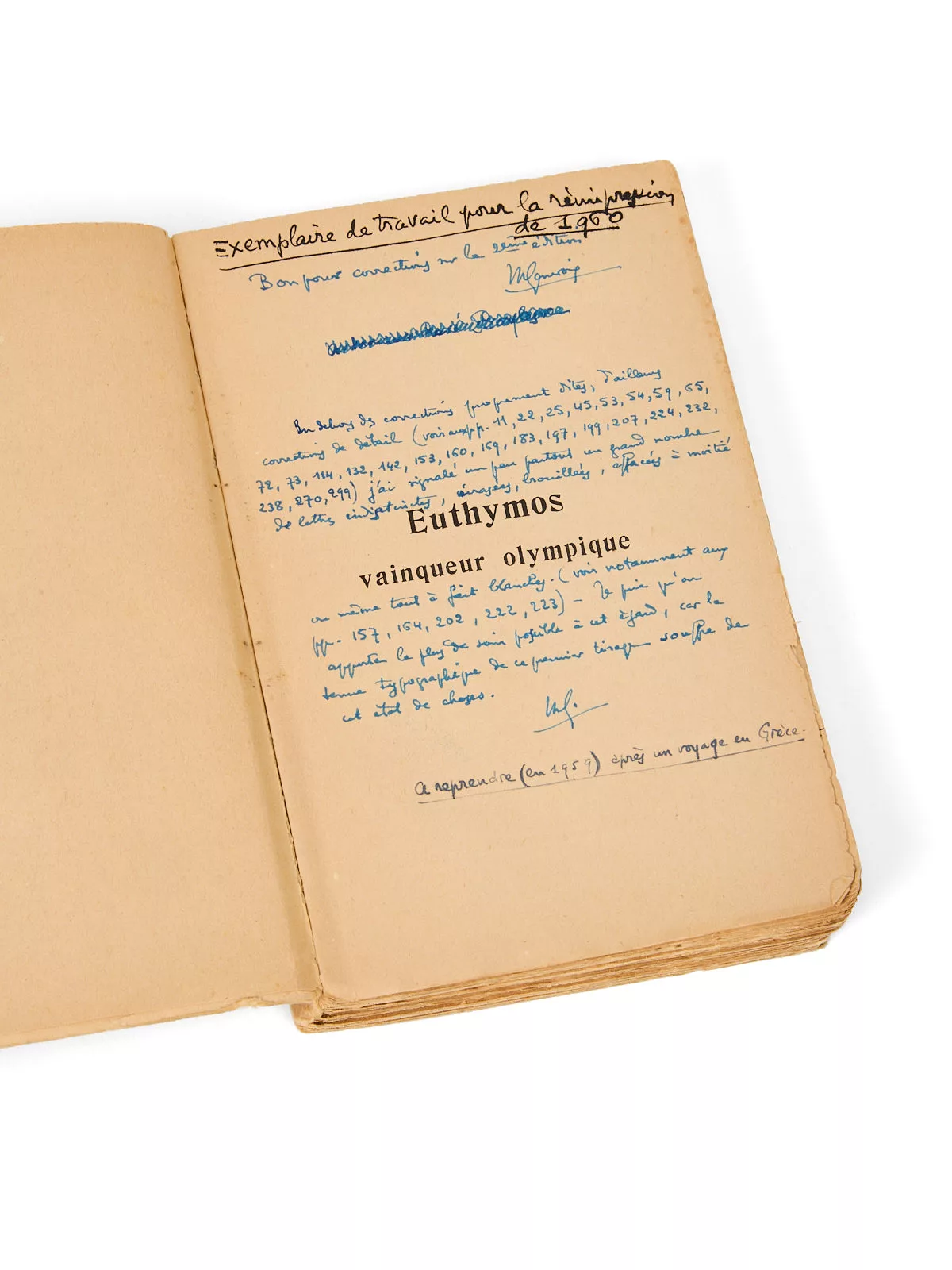
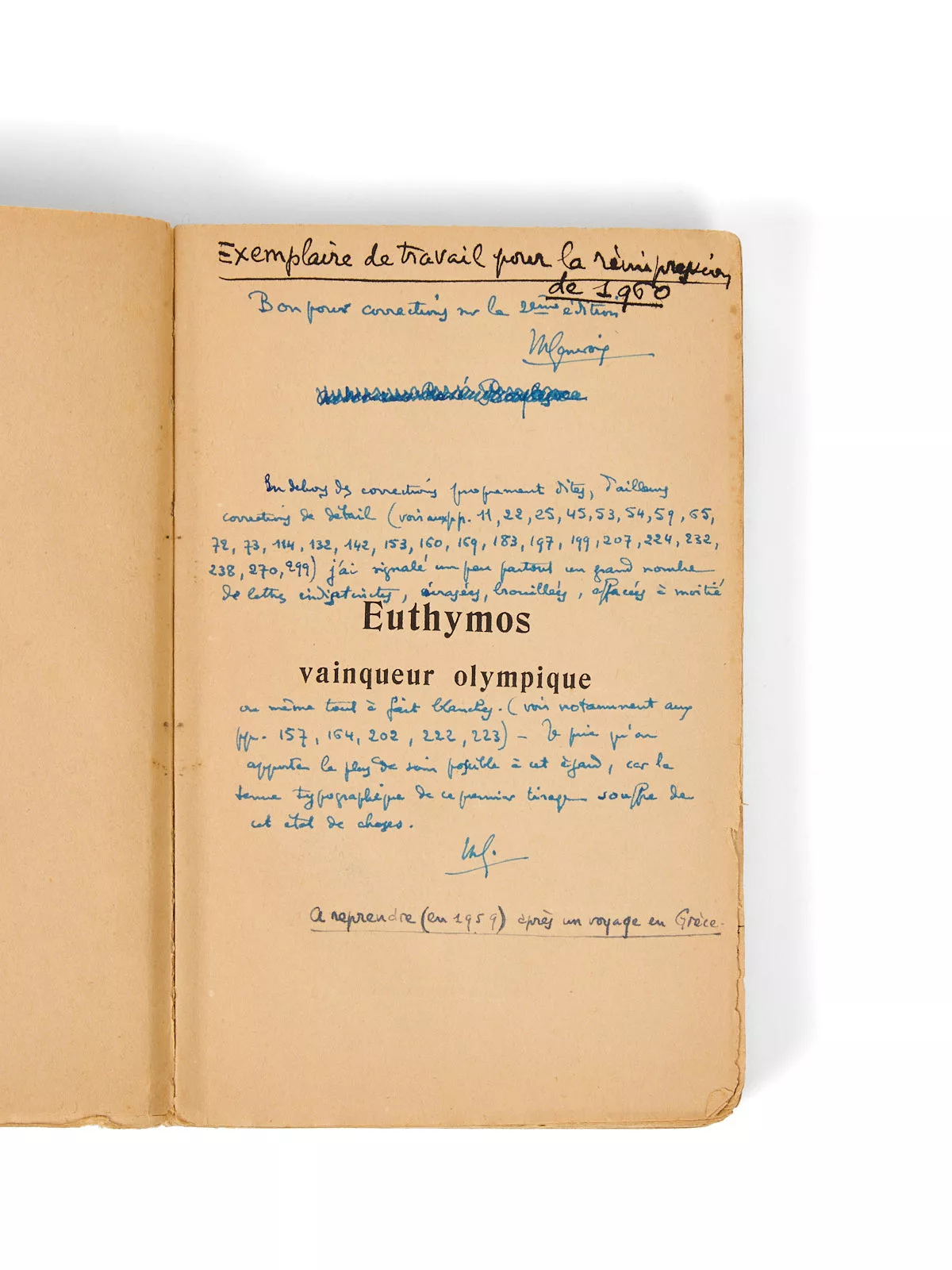
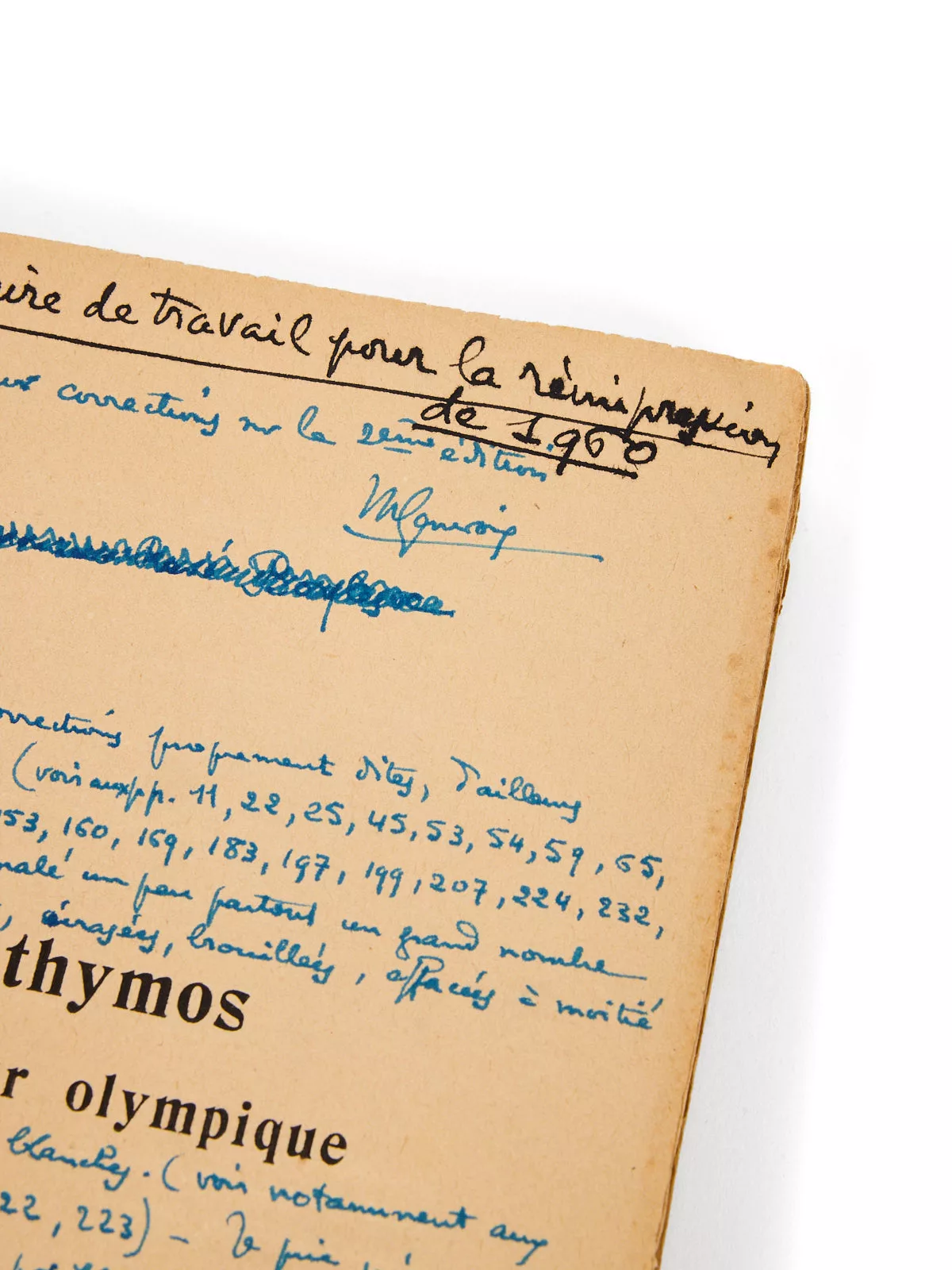
The author's working copy, heavily corrected in preparation for the 1960 reissue under the title Vaincre à Olympie. In the margins, Maurice Genevoix added a series of detailed autograph notes, on both form and content, intended to refine his text and identify flaws in the original printing.
As was his habit, Genevoix amused himself by tracing the outline of each letter of the title and of the publisher's mark on the wrapper.
Long autograph note at the head of the volume:
“Working copy for the 1960 reprint. Suitable for corrections on the second edition. Maurice Genevoix.
Apart from the corrections proper, which are in any case minor points of detail (see pp. 11, 22, 25 … 270, 299), I have noted throughout a large number of letters that are scratched, crushed, blurred, half erased or even entirely blank (see in particular pp. 157, 164, 202, 222, 223). I ask that the greatest possible care be taken in this respect, as the typographical quality of this first printing suffers from this state of affairs. M.G.”
On the title page, finally, the 1924 title is underlined with this note: “title: Vaincre à Olympie.”
During his schooling in Orléans, Genevoix attended the Lycée Pothier, where he practiced gymnastics at a competitive level and, as he recalls in Trente mille jours, belonged to the “glorious USLO [Union sportive du Lycée d’Orléans], scholastic champion of the Centre-Ouest,” devoted to a single sport, rugby, in which he played fly-half. He was nicknamed “Fouinotte” for “his eye and his skill in snatching the oval ball from between the hookers’ feet.”
He kept up his physical training during his two years of preparatory classes at the Lycée Lakanal in Sceaux. Both legs and mind: at the oral examination for entry to the École Normale Supérieure on the rue d’Ulm, Genevoix chose as his “special subject” “The Olympic Games.” He passed the examination brilliantly, finishing first — “cacique” — among the entrants. He immediately chose to complete one of his two years of military service, as was then permitted for students admitted to the Grandes Écoles: posted to Bordeaux, to the 144th Infantry Regiment, he continued to enjoy sport there, later pursuing it further at the Bataillon de Joinville — then called the École normale militaire de gymnastique, founded in 1852 — which already gathered together the finest athletes doing their military service.
In July 1914, Jean Guitton wrote, “Genevoix is master of his body, able like a fine athlete of Olympia to command every muscle — already, too, a master of language, of those words that are the inner muscles; he was a young Greek, as Plato imagined them.” This physical condition may have saved his life when the time came to join the front at Verdun. He returned from the war maimed: sport, and indeed all physical activity, thereafter became nothing more than a memory.
After his war-testimony novels, did Genevoix not seek, in writing Euthymos, to reclaim through the written word the physical virtuosity of his youth, of which the war had permanently deprived him? The writing was finished in April, and publication was ready for June 1924: the book appeared just days before the opening of the Paris Olympic Games, which began on 5 July 1924. It was immediately after finishing the writing and publication of Euthymos that Genevoix began, from November 1924, writing Raboliot.