

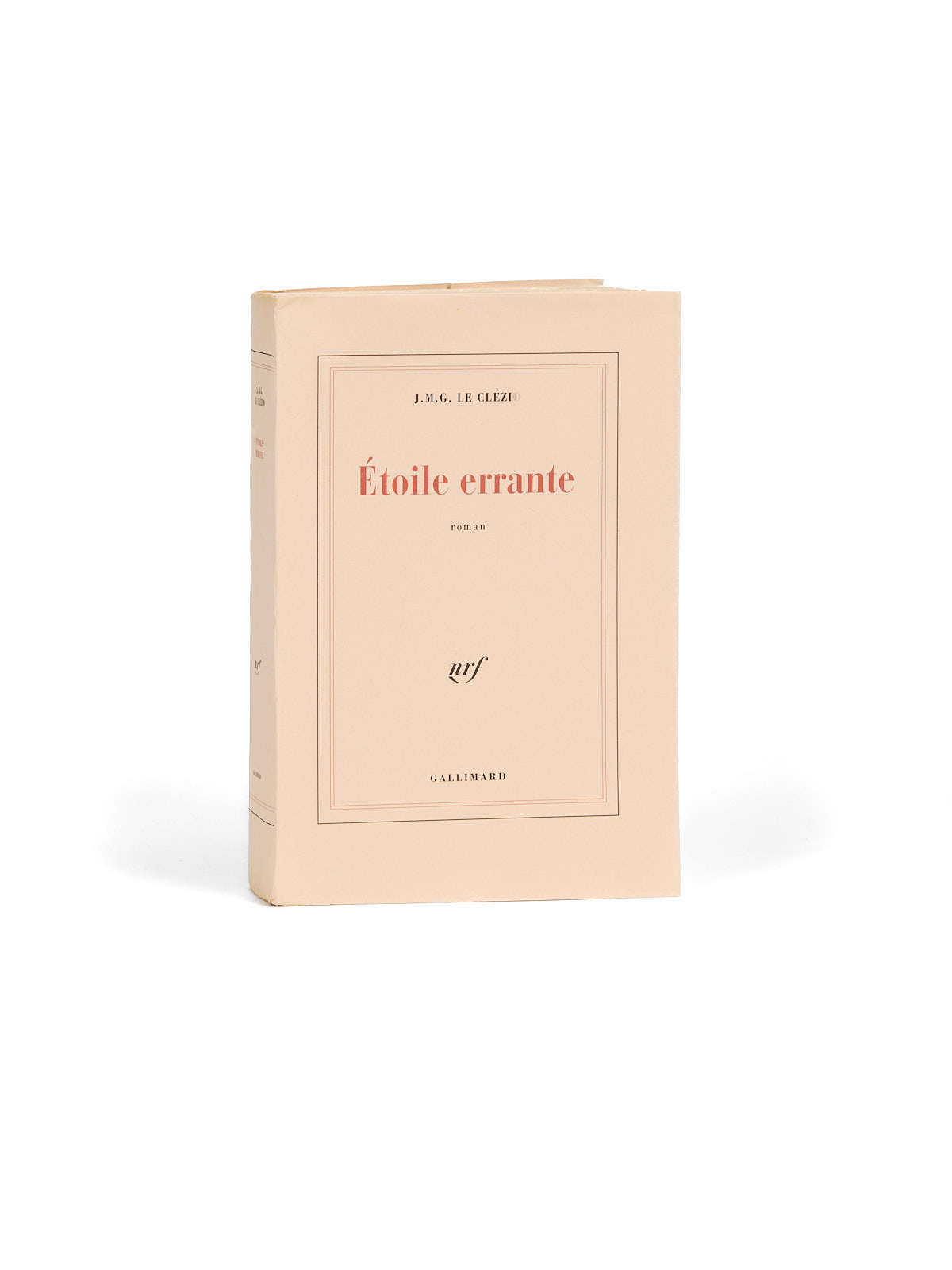
Étoile errante
One of the first 45 copies on white Holland Van Gelder laid paper (no. 26).
This novel is devoted to the Israeli-Palestinian conflict, testimony being at the heart of its project. The central section, entitled “Nejma,” recounts the postwar Palestinian exodus of 1948, at the moment of the end of the British presence in Palestine and Ben Gurion’s proclamation of the State of Israel.
The first part of the text was published in 1988 in the Revue d’études palestiniennes under the title “Camp de Nour Shams, été 1948.” This publication sparked a controversy with Bernard-Henri Lévy, who saw in it an “avowed, unrestrained anti-Zionism,” while Tahar Ben Jelloun, by contrast, expressed his appreciation for the “sobriety” and “accuracy” of the testimony. For this reason, publication of the novel was delayed until 1992 (though it had been completed as early as 1987), in order to avoid any direct association with current events, and in particular with the “intifada of the stones” (L’Événement du jeudi, 22–28 December 1988, pp. 96–97, by Jérôme Garcin: “Le Clézio, victime d’une cabale”).
Le Clézio nonetheless insisted, in various interviews, on the historical research that preceded the writing of the novel; he would return to this point notably in two texts, “Les Cicatrices intérieures” (1992) and “Dans la forêt des paradoxes” (in his Nobel Lecture of 7 December 2008).