

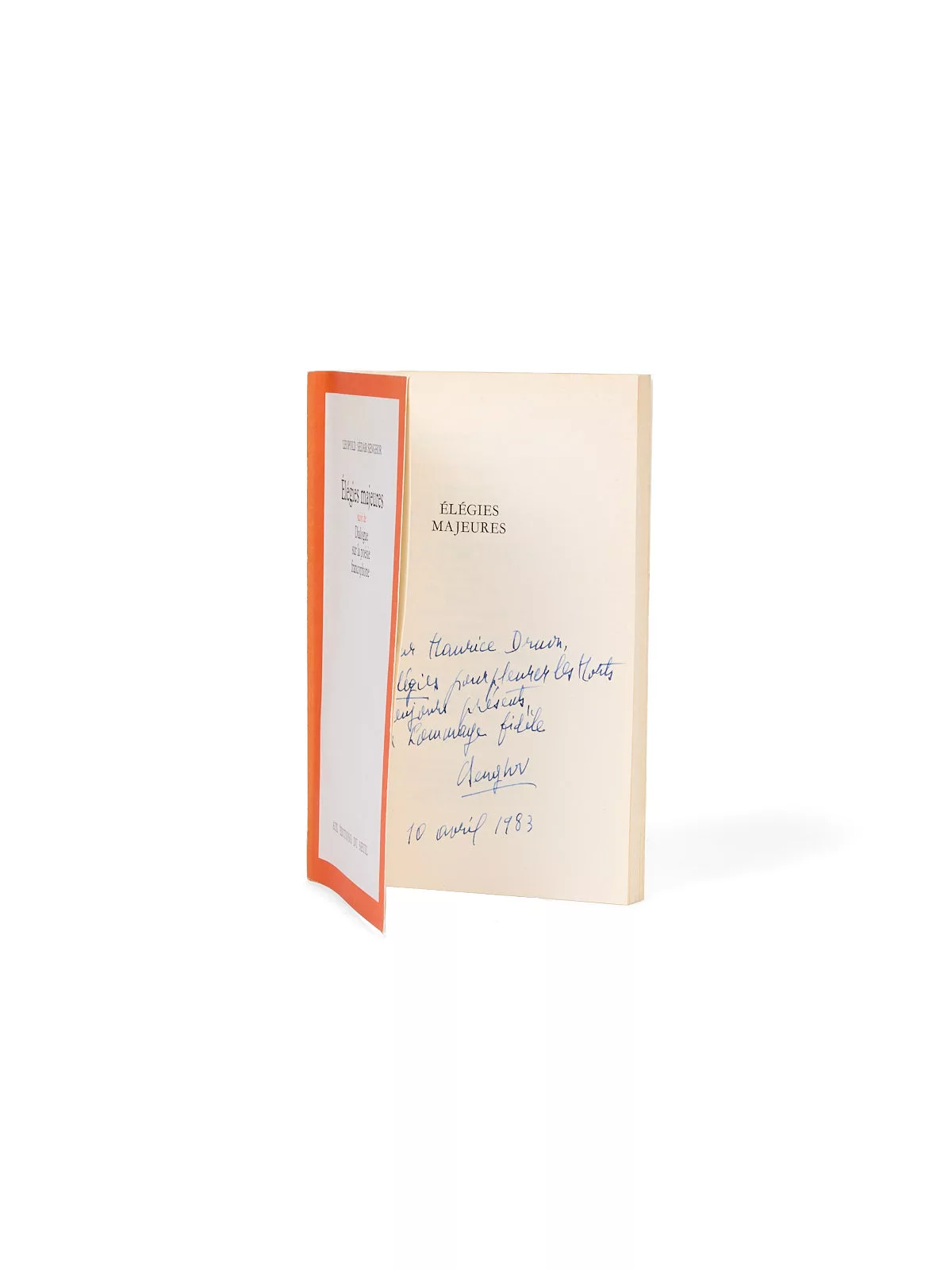
Élégies majeures
Signed presentation inscription: “À Monsieur Maurice Druon, ces Élégies pour pleurer les Morts toujours présents, en hommage fidèle, Senghor, 10 avril 1983.”
Éthiopiques, published in 1956, established Léopold Sédar Senghor as a major poet. Minister under de Gaulle in 1958 and elected in 1960 to head the newly independent Republic of Senegal, he became the leading figure of Francophone Africa, forming a genuine friendship with Georges Pompidou, a former classmate at Henri IV and, like him, an agrégé in literature. One of the “Élégies” is dedicated to Pompidou, alongside “Élégie des Alizés,” “Élégie pour Jean-Marie,” “Élégie pour Martin Luther King,” “Élégie de Carthage” and “Élégie pour la Reine de Saba.”
A fine copy with a fine provenance, inscribed a few weeks before Senghor’s election to the Académie française. Maurice Druon, a former Minister of Cultural Affairs under Georges Pompidou and a member of the Académie since 1966, had long campaigned among his colleagues for the election of an African writer to the Académie française. Senghor became the first, at the age of 77, elected seven weeks after this inscription, on 2 June 1983. Senghor’s neighbor at the Académie would be the ethnologist and politician Jacques Soustelle, a representative of French Algeria: “One cannot imagine two more different men, capable of communing fully at the level of true culture. By bringing them together, the Académie recovers a ‘humanist’ inspiration it had seemed to lose. It records, in a sense, the reconciliation of Africa and Europe and the healing of old wounds,” observed Le Nouveau journal in its edition of 4 June 1983.
Maurice Druon would become Secrétaire perpétuel of the Académie française two years later, in November 1985.