

Éducation européenne
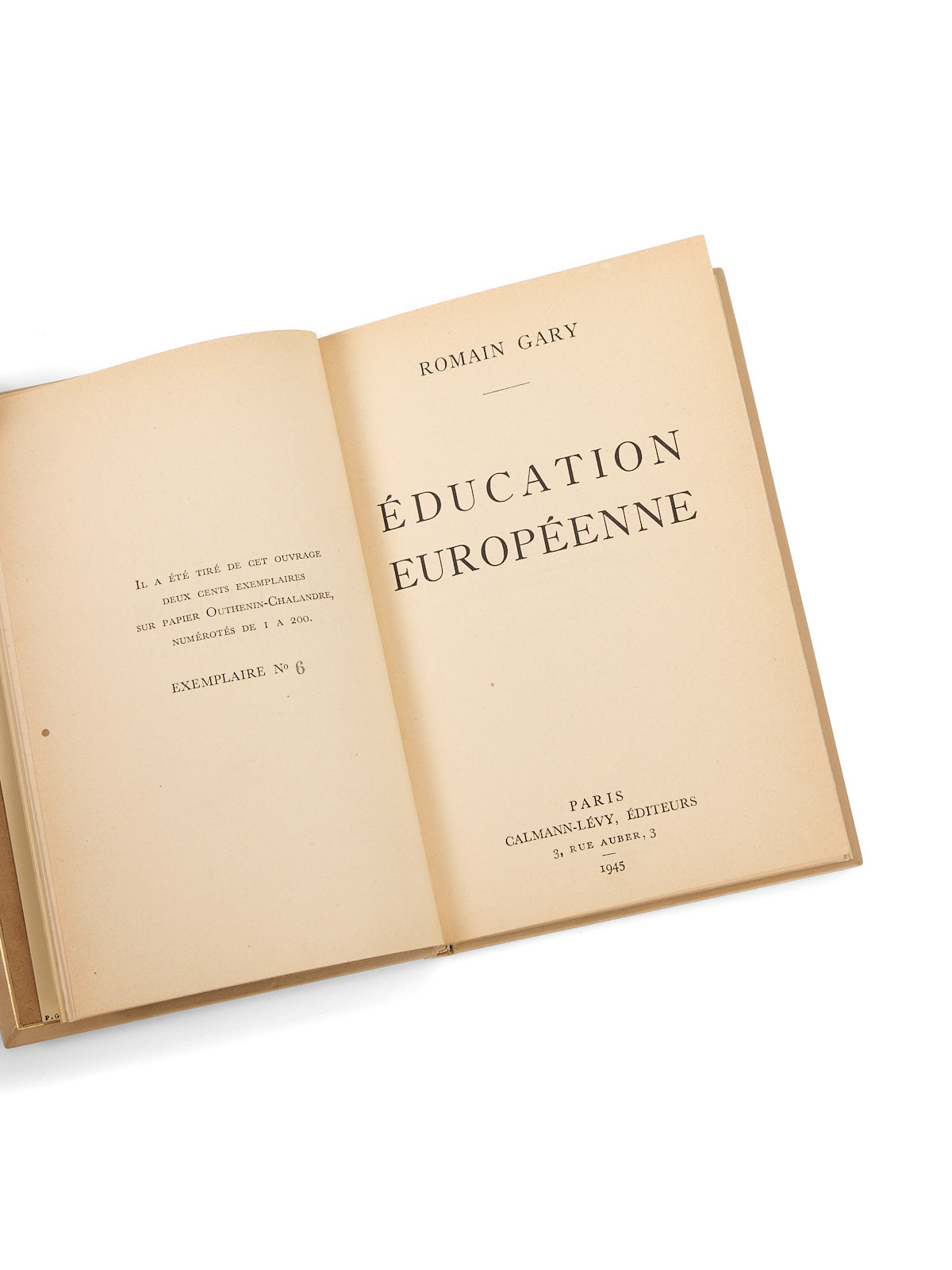
One of the first 200 copies on Outhenin-Chalandre paper (no. 6).
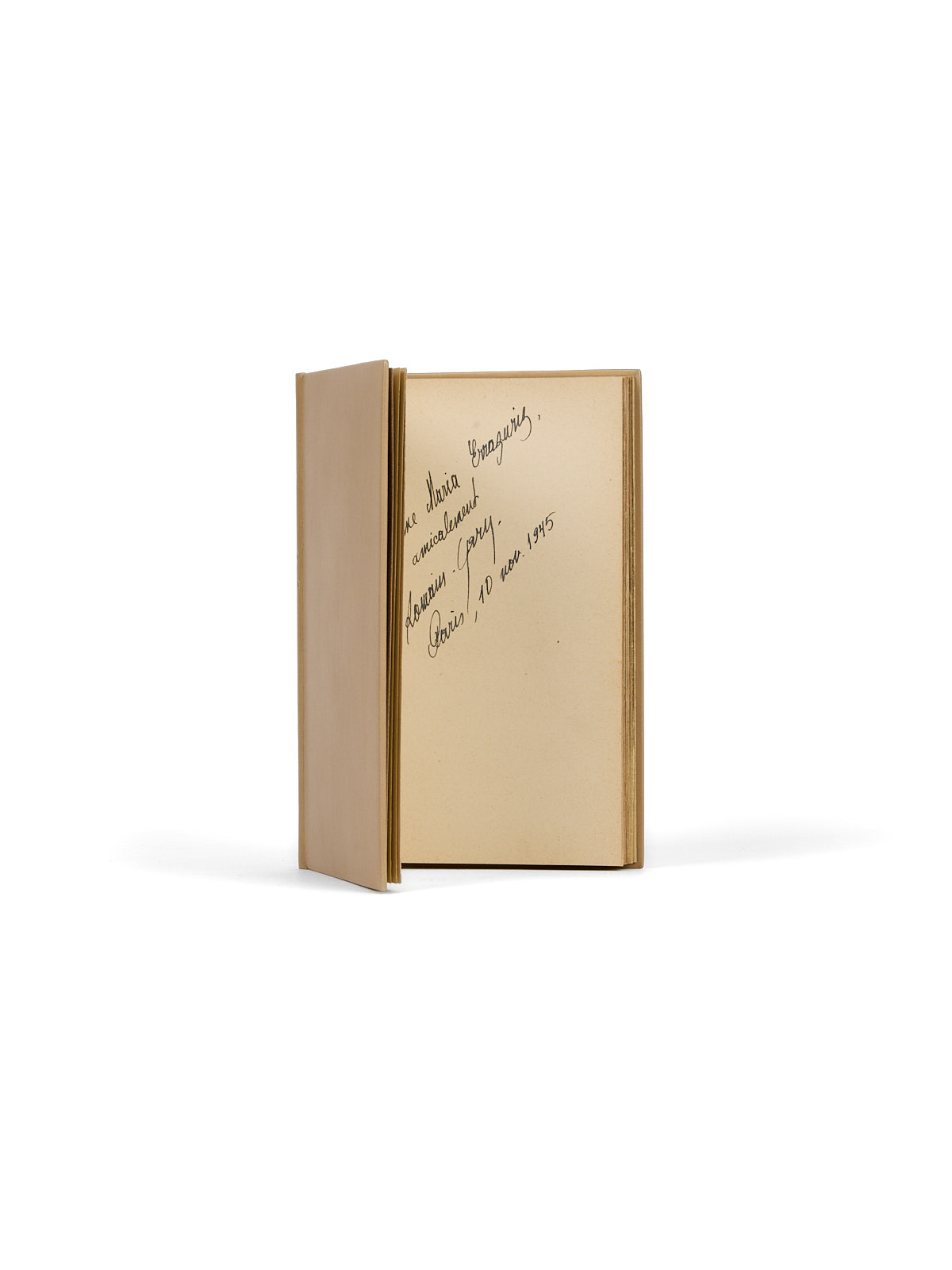
Signed presentation inscription: “À Madame Maria Errázuriz, très amicalement, Romain Gary. Paris, 10 nov. 1945.”
Written during the war while Romain Gary was serving, from July 1942, with the Lorraine Resistance group, this first novel was initially published in English at the end of 1944, under the title Forest of Anger. The French version was reworked between November 1944 and March 1945, and published in summer 1945. The novel is dedicated to a young comrade from the Lorraine group, Robert Colnacap, and won the Prix des Critiques on 7 November 1945, praised by Maurice Nadeau and Albert Camus. Gary himself was the first to be astonished by its success: “What is happening?” he wrote to his friend Raymond Aron: “I receive astonishing letters from Albert Camus, the most beautiful, most moving letter you can imagine from Martin du Gard […]. I receive an amazing note from Gaston Gallimard, who has always rejected my manuscripts and who now asks for my next book.”
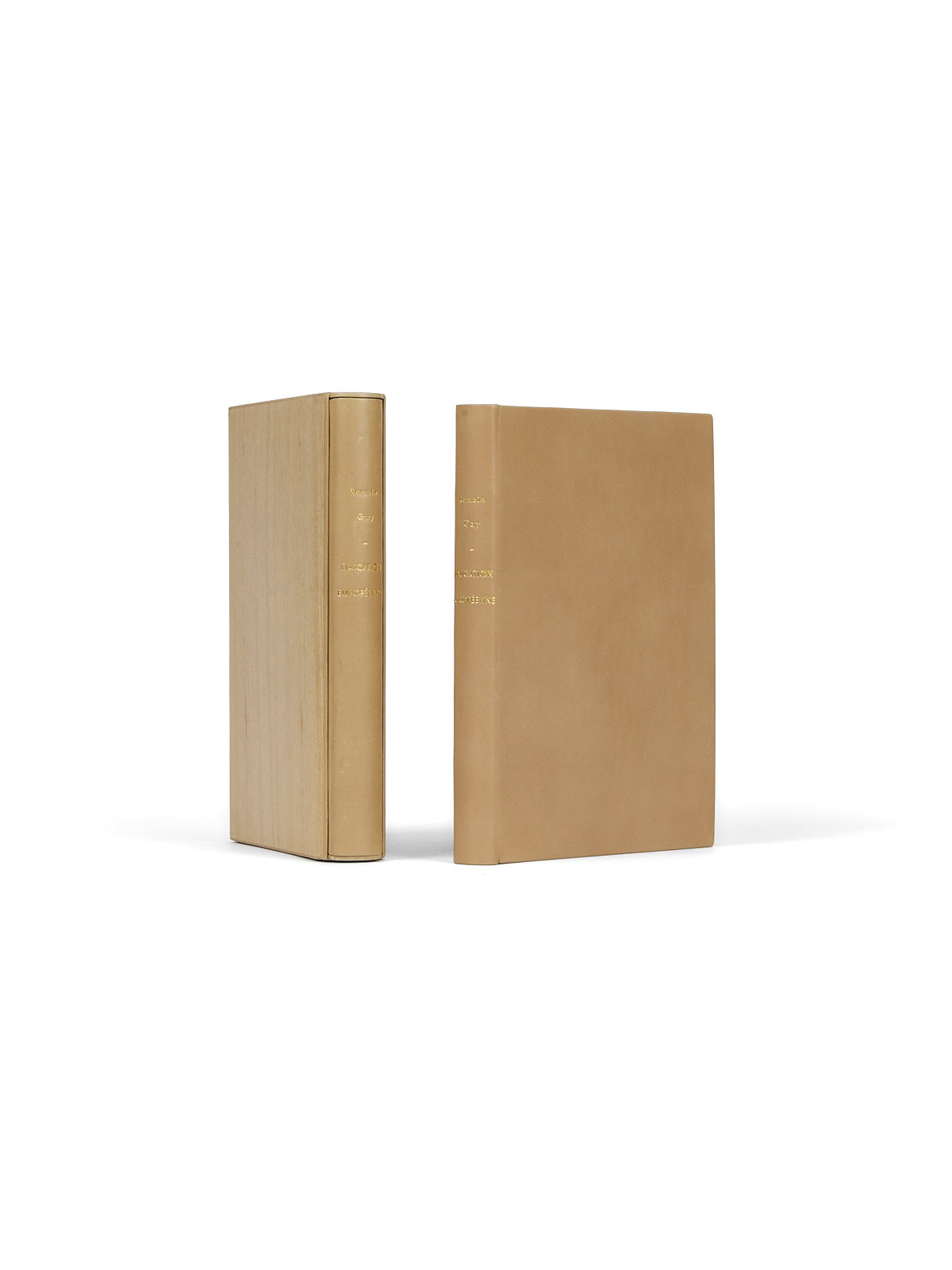
A magnificent copy, with a remarkable provenance from a major figure of the Resistance, María Errázuriz, “Righteous Among the Nations,” who saved about a hundred children from deportation in Paris between 1941 and 1944.
Born in Santiago on 11 December 1893, into the wealthiest family in Chile, María Edwards McClure married the Chilean diplomat Guillermo Errázuriz at the age of eighteen; he died in 1922, aged twenty-three. Settled in Paris and remarried to Jacques Feydeau, son of the playwright, she spent the Second World War actively involved in one of the most secret, most dangerous, and yet most effective Resistance networks, run from London by the Intelligence Service: the Jade-Amicol network.
In the early hours of the conflict, she first volunteered at the American Hospital in Neuilly, joining the team caring for the first wounded members of the Royal Air Force. After the armistice and the occupation of Paris, she approached Germaine de Rothschild and offered her help at the hospital founded by her husband’s family in the previous century, in the 12th arrondissement. There she quickly formed a bond with Claire Heymann, already working as a social worker. Under the Occupation, the hospital’s pavilions were fenced with barbed wire and turned into a detention center: Jewish detainees who had fallen ill at the Vel’ d’Hiv’ and Drancy camp, including many children, were transferred there for treatment. The two women felt compelled to save as many as possible. The method used by “Aunt Maria” and “Aunt Claire” was to prolong the children’s hospitalization, then remove them from the registers and quietly place them in Christian institutions or with foster families, having smuggled them out through the unguarded morgue door. María Errázuriz took charge of falsifying the registers: “there were two policemen watching the entrances and exits. Patients from Drancy were treated there. They didn’t recover quickly! We kept them as long as possible,” recalled Colette Brull-Ulmann, an intern privy to the operation (Des médecins dans la Résistance, Cécile Tartakovsky, France Télévisions, 2020).
From 1942, the now well-established network made contact with the one created and led by Claude Arnould and Philippe Keun, a captain in the Special Operations Executive (SOE) linked to MI6: the Jade-Amicol network. Their command post was set up at the Sainte-Agonie convent in Paris, on Rue de la Santé. It was at María Errázuriz’s home that meetings were held and that funds, needed to pay agents and cover expenses, were brought from London by small single-engine planes called Lysanders, which landed by night on remote fields north of Paris. The connection was clear: Philippe Keun, born in 1911, was none other than the nephew of Jacques Feydeau, whom María Errázuriz had married in 1926 and divorced in 1931. She felt genuine affection for her nephew by marriage, and from the earliest days of the war, each was fully aware of the other’s commitments. María Errázuriz was thus one of the very few people in Paris who knew nearly the whole of the network and its inner workings.
As discreet as she was effective throughout nearly three years of Resistance work, she was arrested following a denunciation in December 1943 and subjected to the torture of the ice-water bath. She said nothing, and her torturers extracted no secrets from her. She was released for lack of evidence, through the direct intervention of the Spanish ambassador, and placed under surveillance. Her nephew was less fortunate: he was arrested by the Gestapo at dawn on 29 June, near Orléans, where his team was preparing to receive a weapons parachute drop, three weeks after D-Day. Arrested and deported to Buchenwald, he was tortured to death and died in the camp, like all his companions arrested on 29 June.
After the war, María Errázuriz received the Medal of Courage awarded by King George VI of England, the Légion d’honneur, and the Croix de guerre with palm, before returning to Chile for a few years; her family there begged her to come back to them. She considered it, having been deeply moved by the sympathy expressed after the commentary provoked in Chile by a Reuters dispatch, which on 11 December 1944 described her heroic actions in a long article published in the daily El Mercurio. Her journey was announced for November 1945; the exact date she left Paris is unknown — but certainly after 10 November, the date of this inscription by Romain Gary, who had only been in France since the summer. How did the two of them know each other?
In Europe, María Errázuriz’s story only came to light from 8 June 1945, when Marcelle Auclair wished to pay tribute to “this South American friend; too fine a story for me to tell you here.” She devoted an article to her on the front page of the weekly newspaper France, describing the actions of “this magnificent friend of France” without naming her beyond her initials. This newspaper, published since the earliest days of Free France in 1940, appeared in London, with an editorial office at 2 Dorset Buildings, Salisbury Square, and is probably the link between Romain Gary and María Errázuriz: it is likely that Captain Gary, then stationed in London that June, read the press. A few weeks later, on 14 July 1945, General de Gaulle decorated him with the Légion d’honneur under the Arc de Triomphe, just as Éducation européenne, freshly printed, was about to be distributed that same summer. That autumn it would win the Grand Prix des Critiques, propelling Gary onto the literary stage.
Romain Gary presented very few inscribed copies of his first book, and mostly to close acquaintances within the publishing world. Copies are known inscribed to Maurice Nadeau, Francis Dumont (an associate at Calmann-Lévy), Roland Feuvrier, Pierre Calmann and Raymond Aron, and only the first three are on the deluxe paper.
A precious copy, presented to a major figure of the Franco-British Resistance. In 2005 she was honored by Yad Vashem with the title of “Righteous Among the Nations”: only two Chilean nationals have received this distinction.
Maria Errázuriz, by André Kervella (Paris, L’Harmattan, 2025), to whom we owe several valuable pieces of information, has just been published. It allows for an even fuller understanding of the remarkable path of this extraordinary woman.