

Éducation européenne
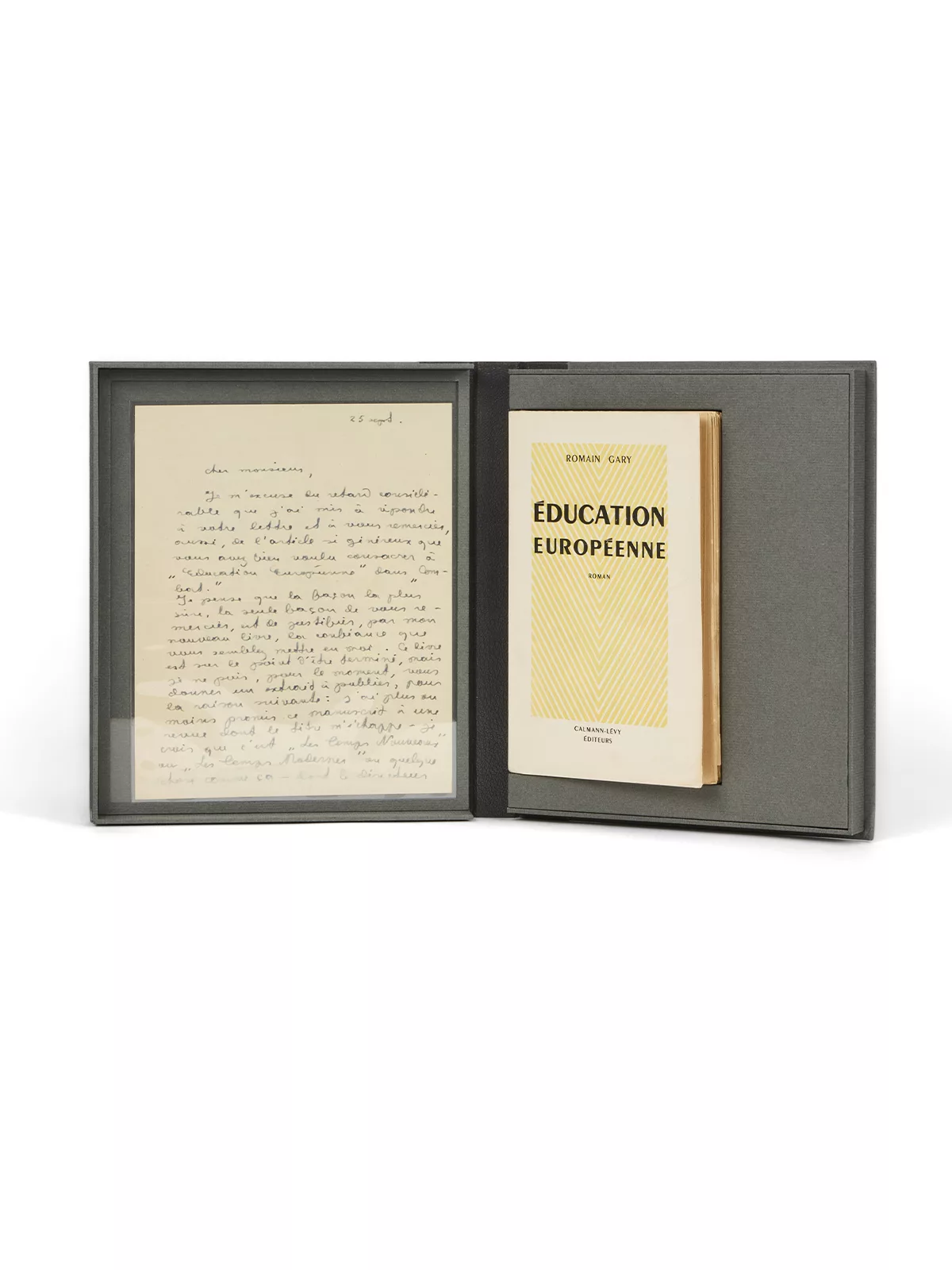
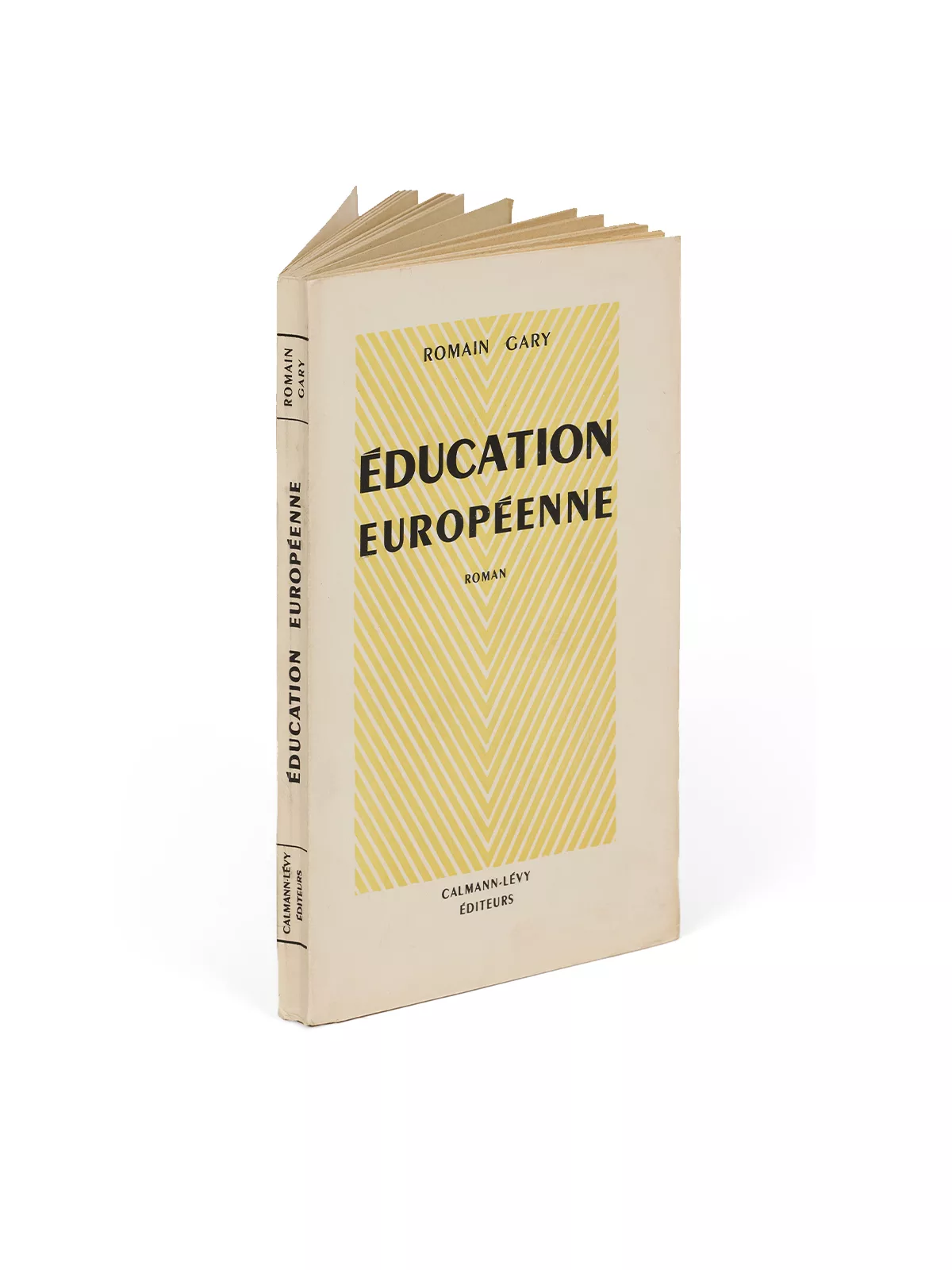
One of the first 200 copies on Outhenin-Chalandre paper (no. 86).
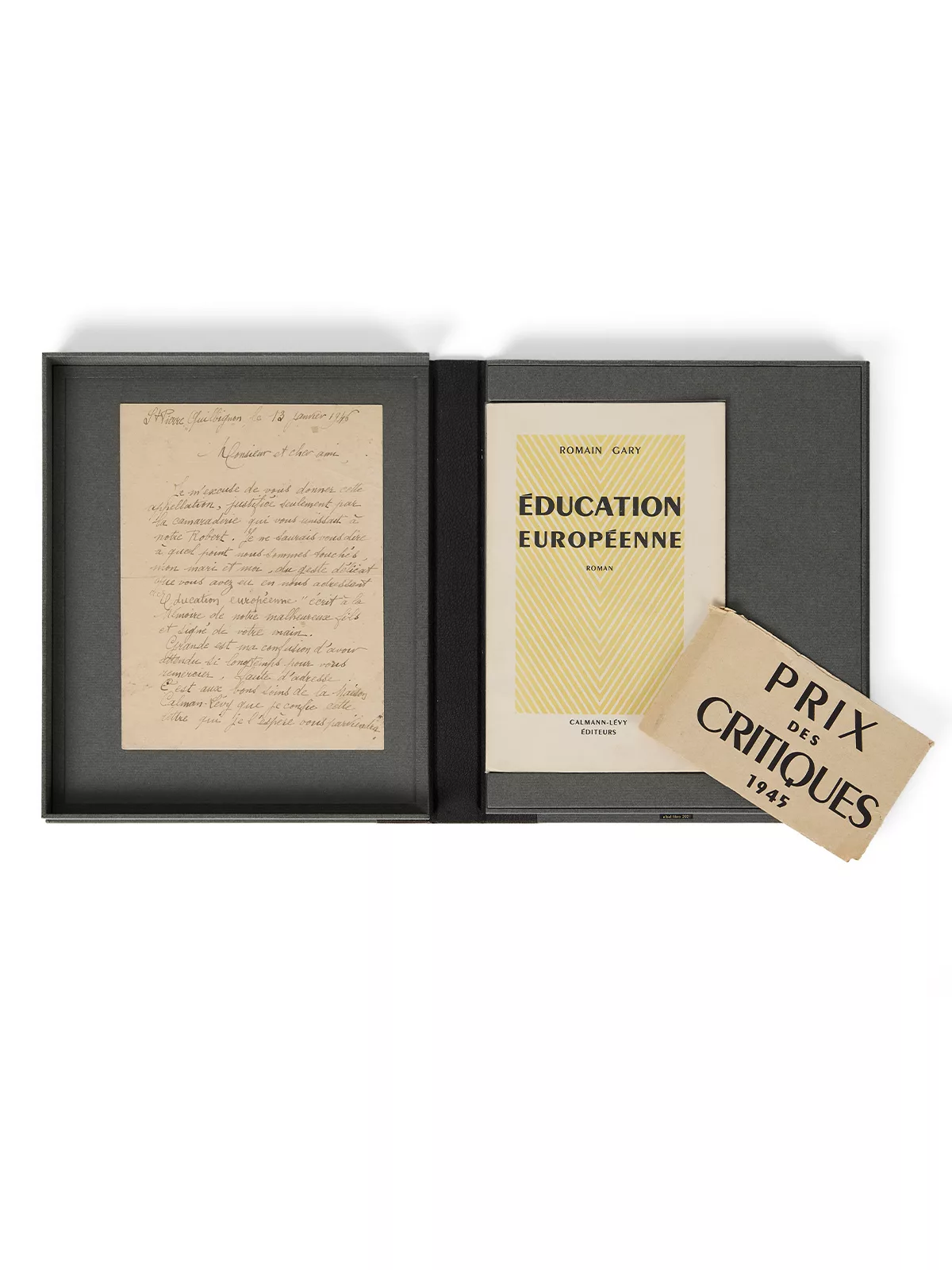
Copy enriched with an autograph letter signed by Mme Colnacap to Gary.
Wraparound band for the Prix des Critiques (awarded September 1945) preserved.
Romain Gary’s first book in French, published six months after its original English edition in London.
Written while Gary was fighting with the Lorraine bomber group, this first novel was originally published in English at the end of 1944 and made its author famous overnight. Gary was still serving as a captain on the London general staff when the novel, now titled Éducation européenne, appeared in France; the title was chosen by Pierre Calmann: “The title I prefer for your book is Éducation européenne. I find the others clearly inferior.”
The French version was reworked between November 1944 and March 1945, with the text considerably revised: “de-Polonization and Europeanization would be the twin foundations of Romain Gary’s glory […] all references to the liberation of Poland are removed from the French version and replaced by entirely new invocations of Europe. Since French has a more universalist calling than Polish, it is now in French that the ‘European’ partisan Adam Dobranski, who loses his accent, writes his poem” (David Bellos, Le Malentendu, L’histoire cachée d’Éducation européenne, in Cahiers de l’Herne).
The book, published in early summer 1945, was dedicated to a young comrade from the Lorraine group, Robert Colnacap.
The copy is accompanied by a very fine autograph letter from the young man’s parents, addressed to Romain Gary: “Monsieur et cher ami, Je m’excuse de vous donner cette appellation, justifiée seulement par la camaraderie qui vous unissait à notre Robert. Je ne saurais vous dire à quel point nous sommes touchés, mon mari et moi, du geste délicat que vous avez eu en nous adressant L’Éducation européenne écrit à la Mémoire de notre malheureux fils et signé de votre main. […] J’aimerais tant savoir où, quand, et dans quelles circonstances vous avez connu notre enfant. Les biographies que j’ai pu lire vous concernant sont muettes – bien entendu – sur votre activité militaire. Je sais seulement que vous êtes un des rares rescapés parmi les aviateurs des Forces Françaises Libres en Angleterre, et que vous avez fait à l’avance, comme tant d’autres, le sacrifice de votre vie pour que l’Humanité devienne enfin libre. […] Si notre petit a eu connaissance de votre roman, il n’a pas dû vous ménager son admiration. Et, s’il vivait encore, comme il savourerait la joie de vous voir décerner aujourd’hui le Prix des Critiques ! […]”
The son of a schoolteacher mother and a father serving in the Navy, Robert Colcanap was born on 11 May 1922, near Morlaix. The Colcanap family settled in Brest in 1926. Still a schoolboy at the time of the armistice, and therefore too young to have fought, he decided to join the Free French Forces. On the very day of the 18 June appeal, he boarded the Meknès at Brest, bound for England. On arrival, he asked to serve in aviation. Charles de Gaulle refused outright: “young man, get your diplomas first.” He obtained his certificate of admission to the French lycée in London on 25 September 1940, passed his examination, and on 28 October signed up as a volunteer with the Free French Air Forces, service number 30,503. He was posted to the battleship Courbet, then transferred to the camp at Old Dean, Camberley.
Despite his young age, he distinguished himself with an outstanding early service record. Commissioned as sub-lieutenant on 15 December 1942, he joined the Lorraine bomber group, where he remained its perpetual youngest member. He was killed on 11 November 1943 during a training exercise over England, following an engine failure aboard his Boston III BZ aircraft. Seven months earlier, on 4 April 1943 in London, Robert Colcanap had written his will, of which the following is an extract:
“Je voudrais que soient conservés mes livres de médecine-Physique-Chimie (achetés avec mes économies), les poésies de Baudelaire, de Péguy et surtout la vie de Mozart ainsi que mes concertos et sonates pour violon, lesquels ont été pendant de longs mois mes meilleurs compagnons et ont constitué la meilleure des consolations. Je regrette de ne pouvoir vous laisser les deux objets auxquels je tenais le plus ; un Kodak 35 acheté au Caire en avril 42 et une ciné-caméra 8 mm (fruits de mes économies) tous deux perdus au cours du torpillage à cent kilomètres au large de Durban, le 1er novembre 1942. J’ai également perdu ce jour mon carnet de route, commencé le 18 juin 1940, sans compter des photos et films pris au Kenya. Grâce à ces documents il eut été facile de retrouver ma vie depuis cette date fatale du 18 juin 1940. Il y avait là, matière à plusieurs romans. Je suis heureux d’avoir fait ce que je considère comme mon devoir ; si c’était à refaire je recommencerais. J’estime en toute conscience que je n’ai rien à me reprocher.”
Several passages of La Promesse de l’aube and of Éducation européenne directly reference events Gary experienced during this service. Fittingly, the reference work devoted to the Lorraine group opens with a sentence and portrait of Robert Colnacap: “Nous jurons de rendre à la patrie sa liberté ! Le 19 juin 1940, un gamin rieur de seize ans et demi débarque en Angleterre. Il s’appelle Robert Colnacap” (opening of Les Bombardiers de la France libre. Groupe Lorraine, by François Broche, Paris, Presses de la Cité, 1979).
The Lorraine bomber group received the Croix de la Libération on 28 May 1945. During the conflict, it flew more than 3,000 sorties, dropped 2,500 tons of bombs, and lost 127 men. On 18 June 1945, it took part in the aerial parade over the Champs-Élysées, forming a Cross of Lorraine with its aircraft. The group was dissolved in 1952, giving rise a year later to the 30th fighter wing, today part of the prestigious Base Aérienne 118 at Mont-de-Marsan of the French Air Force.
A moving copy.