

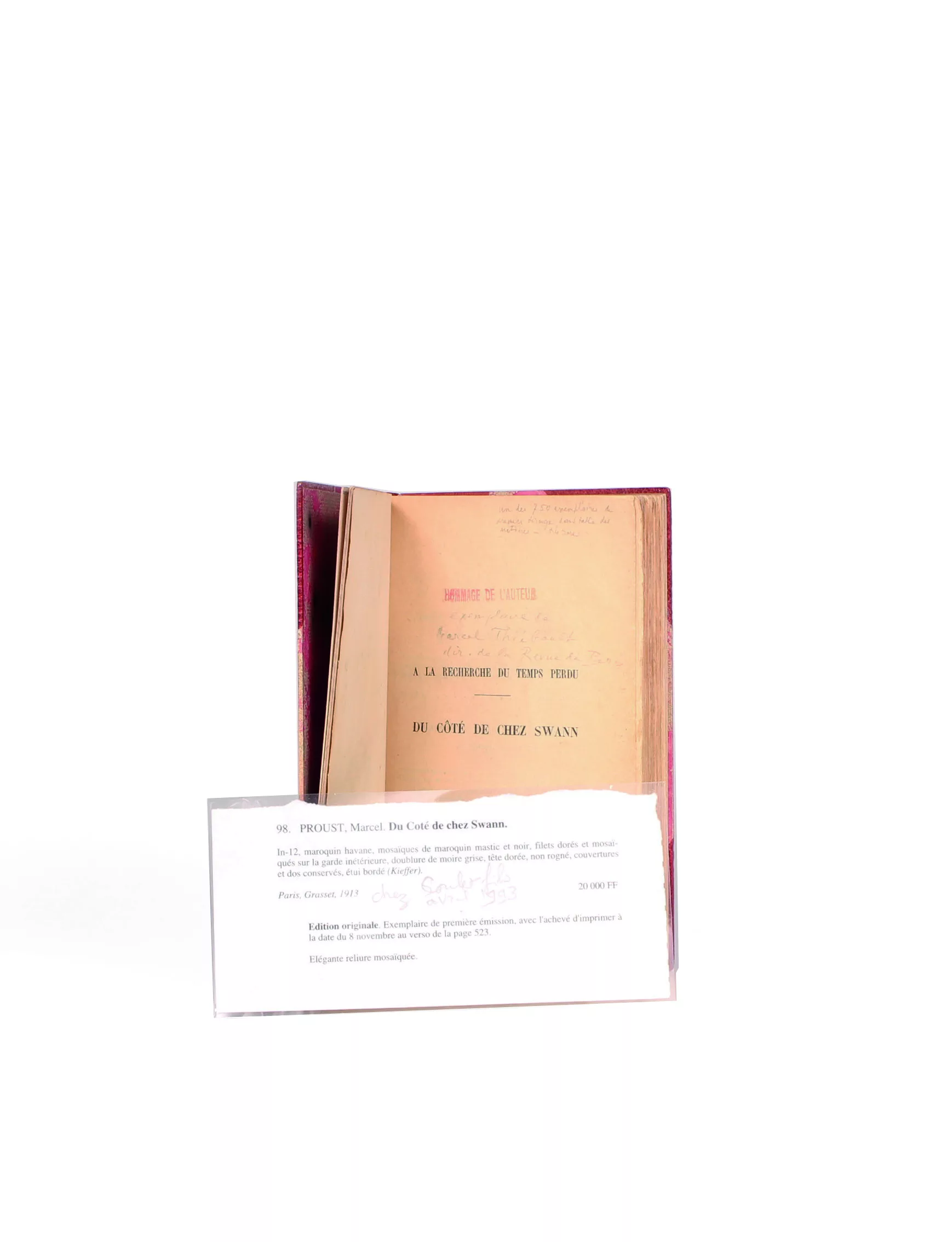
Du côté de chez Swann
Review copy, with stamp “hommage de l'auteur.”
First-issue copy, with the printing statement dated 8 November 1913 on the verso of page 523.
Du côté de chez Swann was printed in 1,750 copies in 1913, followed shortly afterward by two further printings of 500 copies each, with textual and typesetting variants. All bear a printing statement dated 8 November 1913. The deluxe-paper copies (5 on Japan paper and 12 on Holland paper) were printed later, with the errors corrected.
An intermediate state exists between the first and second printings: the table of contents was printed on the verso of p. 523 in some copies, in place of the printing statement (as in the Édouard Loewy copy or that of Docteur Cottet), but this presentation was judged too abrupt, and an additional gathering of two leaves, containing the Table and the printing statement, was added while printing was still under way. These 524 pages are now considered the distinguishing feature of a second printing.
From 1909, Marcel Proust began discussions with publishers about the vast novel-cycle he was planning, and found in Bernard Grasset a receptive partner who agreed to publish, at the author’s expense, the first part of the work: Du côté de chez Swann, in which the novelist reveals his mastery of the sentence, placed at the service of the depiction of feeling and the “intermittences du cœur.” The small world of Combray is revealed here for the first time, opening one of the most remarkable literary cycles ever written, one that asks only for time to be slowed, so that clothes, faces, colors, scents, bodies and time itself might be evoked with total precision, reconstructing the fabric of a world that Proust knew was slipping, day by day, further into imperfection. And yet no one has gone further in portraiture, in flesh, and in memory.
The present copy does not have the spaced-letter misprint in the title page corrected, where the word “GRASSE|T” is broken (the mystery surrounding this typographical accident remains unresolved, despite claims that have persisted for nearly a century).
Provenance: Marcel Thiébault, director of La Revue de Paris, by a manuscript note on the half-title; Bibliothèque François Mitterrand (sale, Piasa, 2001, lot 538).